Nano-Particle Reinforced Polymer Composites
Introduction to Polymer Composites
What is a Composite?
A composite material is made by combining two or more different materials. The goal is to create a new material with properties that are better than any of the individual components on their own. Think of reinforced concrete. You have cement, which is strong under compression but weak when stretched. Then you have steel bars (rebar), which are strong when stretched. By embedding the steel in the cement, you get a material that's strong in both ways.
Polymer composites follow the same logic. They consist of two key ingredients: a matrix and a reinforcement.
- Matrix: The main material that holds everything together. In a polymer composite, this is a polymer, like epoxy or polyester.
- Reinforcement: The material added to the matrix to provide strength and stiffness. This can be fibers, particles, or other forms.
The matrix binds the reinforcement fibers or particles, transfers loads between them, and protects them from environmental damage. The reinforcement, in turn, provides the bulk of the strength and rigidity. This teamwork allows engineers to design materials that are both lightweight and incredibly strong, tailored for specific jobs from building airplanes to making high-performance sports equipment.
Types of Reinforcement
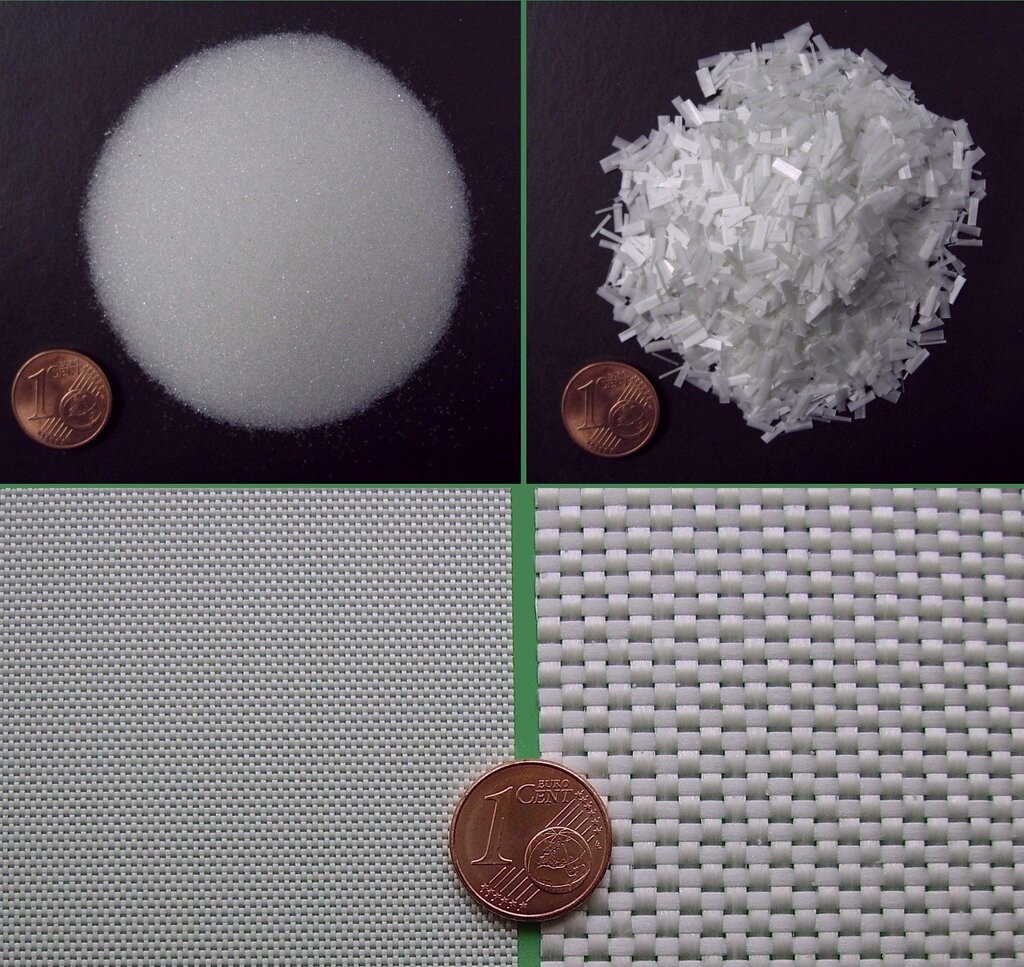
The type of reinforcement used has a huge impact on the final properties of the composite. We can group reinforcements into two main categories: particles and fibers.
Particulate composites use small particles as reinforcement. These particles are typically spherical or irregularly shaped and are mixed into the polymer matrix. While they don't provide the same level of strength as fibers, they can improve other properties like hardness, wear resistance, and stiffness, and they often reduce the overall cost of the material.
Fibrous composites use fibers to carry the load. These fibers can be long and continuous or short and chopped. The way the fibers are arranged is critical. If they are all aligned in one direction, the composite becomes incredibly strong along that direction. If they are arranged randomly, the composite has more uniform, but less dramatic, strength in all directions.
Properties and Applications
The main advantage of polymer composites is their high strength-to-weight ratio. Materials like carbon fiber reinforced polymer (CFRP) can be as strong as steel but weigh five times less. This makes them ideal for applications where weight is a critical factor, such as in aerospace, automotive racing, and high-end bicycles.
Because they are designed materials, composites can be engineered to have specific properties. By choosing the right matrix, reinforcement, and manufacturing process, we can control for strength, stiffness, toughness, corrosion resistance, and thermal conductivity.
This versatility has led to their use in a vast range of products, including:
- Aerospace: Fuselage and wing components
- Automotive: Body panels, chassis, and brake rotors
- Sporting Goods: Tennis rackets, golf clubs, skis, and bicycle frames
- Marine: Boat hulls and masts
- Infrastructure: Bridges and building reinforcements
- Wind Energy: Turbine blades
By understanding these fundamentals, we can begin to see how adding even smaller reinforcements, like nanoparticles, can further revolutionize the properties of these already advanced materials.