MySQL Data Types Explained
Introduction to MySQL Data Types
Data's Building Blocks
When you store information in a database, you need to tell it what kind of information you're storing. Is it a number? A name? A date? This classification is called a data type. Think of it like organizing a pantry. You put liquids in bottles, grains in jars, and spices in small shakers. Each container is designed for a specific type of food.
In MySQL, data types tell the database how to store and handle data. They act as a set of rules for each column in a table, ensuring that a column for a person's age only contains numbers, not their name. This keeps your data organized, predictable, and efficient.
Data types are the classifications of the different kinds of data that are used in programming.
Numbers and Words
The most common types of data you'll work with are numbers and text. MySQL offers several options for each, tailored for different needs.
Numeric types are for any data that involves numbers, like quantities, prices, or measurements.
For whole numbers, you have types like INT (a standard integer), TINYINT (for very small numbers, from -128 to 127), and BIGINT (for extremely large numbers). For numbers with decimal points, you can use DECIMAL for precise values like currency, or FLOAT and DOUBLE for scientific calculations where absolute precision is less critical.
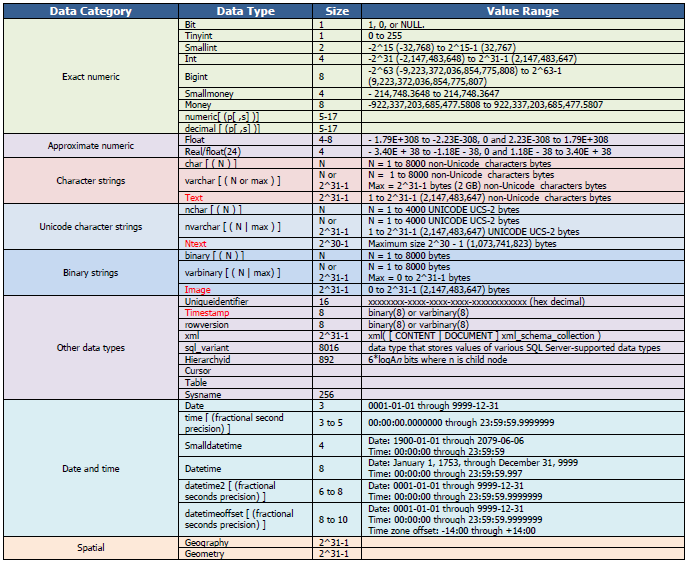
String types handle text data. VARCHAR is a flexible choice for text of varying lengths, like usernames or comments. You just set a maximum length, and it only uses the storage it needs. CHAR is for fixed-length text, such as a two-letter state abbreviation. If you need to store a large amount of text, like a blog post or an article, TEXT is the way to go.
Dates, Times, and Beyond
Beyond simple numbers and text, MySQL has specialized data types for more complex information.
| Data Type | Stores | Example Usage |
|---|---|---|
DATE | A date (year, month, day) | A user's birthday |
TIME | A time of day | A store's opening hours |
DATETIME | Both a date and a time | The exact moment an order was placed |
TIMESTAMP | A point in time, often used for tracking changes | When a record was last updated |
YEAR | A year value | A car's model year |
For geographical information, MySQL provides spatial data types. These can store points, lines, and polygons, which are useful for mapping applications or location-based services. You could use a POINT type to store the coordinates of a specific store, or a POLYGON to outline a delivery zone.
Finally, the JSON data type lets you store structured data in a flexible, document-like format right inside your database. This is great for storing settings, logs, or other data that doesn't fit neatly into traditional rows and columns. You can store a list of a user's interests or the configuration for a product, all within a single field.
Now, let's test your knowledge of these fundamental building blocks.
What is the primary purpose of a data type in MySQL?
You are building an application to track store locations and want to store the precise geographic coordinates of each store. Which data type is specifically designed for this purpose?
Getting comfortable with these data types is a key first step in designing effective and reliable databases.