Music Triads Explained
Introduction to Triads
The Building Blocks of Harmony
At the heart of most of the music we listen to, from pop songs to classical symphonies, is a simple, powerful structure: the triad. A triad is a chord made of three notes. These notes aren't random; they're chosen and stacked in a specific way to create harmony.
Triads are three-note chords built from the 1st (root), 3rd, and 5th degrees of a scale.
Imagine a scale, like C major (C, D, E, F, G, A, B). To build a triad, we start on one note, which we call the root. Then, we skip the next note in the scale and add the one after that. We do this one more time.
Starting on C:
- Root: The starting note, C.
- Third: Skip D, add E.
- Fifth: Skip F, add G.
This gives us the notes C, E, and G, which form a C major triad. The names "third" and "fifth" simply describe their distance from the root note within the scale.
Four Flavors of Triads
Just as a chef uses different spices, a composer uses different types of triads to create different moods. There are four basic types, each defined by the specific intervals, or distances, between its three notes.
| Triad Type | Interval Formula (from Root) | Common Sound |
|---|---|---|
| Major | Major Third + Perfect Fifth | Bright, happy, stable |
| Minor | Minor Third + Perfect Fifth | Sad, pensive, mellow |
| Diminished | Minor Third + Diminished Fifth | Tense, unstable, dark |
| Augmented | Major Third + Augmented Fifth | Eerie, unsettled, surprising |
Let's use C as our root to see how this works.
Major Triad (C): The C major triad is C-E-G. The distance from C to E is a major third, and from C to G is a perfect fifth. This is the happy, familiar sound of many popular songs.
Minor Triad (Cm): To make a C minor triad, we lower the third note by one half step. So, C-E-G becomes C-E♭-G. The interval from C to E♭ is a minor third, giving the chord its characteristic sad or thoughtful quality.
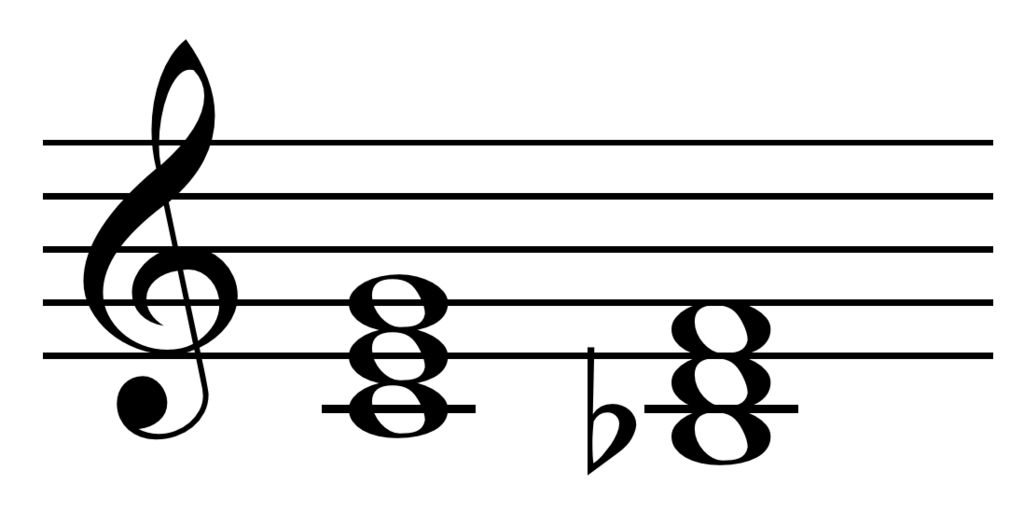
Diminished Triad (Cdim): If we take the C minor triad (C-E♭-G) and lower the fifth by a half step, we get a C diminished triad: C-E♭-G♭. Both the third and fifth are lowered compared to a major triad. This creates a sound full of tension that wants to resolve to another chord.
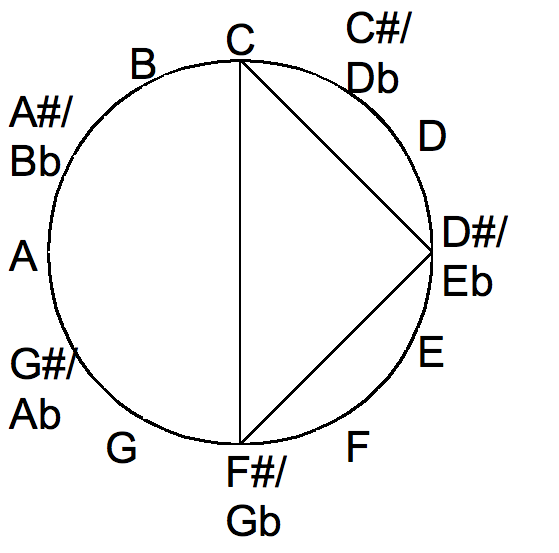
Augmented Triad (Caug): For an augmented triad, we start with a C major triad (C-E-G) and raise the fifth by a half step: C-E-G♯. The raised fifth gives it a strange, dreamy, or unsettled feeling.
Triads in a Scale
Triads aren't just built on the first note of a scale. We can build a triad on every note of a scale, and doing so gives us the basic harmonic palette for a key. When we use only the notes available in that scale, we create what are called diatonic triads.
Let’s go back to the C major scale (C, D, E, F, G, A, B). By stacking thirds on each note, we discover a predictable pattern of major, minor, and diminished triads.
Notice the pattern that emerges in every major key:
- Major Triads: Built on the 1st, 4th, and 5th scale degrees (I, IV, V).
- Minor Triads: Built on the 2nd, 3rd, and 6th scale degrees (ii, iii, vi).
- Diminished Triad: Built on the 7th scale degree (vii°).
This pattern is the foundation for countless chord progressions. Understanding it is the first step toward understanding why certain chords sound so good together.
Now, let's test your knowledge of these fundamental building blocks.
What are the three notes that make up a basic triad called?
To change a major triad into its parallel minor triad, you must...