Music Theory for Producers
Rhythm and Meter
The Pulse of Music
Rhythm is the engine of a song. It's the pattern of sounds and silences over time that makes you want to tap your foot or dance. At its core, rhythm is organized around the duration of individual notes. Some notes are long, others are short, and the combination of these durations creates a rhythmic pattern.
The building blocks of rhythm are note values. Each note has a specific length, and they're all related to each other mathematically. The longest standard note is the whole note. A half note is half the length of a whole note. A quarter note is a quarter of the length of a whole note, and so on. This division creates a hierarchy of durations.
Understanding this relationship is key. Two half notes take up the same amount of time as one whole note. Four quarter notes equal one whole note. This simple math is the foundation for every rhythm you'll ever create.
Keeping Time
While note values tell you how long each note lasts, meter organizes these notes into a regular pulse. Meter is defined by the time signature, which you'll see at the beginning of a piece of sheet music or in your DAW's settings. It looks like a fraction, such as 4/4 or 3/4.
The top number tells you how many beats are in each measure, or bar. The bottom number tells you which note value gets one beat. In 4/4 time, there are four beats per measure, and the quarter note gets one beat. This is the most common time signature in pop, rock, electronic, and hip-hop music. In 3/4 time, there are three beats per measure, and the quarter note still gets the beat. This creates the waltz feel.
Think of a measure as a container. The time signature tells you how much rhythmic value that container can hold.
But what about rhythms that don't fall neatly on the main beats? That's where syncopation comes in. Syncopation is the art of accenting the off-beats, the notes that fall in between the main pulses. It's the secret ingredient that gives rhythms groove and makes them feel less robotic. By placing notes on the "and" of a beat (like "one-and-two-and"), you create rhythmic tension and interest.
Programming Rhythms
In a Digital Audio Workstation (DAW), you'll typically program rhythms in a piano roll or a step sequencer. A step sequencer breaks a measure down into a grid, usually of 16 steps for a 4/4 measure. Each step represents a sixteenth note. You simply click on the steps where you want a sound to play.
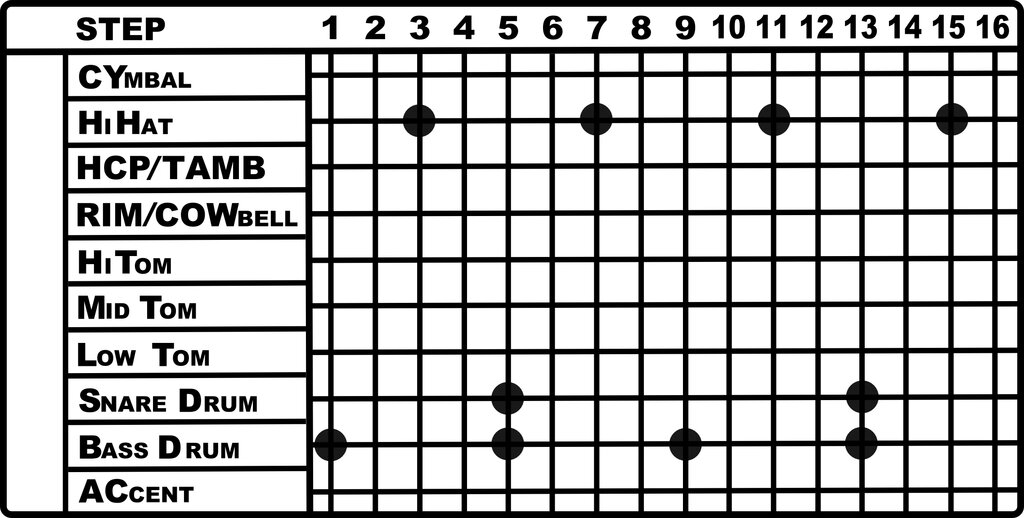
Let's build a classic beat. In a 16-step grid, the main beats (quarter notes) fall on steps 1, 5, 9, and 13.
- Kick Drum: Place the kick on the main beats: 1, 5, 9, and 13. This is called a "four on the floor" pattern, and it's the foundation of most dance music.
- Snare Drum: Place the snare on beats 2 and 4, which are steps 5 and 13. Notice the snare now shares a step with the kick. This creates a strong backbeat.
- Hi-Hats: For a simple pattern, place closed hi-hats on every eighth note. That means steps 1, 3, 5, 7, 9, 11, 13, and 15.
| Step | 1 | 2 | 3 | 4 | 5 | 6 | 7 | 8 | 9 | 10 | 11 | 12 | 13 | 14 | 15 | 16 |
|---|---|---|---|---|---|---|---|---|---|---|---|---|---|---|---|---|
| Kick | X | X | X | X | ||||||||||||
| Snare | X | X | ||||||||||||||
| Hat | X | X | X | X | X | X | X | X |
This is just a starting point. From here, you can add or remove hits to create syncopation. Try removing the kick on step 13, or add an extra kick on step 8 or 16. Experimenting with these simple patterns is the best way to develop your rhythmic intuition.
How many quarter notes are equal in duration to one whole note?
In the time signature 4/4, what does the top number '4' represent?
With these fundamentals of note values, time signatures, and syncopation, you have the tools to build the rhythmic foundation for any track. Practice programming different patterns, and listen closely to the rhythms in your favorite songs.