Music Theory and MIDI Keyboard Fundamentals
Keyboard Layout
The Keyboard Landscape
Look at any piano or MIDI keyboard. You'll immediately see a repeating pattern of white and black keys. The black keys are grouped into sets of two, then three, then two, and so on, all the way up and down the instrument.

This entire pattern consists of 12 keys: seven white and five black. Once you get past the 12th key, the pattern simply starts over. This makes the keyboard much less intimidating than it might first appear. If you can understand one small section, you understand the whole thing.
A helpful landmark is the note C. You can find any C by looking for the white key immediately to the left of a group of two black keys. Try finding all the Cs on a keyboard. They're your guideposts for navigating the musical terrain.
Octaves and Repetition
The repeating 12-key pattern is called an octave. An octave is the distance from one note to the next note with the same name. For instance, the distance from one C to the next C up the keyboard is one octave. The higher C sounds the same, just at a higher pitch.
Octave
noun
The interval between one musical pitch and another with double or half its frequency. On a keyboard, it's the span of 12 keys from one note to the next one with the same name.
Keyboards are organized by octaves to make them easier to navigate. Instead of having to learn dozens of unique key positions, you only need to learn one 12-key pattern. This pattern is then just duplicated up and down, with each repetition forming a new octave.
Middle C, Your Home Base
The most important landmark on the entire keyboard is Middle C. It's called "middle" because it's located near the center of a full-sized piano. On most MIDI keyboards, it's also near the physical center. Think of it as your home base—a starting point for finding other notes.
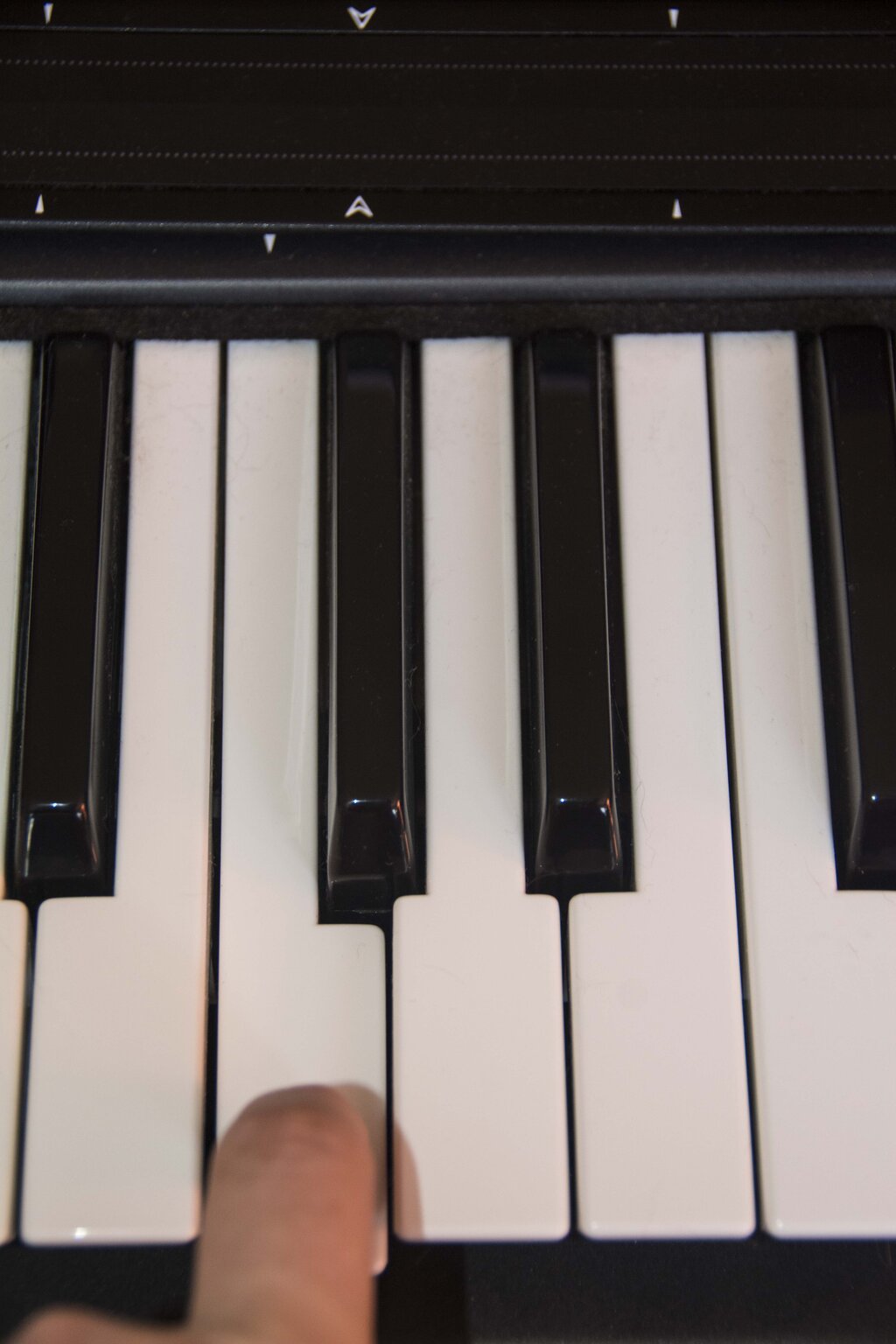
Musicians refer to this specific C as C4. The number indicates which octave the C belongs to. The C an octave below it is C3, and the C an octave above it is C5. This numbering system applies to all the notes, allowing you to pinpoint any key on the keyboard, like G4 or A2.
Keys and Written Music
So, how do these keys on the keyboard relate to the notes you see on a piece of sheet music? Each key corresponds to a specific line or space on the musical staff. The staff is the set of five lines where musical notes are written.
Middle C is special here, too. It sits on a small line of its own (called a ledger line) right between the two main parts of the staff: the treble clef (usually for higher notes) and the bass clef (usually for lower notes).
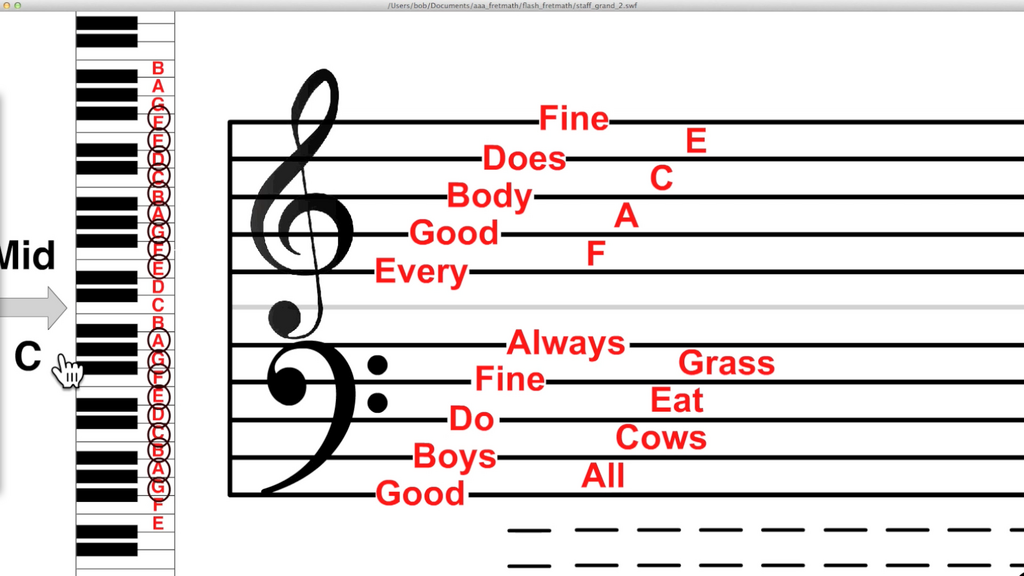
As notes are written higher on the staff, you play keys further to the right on the keyboard. As they go lower on the staff, you move to the left. Understanding this connection is the first step in learning to read music and play it on your keyboard.
Time to review these core concepts.
Let's check your understanding.
How many total keys make up one full, repeating pattern on a piano keyboard?
Where can you find any note 'C' on the keyboard?
With these basics down, you now have a map of the keyboard. You can find your way around, identify any note, and see how the physical keys connect to written music.