Music Industry Evolution in the Creator Economy
Music Industry Overview
The Music Industry Machine
The music industry can seem like a tangled web. At its heart, it's a system designed to connect artists with audiences and manage the money that flows between them. Understanding this structure starts with seeing how the key players and different rights fit together.
The Key Players
Every piece of music has two distinct copyrights: one for the song itself (the composition, including lyrics and melody) and one for the specific recording of that song (the master).
This distinction is crucial because different players handle each copyright.
Artists and Songwriters are the creators. An artist performs the music, while a songwriter writes the composition. Often, the artist and songwriter are the same person, but not always. Elvis Presley, for example, was a legendary artist, but he rarely wrote his own songs.
Record Labels invest in artists to create and market recordings. They typically own the master recordings and focus on getting those recordings heard. Their job involves everything from funding studio time to promoting the final album.
Music Publishers represent songwriters and their compositions. They work to get a songwriter's music placed in movies, used by other artists, or performed publicly. They collect royalties on behalf of the songwriter for the use of the composition.
Distributors are the link between record labels and retailers. In the past, this meant physically shipping CDs and vinyl to stores. Today, it mostly involves delivering digital files to streaming services and online stores like Spotify and Apple Music.
Following the Money
With the key players in mind, we can look at how they traditionally earn money. Revenue in the music industry flows from a few primary sources, each tied to a specific type of music consumption.
| Revenue Stream | Description | Key Players Involved |
|---|---|---|
| Physical Sales | Selling physical media like vinyl records, CDs, and cassette tapes. | Record Label, Distributor, Retailer, Artist |
| Digital Downloads | Selling permanent downloads of tracks or albums through stores like iTunes. | Record Label, Distributor, Publisher, Artist, Songwriter |
| Streaming | Royalties generated when users stream a song on platforms like Spotify or YouTube. | All key players |
| Live Performance | Revenue from ticket sales for concerts and tours, plus merchandise sold at shows. | Artist, Promoter, Venue |
| Licensing (Sync) | Fees paid to use a song in a movie, TV show, commercial, or video game. | Publisher (for composition), Record Label (for recording) |
Streaming, in particular, generates different types of royalties. Mechanical royalties are paid to songwriters and publishers whenever a song is reproduced, which includes streams. Performance royalties are paid when a song is performed publicly, which includes being played on the radio, in a restaurant, or streamed online.
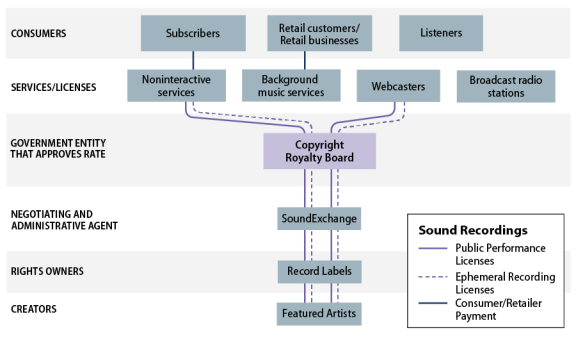
As you can see, money flows from the consumer through various organizations, each taking a cut before the funds reach the artist and songwriter. The system ensures that both the composition and the recording are paid for whenever music is used.
Let's check your understanding of these core concepts.
Every piece of music has two distinct copyrights. What are they?
A record label's primary business is focused on which of the following?
This framework of players and revenue streams forms the bedrock of the traditional music business. While new models are emerging, this structure still manages the vast majority of music transactions around the world.