Multivariable Calculus Essentials
Vectors and Geometry
Vectors: More Than Arrows
Think of a vector as a set of instructions. It tells you two things: which direction to go and how far. In a flat, two-dimensional world (like a map), a vector might say "go 3 steps east and 4 steps north." We write this as a pair of numbers, like .
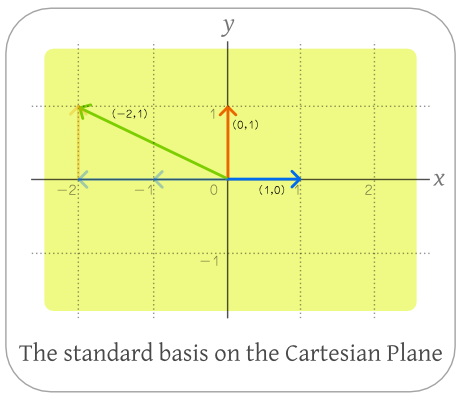
But the world isn't flat. To locate anything in real space, you need three directions: length, width, and height. This is where 3D vectors come in. A 3D vector is just a list of three numbers, often written as . For example, the vector means go 3 units along the x-axis, 4 units along the y-axis, and 5 units up the z-axis.
Working with vectors is straightforward. You can add them, subtract them, and multiply them by a regular number (a scalar). These operations happen component-by-component. Let's say we have two vectors, and , and a scalar .
For example, if and , then . And .
Multiplying Vectors
What about multiplying two vectors together? It's not as simple as component-by-component multiplication. There are two important ways to do it, each with a different purpose and result: the dot product and the cross product.
Dot Product
noun
A way of multiplying two vectors that results in a single number (a scalar). It tells you how much one vector points in the direction of another.
The dot product is calculated by multiplying corresponding components and adding the results.
The dot product is useful for finding the angle between two vectors and for determining if they are perpendicular (orthogonal). If , the vectors are at a right angle to each other.
The other method is the cross product. Unlike the dot product, the cross product of two vectors gives you another vector.
Cross Product
noun
A way of multiplying two vectors in 3D space that results in a new vector. This new vector is perpendicular to both of the original vectors.
This new perpendicular vector is incredibly useful. For example, if you have two vectors that define a flat surface (a plane), their cross product gives you a vector that points straight out from that surface, called a normal vector.
Describing Lines and Planes
With vectors, we can describe any line or plane in 3D space. A line needs two things: a point on the line and a direction to travel in. We can use a vector for the direction.
The vector equation of a line is written as . Here, is a position vector to a known point on the line, is the direction vector of the line, and is a parameter that can be any real number. As changes, the point moves along the line.
This is often broken down into a set of parametric equations, one for each coordinate:
Planes work similarly, but instead of a direction vector, we use a normal vector —one that's perpendicular to the plane. The equation of a plane is defined by this normal vector and a point that lies on the plane. The equation is derived from the fact that any vector lying in the plane must be perpendicular to the normal vector. Their dot product must be zero.
This expands out to the more common form: .
Curves and Surfaces
Parametric equations aren't just for straight lines. By making the components , , and more interesting functions of , we can trace out any curve in 3D space. For instance, a helix (like a corkscrew) can be described parametrically.
Just as a curve can be described with one parameter (), a surface can be described with two parameters, say and . For example, the equation of a sphere with radius can be written using two angles, and (our and ).
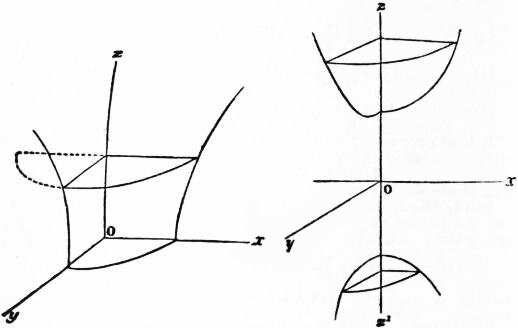
This ability to describe points, lines, planes, curves, and surfaces using vectors and equations is the foundation for exploring the geometry of our three-dimensional world and a crucial stepping stone into multivariable calculus.