Multimodal Embedding Models Explained
Introduction to Multimodal Embeddings
Beyond a Single Sense
Humans experience the world through multiple senses at once. You see a storm cloud, hear the thunder, and feel the rain. Each piece of information—sight, sound, feeling—is a different modality, and your brain seamlessly combines them to form a complete understanding: a storm is here.
Computers, for a long time, mostly worked with one modality at a time. They could analyze text, or process an image, but they struggled to understand the connection between a picture of a dog and the sound of a bark. This is where multimodal embeddings come in. They are a way to translate different types of data into a common mathematical language.
The goal is to create a shared space where the concept of a 'dog' from a photo is located right next to the concept of a 'dog' from a text description.
Think of it like a universal translator. An embedding model takes an image, a snippet of text, or a sound clip and converts it into a list of numbers, called a vector. In this shared 'embedding space,' vectors representing similar concepts are mathematically close to each other, regardless of their original format. The vector for a photo of an apple is near the vector for the word "apple."
A Richer Understanding
Why is this so important? Because the world is multimodal. A news article is more than just words; it might have photos, charts, and videos. A social media post pairs a caption with an image. By integrating these different data types, AI models gain a much deeper and more nuanced understanding, much like a human does.
This holistic view allows a model to grasp context that would be lost in a single modality. It can understand sarcasm in a video by combining a user's tone of voice (audio), their facial expression (image), and their words (text). Without this fusion, the meaning might be completely misinterpreted.
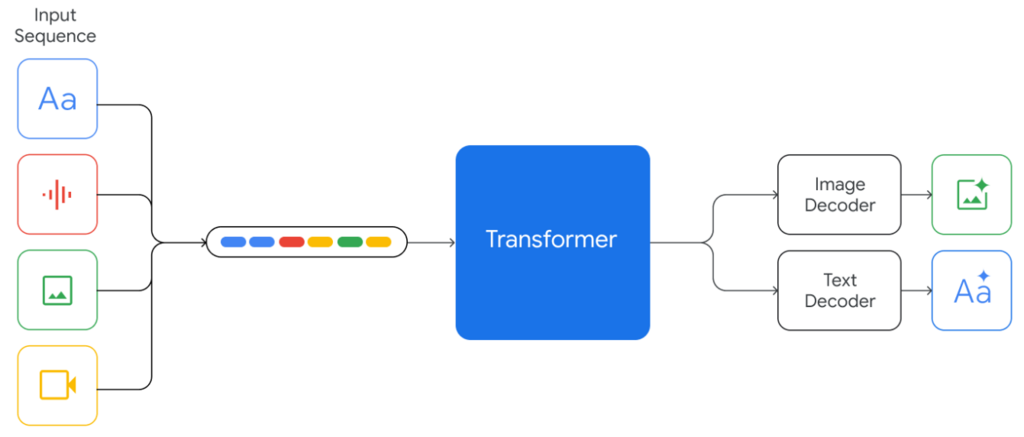
This ability to connect different data streams is a fundamental step toward creating more capable and intuitive AI systems.
What This Unlocks
With a shared understanding of different data types, we can build powerful applications that were previously impossible. Multimodal embeddings are the foundation for a wide range of modern AI features.
| Application | Description |
|---|---|
| Image Captioning | A model analyzes an image and generates a descriptive text caption. |
| Visual Question Answering | A model answers natural language questions about the content of an image. |
| Cross-Modal Retrieval | You can search for images using a text description, or find a video clip using an audio sample. |
For example, you could give a model a picture of a golden retriever playing in a park and it could generate the caption, "A golden retriever catches a frisbee in a grassy field." Or you could ask it, "What color is the frisbee?" and it could answer "Red." This is only possible because the model can link the visual information in the image with the concepts and relationships described by language, all thanks to a shared embedding space.