Multi-Tenancy Permissions in Next.js with Clerk
Introduction to Multi-Tenancy
What is Multi-Tenancy?
Imagine an apartment building. Many different people (tenants) live in their own private apartments, but they all share the building's core infrastructure like the plumbing, electrical systems, and the main entrance. Multi-tenancy in software works on a similar principle.
Multi-tenancy is a software architecture that let a single software deployment serve multiple tenants.
A single instance of an application runs on a server, but it serves multiple customers, or "tenants." Each tenant has their own separate, secure space within the application, but they all use the same underlying software and hardware. A tenant is typically a single organization or customer, like a company that signs up for a project management tool. For that company, all its employees share the same tenancy.
This is different from a single-tenant architecture, where each customer gets their own unique instance of the application and its supporting infrastructure. It’s like giving every resident their own single-family house instead of an apartment.
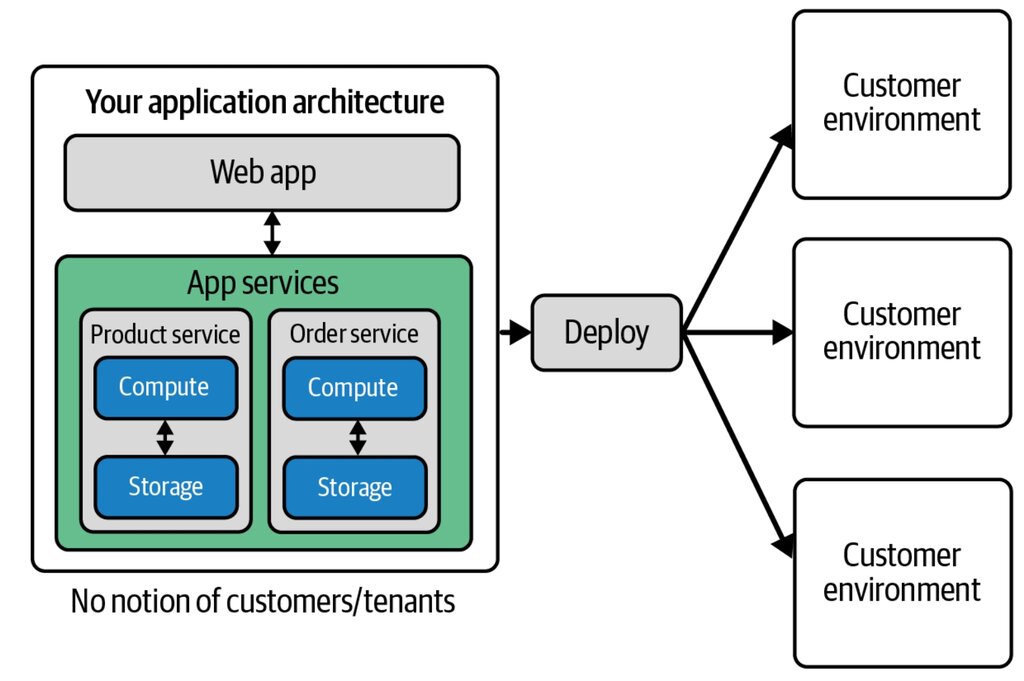
In the single-tenant model, scaling means deploying a whole new stack for each new customer. It's secure but can be expensive and slow to provision.
Now, compare that with the multi-tenant approach.
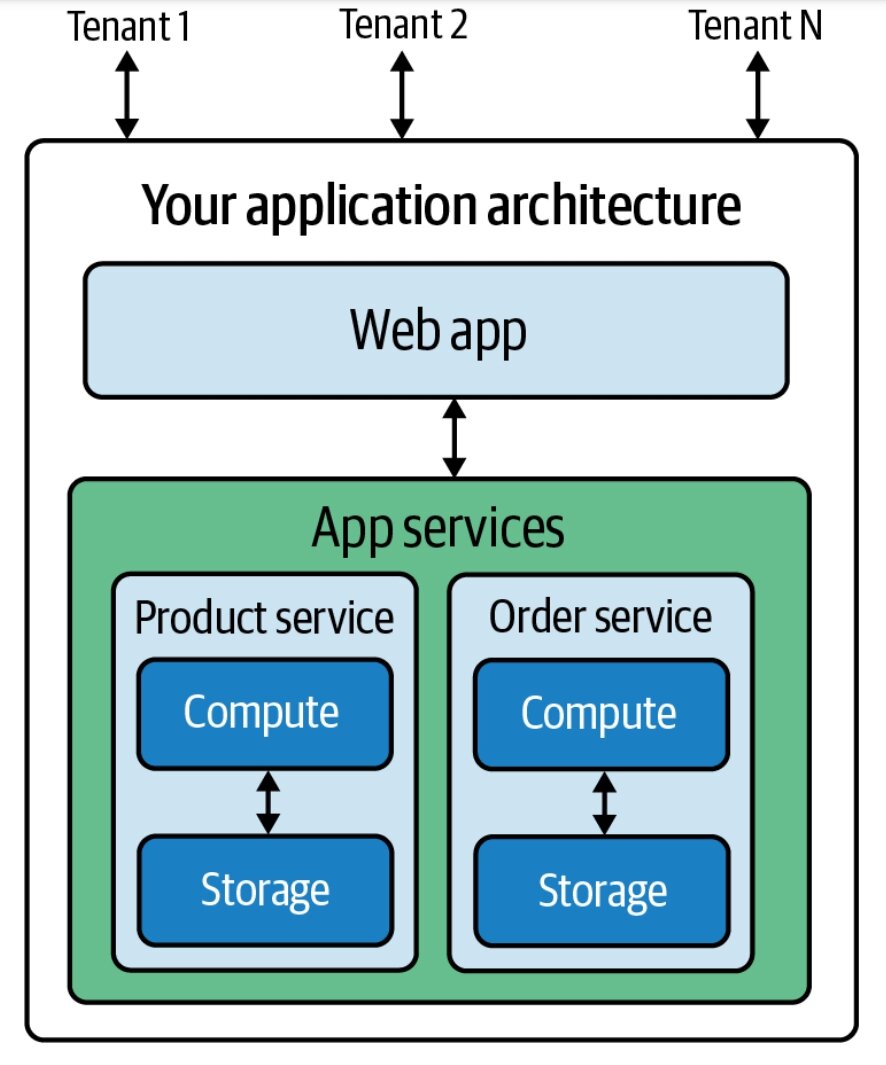
Here, multiple tenants share the same application and services. This model is the backbone of most Software-as-a-Service (SaaS) products like Slack, Figma, or Salesforce. It's powerful because it's efficient. Instead of managing hundreds of separate application instances, you manage just one. This lowers costs for maintenance, hosting, and updates. When you push a new feature, all tenants get it at once.
Common Multi-Tenancy Models
The biggest architectural decision in a multi-tenant application is how you store the data. How do you keep one tenant's information completely separate from another's? There are three common models, each with its own trade-offs.
1. Shared Database, Shared Schema: In this model, all tenants share a single database and the same set of tables. A special column, often called tenant_id, is added to each table to distinguish which rows belong to which tenant. This is the simplest and most cost-effective approach, but it offers the weakest data isolation.
2. Shared Database, Separate Schemas: Here, all tenants still share a single database instance, but each tenant gets their own dedicated set of tables within a separate "schema." This provides strong logical data separation and is a good middle ground between isolation and cost.
3. Separate Databases: This model provides the highest level of isolation. Each tenant gets their very own database. It's the most secure and reduces the risk of "noisy neighbors" (where one tenant's heavy usage impacts others), but it's also the most expensive and complex to manage.
| Model | Isolation | Cost | Complexity |
|---|---|---|---|
| Shared DB, Shared Schema | Low | Low | Low |
| Shared DB, Separate Schemas | Medium | Medium | Medium |
| Separate Databases | High | High | High |
Challenges and Security
Building a multi-tenant application introduces unique challenges, primarily centered around security and performance. The most critical responsibility is ensuring data is perfectly isolated. A bug in your code could accidentally expose one tenant's data to another, which would be a catastrophic security breach.
This is why the data model you choose is so important. A Separate Databases model makes accidental data leakage nearly impossible at the database level. In a Shared Schema model, every single database query must be carefully written to include a WHERE tenant_id = 'current_tenant_id' clause. Forgetting it just once could lead to a disaster.
In multi-tenancy, security isn't just a feature; it's the foundation. Your architecture must be designed from day one to enforce strict tenant isolation.
Other challenges include:
- Performance: The "noisy neighbor" problem is a real concern. If one tenant runs a massive report, it could consume server resources and slow down the application for everyone else. Architects need to build in safeguards like resource throttling.
- Customization: Tenants often want to customize their version of the application, from changing the look and feel to adding custom data fields. Supporting this without creating a maintenance nightmare is a complex engineering problem.
- Onboarding: Provisioning a new tenant must be a smooth, automated process. For the separate database model, this means programmatically spinning up and configuring a new database for each new customer.
Now that you understand the core concepts of multi-tenancy, let's test your knowledge.
Which analogy best describes a multi-tenant software architecture?
Which data storage model for multi-tenancy offers the strongest data isolation but is also the most expensive to manage?
Choosing the right multi-tenancy model is a crucial first step. It impacts everything from cost and scalability to the security and complexity of your application.