Muay Thai Technical Mastery and Tactics
Kick Biomechanics
The Kinetic Chain
A powerful roundhouse kick isn't just a leg movement; it's a full-body event. The force doesn't start in your thigh, but in the ground beneath your feet. This transfer of energy, from the floor up through your legs, core, and finally into your striking shin, is called kinetic linking. Think of it like cracking a whip. The handle (your foot) moves a short distance, but that energy multiplies as it travels to the tip.
Each link in the chain adds to the kick’s momentum. A weak link, like an unstable core or a flat foot, will cause energy to leak out, drastically reducing your power. The entire sequence, from floor to impact, happens in a fraction of a second.
Pivotal Performance
The engine of the roundhouse kick is hip rotation, and the key that turns it on is the pivot of your lead (or standing) foot. Without a proper pivot, your hips are locked, and your kick becomes a simple, weak leg lift. As you initiate the kick, your supporting foot must turn outwards, away from the target.
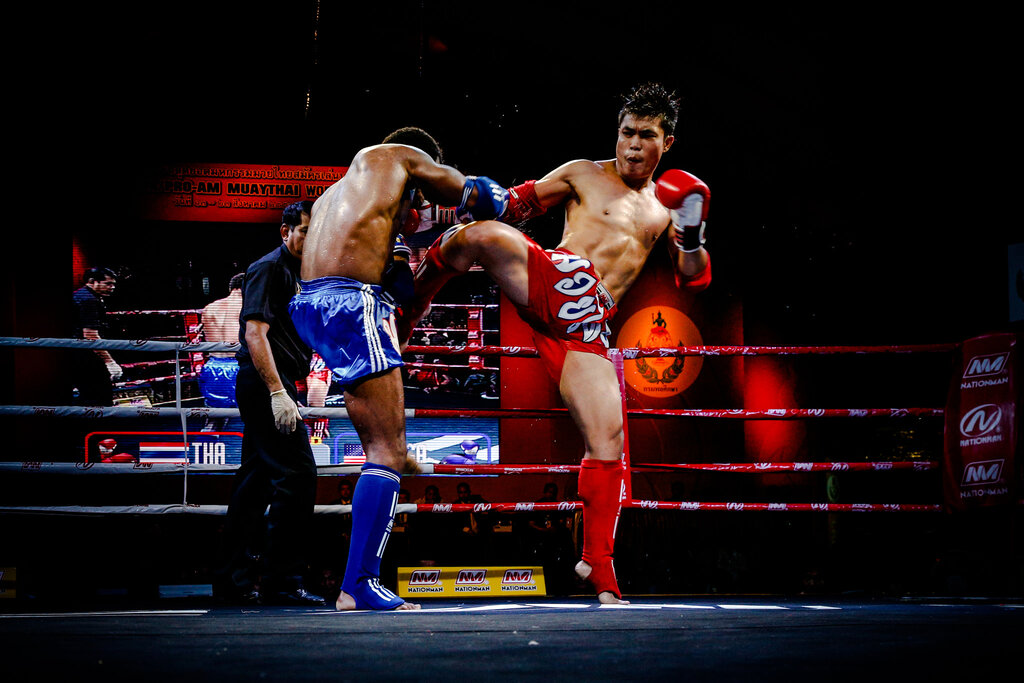
How much should you pivot? It depends on the target and the situation, but for a full-power kick, you should aim to pivot at least 90 degrees, and ideally closer to 180. Your heel should end up pointing towards your opponent. This movement does two things: it opens your hips to allow for maximum rotation, and it aligns your joints—ankle, knee, and hip—to create a stable pillar of support.
A flat-footed pivot is a slow pivot. Stay on the ball of your foot to ensure you can turn quickly and smoothly.
The Counterbalance and Snap
As your kicking side rotates forward, something has to go the other way to keep you from spinning out of control. This is the job of your arms. The arm on your kicking side should swing downwards and across your body. This acts as a counterbalance and also helps to pull your hip into the kick, increasing rotational speed.
The final piece of the puzzle is the hip turnover. This is what separates a slapping kick from a devastating one. Just before impact, you should actively roll your hip over, so your shin, not your instep, makes contact. Imagine you are trying to show the ceiling the sole of your kicking foot. This motion engages your glutes and obliques, adding the final, sharp 'snap' of power to the end of the kinetic chain. It turns the leg from a simple swinging club into a bladed weapon.
Our data indicates that the typical Karate and Taekwondo snap-like kick is based heavily on rapid knee extension, while Muay Thai uses a technique that places greater emphasise on COM movements to develop high impact forces.
A powerful kick that leaves you off-balance is a liability. After impact, you should be able to retract the leg quickly along the same path and reset into your stance, ready to defend or throw another strike. A good drill is to practice throwing the kick and holding your leg at its highest point for a few seconds before retracting. This builds the stabiliser muscles crucial for balance and control.
Ready to test your knowledge of these mechanics?
What is the term for the process of transferring energy from the ground, up through the body, and into a roundhouse kick?
What is the primary reason for pivoting on the supporting foot during a roundhouse kick?
Understanding these mechanical details turns a good kick into a great one. Focus on integrating the pivot, arm swing, and hip turnover into a single, fluid motion.