Muay Thai Technical Excellence
Refining the Eight Limbs
The Source of Power
In Muay Thai, true power doesn't come from brute muscle. It comes from the ground. Every strike, whether a punch or a kick, is the final expression of a chain reaction that starts with your feet on the canvas. This is the essence of the —a sequence of movements where energy is transferred from one part of the body to the next, gaining momentum along the way. Mastering this transfer is what separates a novice's slap from a fighter's knockout blow. Instead of isolating muscles, you learn to move your body as a single, coordinated unit. Your legs, hips, core, and shoulders work in harmony to channel force from the floor into your opponent.
Practitioners master the art of generating maximum force in their strikes by utilising proper body mechanics, hip rotation, and weight transfer.
Power from the Ground Up
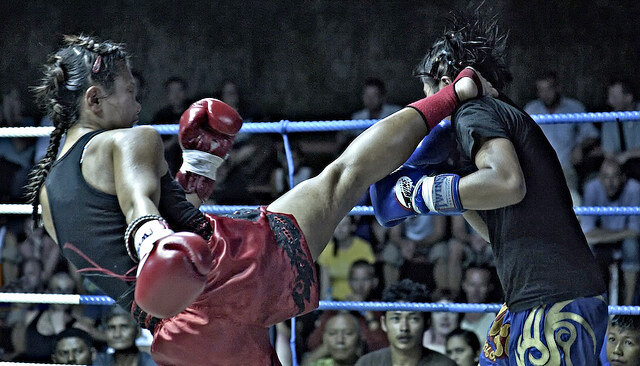
Let's focus on the roundhouse kick. The single most important element for power is the pivot of your standing foot. As you initiate the kick, your supporting foot must turn outwards, typically 45 degrees or more. This isn't just a foot-shuffling exercise; it's the key that unlocks your hips.
Without the pivot, your hips are locked in place, and the kick becomes a simple, weak leg lift. With the pivot, your hips can rotate fully into the target, generating immense torque. Think of it like cracking a whip. The handle (your core and hips) makes a small, powerful rotation, which translates into incredible speed at the tip (your shin). This rotation also naturally ensures your shin, not your fragile foot, makes contact. A common mistake is 'flagging' the hands—dropping your guard for balance. Instead, keep your rear hand glued to your jaw and your lead arm tight to your body or extended to block a counter.
The same principle applies to the long knee. While it looks like a simple leg-raising motion, a powerful long knee is driven by a forward thrust of the hips. As you bring the knee up, you simultaneously push your hips forward as if trying to drive them through your opponent. This creates penetration and transfers your body weight into the strike, making it far more damaging than just lifting your knee with your quad.
Upper Body Weapons
Punches in Muay Thai follow the same kinetic rule: power originates from the feet. For a cross, you pivot on your rear foot, allowing your hip and torso to rotate and snap the punch forward. This whole-body rotation is what generates force, not just your arm and shoulder muscles. Critically, as you extend your punching arm, your shoulder should rise to cover your jawline. This provides a natural shield, protecting you from hooks and counters. Never punch with a dropped shoulder.
Elbows are devastating short-range tools precisely because they leverage this rotation over a very short distance. Whether you throw a horizontal, uppercut, or downward slashing elbow, the movement should feel like you're trying to pull a rope that starts at your rear foot. The arm itself does little work; it's just the delivery system for the torque generated by your core and hips. The trajectory is tight and direct, cutting through the opponent's guard rather than looping around it.
According to the principles of the kinetic chain in Muay Thai, where does the power for a strike primarily originate?
What is the single most important element for unlocking hip rotation and generating maximum power in a roundhouse kick?
By focusing on these mechanical details, you transform simple movements into powerful, efficient, and safe techniques. It's about working smarter, not just harder, and letting your entire body become the weapon.