Muay Boran Mastery Journey
Muay Boran Fundamentals
From the Ring to the Battlefield
You already know the power of modern Muay Thai, the 'Art of Eight Limbs.' It's a sport refined for the ring, with rules and limitations. But its ancestor, Muay Boran, was forged for a different purpose: survival. This is not a sport; it is a system of combat developed for the battlefield, where there are no rules and the goal is to end a threat quickly and decisively.
Muay Thai Boran (“Boran” is Thai for ‘ancient’ or ‘old’) is one of the most powerful systems of combat in the world.
The fundamental difference lies in intent and application. Sport Muay Thai uses a narrow, upright stance, perfect for quick footwork and delivering kicks in a controlled environment. Muay Boran operates from a lower, wider base. This isn't just a stylistic choice; it's a tactical necessity.
The Boran Stance and Guard
Transitioning to the Muay Boran stance requires you to lower your center of gravity. Spread your feet slightly wider than shoulder-width, with your lead foot pointing forward and your rear foot angled out. Bend your knees more than you would in a modern stance. This creates a stable platform, grounding you for explosive power and making you harder to unbalance.
From this solid base, we establish the Jot Muay, the traditional guard. Unlike the high, open guard of sport Muay Thai that prioritizes blocking kicks, the Jot Muay is focused on protecting your centerline. The hands are held closer to the body, often with the lead hand extended slightly forward and the rear hand protecting the jaw. The elbows stay tucked in, shielding the ribs. This posture is designed to defend against straight-line attacks and create a tight shell from which to launch devastating counter-attacks at close range.
The Nine Weapons
Modern Muay Thai is famous for its eight limbs: two fists, two elbows, two knees, and two shins. Muay Boran adds a ninth weapon to this arsenal, the Nawa Awoot.
Nawa Awoot
noun
The 'Nine Weapons' of Muay Boran, referring to the eight limbs of modern Muay Thai plus the head.
The ninth weapon is the head. In the chaos of close-quarters combat, the head becomes a formidable tool for strikes, bumps, and controlling an opponent. A well-placed headbutt can disorient or knock out an attacker, creating an opening for a finishing technique. This is a primary reason the Jot Muay guard is so compact, as it naturally positions the practitioner to both defend against and deliver these ninth-limb strikes.
This integration of the head transforms the close-range game entirely. It's not just about clinching and kneeing; it's about using every part of your body as a weapon.
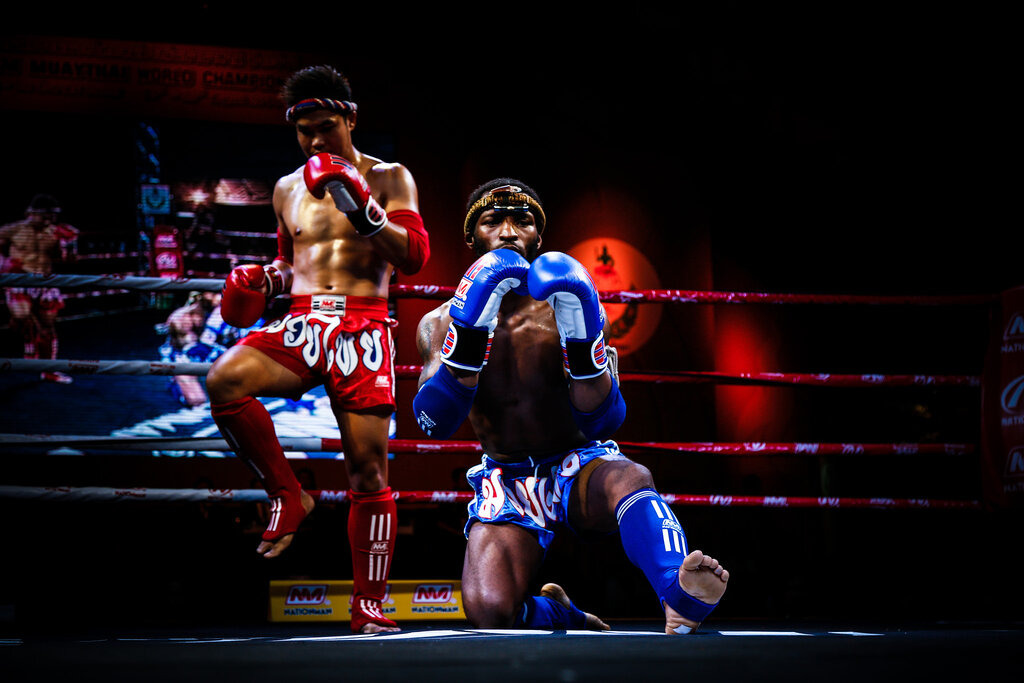
Fundamental Footwork
The foundation of all movement in Muay Boran is the Yang Sam Khum, or 'Three-Step Movement.' This footwork pattern is designed to maintain balance while moving in any direction, allowing for seamless transitions between offense and defense. It feels different from the bouncy rhythm of a modern Thai boxer.
Imagine a triangle on the ground. Your feet occupy two points of the triangle. To move, you step to the third point, then re-establish your base by moving the trailing foot. It’s a deliberate, gliding motion, not a hop. This ensures you are always grounded and ready to either absorb an attack or launch one with full power from your stable stance.
To practice Yang Sam Khum:
- Start in your low, wide Boran stance.
- To move forward, slide your lead foot forward a short distance.
- Slide your rear foot forward the same distance to re-establish your stance.
- To move backward, reverse the process: rear foot first, then lead foot.
Always maintain your stance width and low center of gravity. This is the key to balance and power.
Mastering this footwork is crucial. It connects the stable stance to the devastating power of the Nine Weapons, creating a combat system that is both ancient and brutally effective. Now, let's test your understanding of these core principles.
What is the primary purpose for which Muay Boran was originally developed?
Compared to a modern Muay Thai stance, the Muay Boran stance is typically:
Understanding these foundational elements is the first step in exploring the deep and powerful art of Muay Boran.