Mountain Home Foundations
Site Evaluation
Reading the Land
Before you can even dream about floor plans or window placements for your mountain home, you have to understand the ground it will stand on. Site evaluation is like getting to know a person before you build a relationship. It's the crucial first step where you listen to what the land is telling you. Skipping this conversation can lead to costly problems and structural heartbreak down the road.
Selecting an appropriate site is a critical first step in sustainable building design.
A thorough assessment reveals the site's strengths, weaknesses, and hidden challenges. It helps you make informed decisions, not just about where to build, but how to build, ensuring your home is safe, stable, and in harmony with its environment for decades to come.
What's Under Your Feet?
The ground beneath a building site is never just "dirt." It's a complex layer cake of materials with different personalities. Some soils, like clay, swell up with moisture and shrink when they dry out, putting constant stress on a foundation. Sandy soils drain well but can be unstable. Solid bedrock is the gold standard for support, but blasting and excavating it is expensive and difficult.
Understanding this composition is fundamental. The soil needs to have adequate bearing capacity, which is its ability to support the weight of your house without shifting or compressing. A geotechnical engineer performs tests to analyze these layers and determine their strength. This isn't a step to skip; a soil report is the foundation of a good foundation design.
Knowing what's below allows an engineer to choose the right strategy, whether that means using deep footings to reach a stable layer or designing a foundation that can "float" on more challenging soil.
Living on an Angle
Mountain views often come with sloped terrain. While beautiful, slopes introduce the risk of instability. Gravity is always at work, pulling soil and rock downhill. The key is to determine if the slope is stable enough to build on safely.
Geologists look for signs of past landslides, like unusually lumpy ground or crescent-shaped cracks on the hillside. They also assess the slope's angle, the type of material it's made of, and how water affects it. A slope that's perfectly stable when dry can become dangerously unstable when saturated with rain or snowmelt.
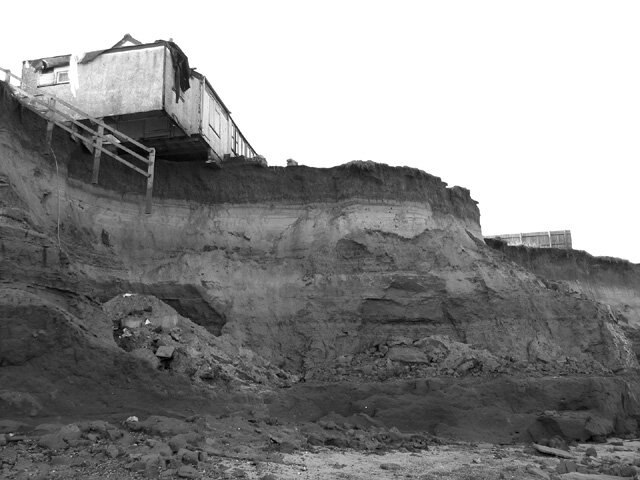
Building on a slope often requires cutting into the hillside or building up a level pad. Both actions can disturb the natural stability. Proper engineering, retaining walls, and drainage systems are essential to ensure the hillside stays put and your home remains secure.
Where the Water Goes
Water is the architect of many landscapes, and it can be a building's worst enemy if not managed correctly. Before you build, you must understand the site's drainage patterns. Where does water come from during a storm? Where does it flow, and where does it collect?
A home should be sited to shed water, not to block it or sit in its path. Water pooling against a foundation creates immense pressure, can cause leaks and flooding, and contributes to soil instability. The goal is to work with gravity and the natural topography to guide water safely around and away from your home.
Finally, consider potential environmental hazards. Is the site in a floodplain? Is it prone to wildfires? Are there high winds? In mountain settings, avalanches can be a risk in certain areas. Identifying these hazards is not meant to scare you away, but to ensure the home's design and location are chosen to mitigate those risks effectively.
Moving forward with your project, it's time to test what you've learned about evaluating a potential building site.
What is the primary reason for conducting a thorough site evaluation before building a home?
In soil analysis, what does "bearing capacity" refer to?
By carefully studying the soil, slope, and water, you build a partnership with the land. This deep understanding is the only way to create a home that is not just placed upon the landscape, but is truly a part of it.