Mountain Building Forces Explained
Earth's Structure
Under the Surface
The ground beneath our feet feels solid and unchanging, but it's just the very top of a vast, dynamic planet. Earth is structured in layers, almost like an onion. Understanding these layers—the crust, mantle, and core—is the first step to grasping the powerful forces that shape our world, from the tallest mountains to the deepest oceans.
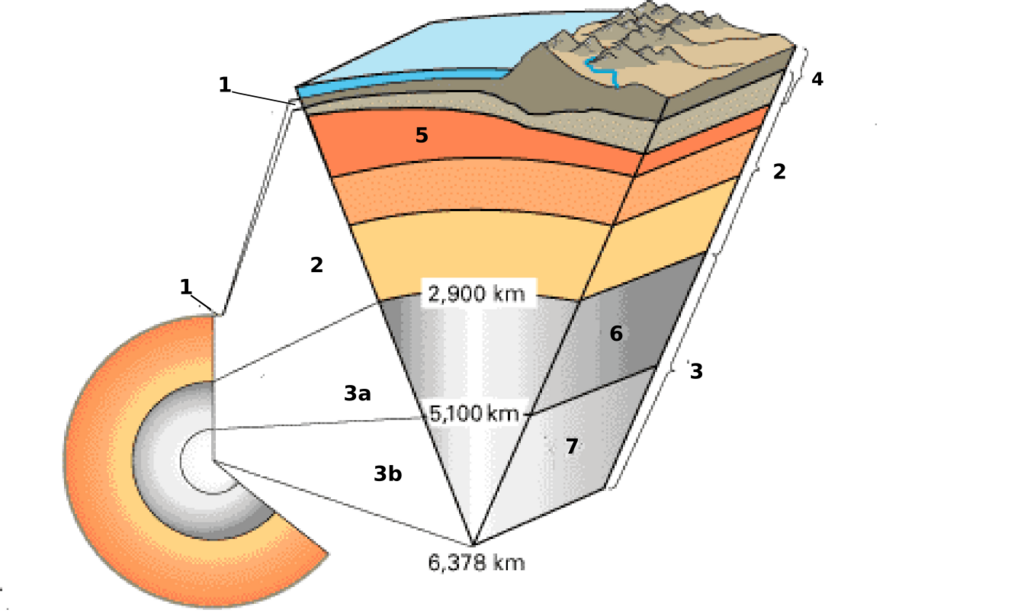
These layers aren't just stacked on top of one another. They differ dramatically in thickness, temperature, and what they're made of. Let's start from the outside and work our way in.
The Crust We Live On
The crust is Earth's outermost layer, the thin shell where all life exists. It's by far the thinnest layer, but its thickness varies. Under the continents, it can be up to 70 kilometers deep, while under the oceans, it might be only 5 kilometers thick.
There are two main types of crust:
- Continental crust: This is what makes up the landmasses. It's thicker, less dense, and primarily composed of rocks like granite.
- Oceanic crust: Found at the bottom of the oceans, this crust is thinner, denser, and made mostly of basalt, a dark volcanic rock.
Think of the crust as the skin of an apple—incredibly thin compared to the rest of the fruit, but it's where everything on the surface happens.
The crust is broken into large pieces called tectonic plates. The slow, constant movement of these plates is what causes earthquakes and volcanic eruptions, and over millions of years, it builds mountain ranges. While we won't go deep into plate tectonics here, just know that the crust is where the action is.
The Mantle and Core
Beneath the crust lies the mantle, a thick layer of solid rock that makes up about 84% of Earth's volume. It extends down nearly 2,900 kilometers. Though it's a solid, the rock in the mantle can slowly flow over geological timescales, a property called plasticity. This slow churning movement in the upper mantle is what drives the motion of the tectonic plates above it.
Mantle
noun
The region of the Earth's interior between the crust and the core, believed to consist of hot, dense silicate rocks.
At the very center of our planet is the core, which is divided into two parts.
The outer core is a layer of molten iron and nickel. The churning motion of this liquid metal generates Earth's magnetic field, which protects the planet from harmful solar radiation. Without it, life on the surface wouldn't be possible.
The inner core, despite being even hotter than the outer core, is a solid ball of iron and nickel. The immense pressure at the center of the Earth is so great that it forces the atoms into a solid state, even at temperatures hotter than the surface of the sun.
Each layer plays a crucial role. The crust provides the platform for life, the flowing mantle drives the movement of continents, and the core generates the magnetic field that shields us. Together, they make Earth a geologically active and habitable world.
Ready to check your understanding?
Which layer of the Earth is the thinnest and is where all life exists?
The slow, flowing movement of solid rock in which layer drives the motion of tectonic plates?
Now you have a foundational understanding of Earth's structure, from its thin, rocky crust to its intensely hot, solid core.