Motion and Dynamics Physics Fundamentals
Introduction to Kinematics
The Language of Motion
Physics is the study of how things move and interact. The branch of physics that describes motion itself, without getting into the forces that cause it, is called kinematics. It's like learning the grammar of movement. Before we can understand the story of why an object moves, we first need a clear way to describe how it moves.
The first step is to distinguish between two common words we often use interchangeably: distance and displacement.
distance
noun
The total length of the path traveled by an object.
Distance is a straightforward measure of how much ground an object has covered. If you walk 3 miles to a friend's house and 3 miles back, you've traveled a distance of 6 miles. It’s a scalar quantity, meaning it only has magnitude (a number) and no direction.
displacement
noun
The change in an object's position, measured as a straight line from the starting point to the ending point.
Displacement is different. It’s a vector quantity, which means it has both magnitude and direction. If you walk 3 miles to a friend's house and 3 miles back, you end up exactly where you started. Your total displacement is zero. Displacement only cares about your starting and ending points, not the path you took to get between them.
Speed and Velocity
Just as we distinguished between distance and displacement, we must do the same for speed and velocity. Speed is how fast you're going, while velocity is how fast you're going in a specific direction.
- Speed is a scalar quantity. It's the rate at which an object covers distance. A car traveling at 60 miles per hour has a speed.
- Velocity is a vector quantity. It's the rate at which an object's position changes (its displacement). That same car has a velocity of 60 miles per hour due east.
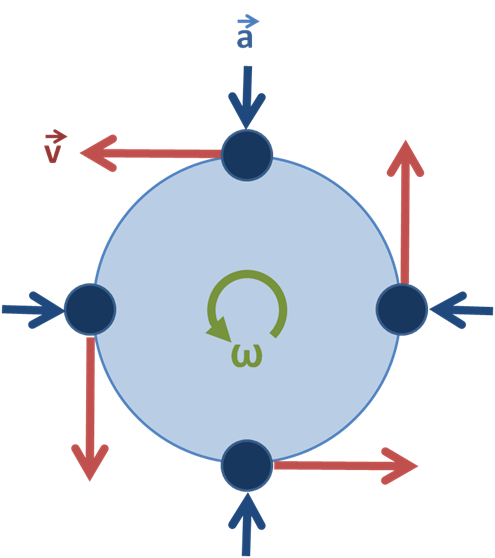
Imagine a race car on a circular track. It might maintain a constant speed of 100 mph. But its velocity is always changing because its direction is always changing. If it weren't, it would be driving in a straight line!
Acceleration
When an object's velocity changes, it is accelerating. Like velocity, acceleration is a vector—it has both magnitude and direction. Most people think of acceleration as just speeding up, but in physics, it's more than that. You are accelerating if you are:
- Speeding up (positive acceleration in the direction of motion)
- Slowing down (negative acceleration, or acceleration opposite the direction of motion)
- Changing direction (even if your speed is constant)
That race car on the circular track? It's constantly accelerating towards the center of the circle, even with a constant speed, because its direction of travel is constantly changing.
Equations for Constant Acceleration
Things get really interesting when we consider motion with constant acceleration, like an object falling under gravity (ignoring air resistance). For these situations, physicists have developed a set of powerful equations, often called the kinematic equations. They relate displacement (), initial velocity (), final velocity (), acceleration (), and time ().
Let's try an example. A ball is dropped from a tall building. If it starts from rest () and accelerates downwards due to gravity (), how fast is it going after 3 seconds? We can use the first equation: .
Graphs of Motion
A picture is worth a thousand words, and in kinematics, a graph is worth a thousand calculations. We can represent motion visually using position-time, velocity-time, and acceleration-time graphs.
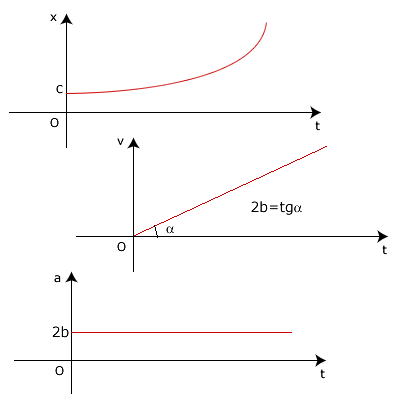
For a velocity-time graph, two key features tell us a lot:
- The slope of the line represents acceleration. A steep slope means high acceleration, a flat horizontal line means zero acceleration (constant velocity), and a negative slope means deceleration.
- The area under the curve represents displacement. You can find out how far an object has traveled by calculating the area between the line and the time axis.
Studying these graphs allows us to see the relationships between position, velocity, and acceleration instantly.
Now, let's put these ideas to the test with a few questions.
A person runs a full lap around a 400-meter circular track and ends up back at their starting line. What is their total displacement?
A car is traveling west at a constant speed of 50 mph. It then makes a turn and travels north, also at a constant speed of 50 mph. Which of the following statements is true?
This covers the essentials of describing motion in a straight line. By mastering displacement, velocity, and acceleration, you've built the foundation for tackling more complex movements and, eventually, the forces behind them.