Mormonism Origins and Beliefs
Founding and Early History
A Vision in the Woods
The story of the Latter-day Saints begins with a teenage boy named Joseph Smith. In the early 1820s, western New York was a hotbed of religious revivalism, a period known as the Second Great Awakening. Different Christian denominations competed for converts, leaving many people, including the young Smith, confused about which church was true.
In 1820, at the age of 14, Smith went into a grove of trees near his family's farm to pray for guidance. According to his account, he was visited by two divine beings, God the Father and Jesus Christ. They told him that none of the existing churches were correct and that he should join none of them. This event, known as the First Vision, is the foundational experience of the Latter-day Saint movement.
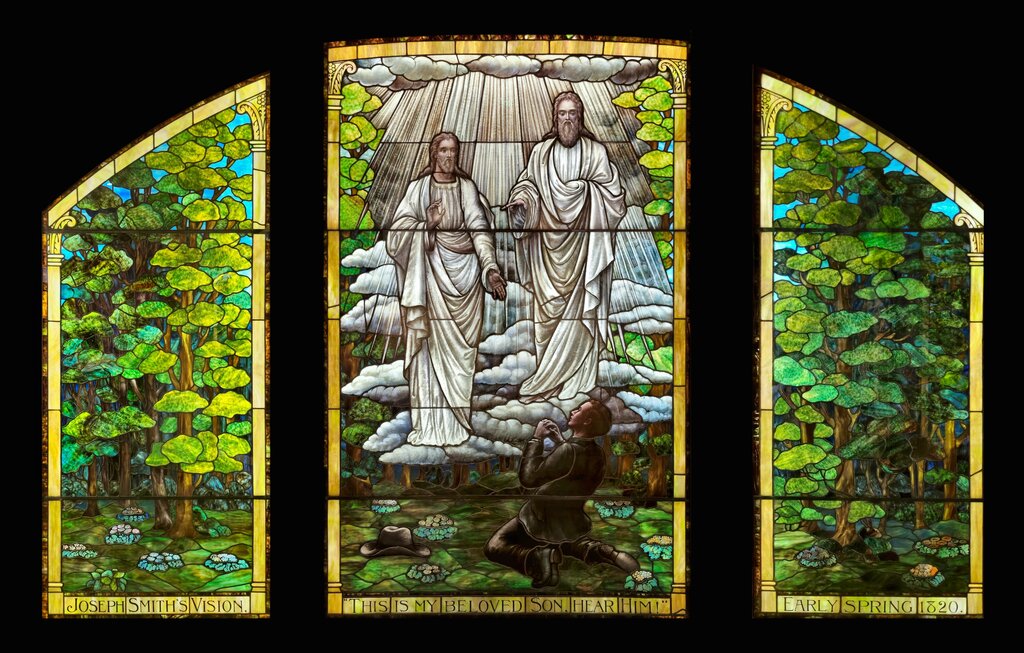
This vision set Smith on a path as a prophet, a person chosen to receive and share God's word. A few years later, Smith said he was visited by an angel named Moroni, who guided him to a set of buried golden plates. These plates, inscribed with an ancient text, would become the basis for a new volume of scripture.
A New Scripture
Joseph Smith claimed that with divine aid, including special instruments called the Urim and Thummim, he translated the characters on the golden plates. The resulting text, the Book of Mormon, was published in 1830. It tells the story of ancient peoples in the Americas, whom it describes as descendants of Israelites. The book presents their history and their interactions with a resurrected Jesus Christ, who is said to have visited them after his ascension in Jerusalem.

The Book of Mormon was a radical document. It positioned itself as a companion to the Bible, another testament of Jesus Christ, and provided a new, distinctly American religious narrative. Its publication was a pivotal moment. Shortly after, on April 6, 1830, Joseph Smith and a small group of followers formally organized the Church of Christ in Fayette, New York. This small congregation would grow into a global faith.
Building Zion
The early church members, who called themselves Saints, believed they were tasked with building "Zion," a holy city in preparation for the second coming of Jesus Christ. This mission led them on a series of westward migrations, driven by both divine revelation and intense persecution from their neighbors.
Their first major gathering place was Kirtland, Ohio. Here, they built their first temple and the church's leadership structure began to take shape. However, financial troubles, including the failure of a church-run bank, and dissent within the community caused many to leave. At the same time, another center was established in Jackson County, Missouri, which Smith identified as the center place of Zion.
Local residents in Missouri grew wary of the Saints' growing numbers, economic cooperation, and political power. Their opposition to slavery and their belief in continuing revelation also created significant friction.
Violent conflict erupted. Mobs drove the Saints from Jackson County in 1833 and later from the entire state of Missouri in 1838 following an extermination order issued by the governor. Bruised but not broken, the refugees fled east across the Mississippi River into Illinois.
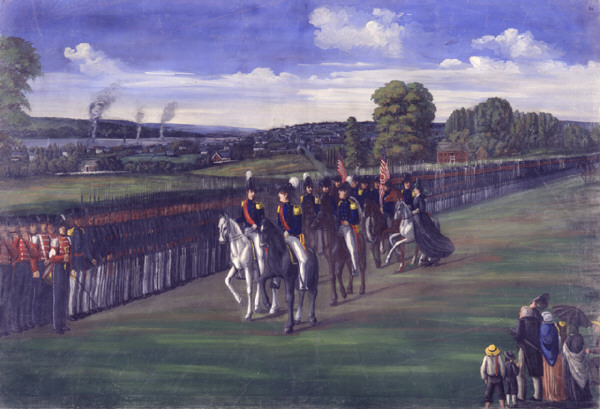
In Illinois, they founded the city of Nauvoo. For a time, it flourished, quickly becoming one of the largest cities in the state. The Saints were granted a liberal city charter that allowed them a high degree of autonomy, including their own court system and a militia known as the Nauvoo Legion. It was here that Smith introduced some of the faith's most distinctive and controversial teachings, such as baptism for the dead and plural marriage.
Crisis in Nauvoo
The very success and uniqueness of Nauvoo stoked fear and animosity among its neighbors. Internal dissent also grew, particularly over the secret practice of plural marriage. In 1844, a group of dissenters published a newspaper, the Nauvoo Expositor, exposing the practice and accusing Smith of abusing his power.
In response, Joseph Smith, acting as mayor, ordered the destruction of the newspaper's printing press. This act was seen by outsiders as a suppression of free speech and an attack on American principles. The state of Illinois intervened, charging Smith with treason.
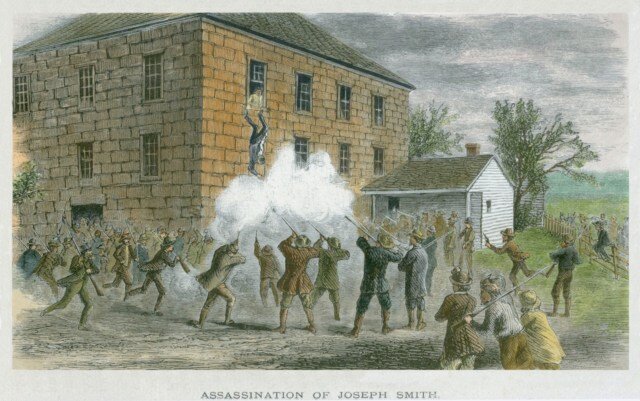
Joseph and his brother Hyrum surrendered to the authorities and were jailed in nearby Carthage, Illinois. On June 27, 1844, a mob with blackened faces stormed the jail and murdered both men.
The death of its founding prophet plunged the church into a succession crisis. Several figures claimed the right to lead. The majority of members ultimately followed Brigham Young, the senior apostle, who would lead them on their final, iconic trek west to the Salt Lake Valley. But the foundational era, shaped by Joseph Smith's visions, revelations, and ultimate martyrdom, had come to a violent end.
According to Joseph Smith's account, what was the primary message he received during his "First Vision" in 1820?
The Book of Mormon, published in 1830, describes the history of ancient peoples in the Americas and their interactions with a resurrected Jesus Christ.