Monte Carlo Simulations Practical Applications
Introduction to Monte Carlo Simulations
What Are Monte Carlo Simulations?
At its heart, a Monte Carlo simulation is a way to understand the potential outcomes of an uncertain event. Instead of solving a problem with a single, precise formula, you run a process over and over again with random inputs to see what range of results you get. Think of it as a computational way of playing out thousands of "what if" scenarios.
The name itself hints at this element of chance. It was coined in the 1940s by physicists working on the Manhattan Project, including Stanislaw Ulam and John von Neumann. They were trying to model the unpredictable behavior of neutrons, a problem too complex for standard mathematics at the time. The name is a nod to the Monte Carlo Casino in Monaco, a famous hub of games of chance. They needed a method to deal with uncertainty, and what's more uncertain than the roll of a die or the spin of a roulette wheel?
Randomness in Action
The core idea is to use randomness to solve problems that might seem deterministic. A classic example is using a Monte Carlo simulation to estimate the value of .
Imagine a square dartboard with a circle drawn perfectly inside it, touching all four sides. If you throw darts at this board completely at random, some will land inside the circle and some will land outside it but still within the square. Because you're throwing randomly, the ratio of darts inside the circle to the total number of darts thrown should be proportional to the ratio of the circle's area to the square's area.
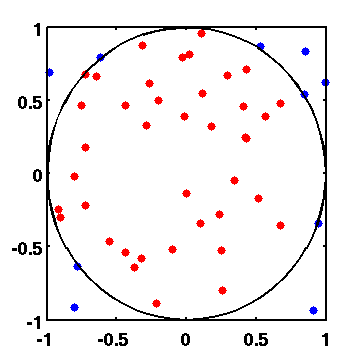
We know the formulas for these areas. Let's say the square has sides of length 2, so its area is . The circle's radius would be 1, making its area . The ratio of the areas is .
By running thousands or even millions of these random "dart throws" in a computer simulation, we can count how many land inside the circle and use that to get a surprisingly accurate estimate for . This works because of a fundamental principle in statistics.
The law of large numbers is fundamental to the Monte Carlo method, ensuring that as the number of simulations increases, the average of the results will converge to the expected value.
Essentially, the more times you repeat the random experiment, the more the average outcome will settle on the true answer. Each simulation is a small piece of evidence, and by gathering enough evidence, a clear picture emerges from the randomness.
Pros and Cons
So why use this method? Monte Carlo simulations are incredibly powerful for a few reasons.
They excel at modeling complex systems with many interacting, uncertain variables. Think about predicting stock prices, modeling traffic flow, or figuring out the probability of completing a big project on time. In these cases, a single clean formula just doesn't exist.
They are also flexible and conceptually straightforward. The basic process of defining inputs, running random trials, and aggregating the results can be applied to a vast range of problems across finance, engineering, science, and even art.
However, they aren't a perfect solution for every problem. Their primary limitation is that they are computationally expensive. To get a precise and reliable result, you often need to run millions or billions of simulations, which requires significant computing power and time. The quality of the result is also entirely dependent on the quality of the model and the random number generator. If your assumptions about the underlying probabilities are wrong, the simulation will give you a precise but incorrect answer.
Finally, Monte Carlo simulations provide a probabilistic answer, not a deterministic one. They tell you the likelihood of different outcomes, but they don't give you a single, exact number. For some problems, an approximation is all you need, but for others, an exact solution might be required.
The name 'Monte Carlo' simulation was chosen because:
When using a Monte Carlo simulation to estimate the value of π by 'throwing darts' at a square with an inscribed circle, what does the ratio of 'darts in the circle' to 'total darts thrown' approximate?
Monte Carlo methods provide a powerful framework for tackling uncertainty by embracing randomness. While not a universal tool, they are essential for solving complex problems where traditional formulas fall short.