Monetize Your Digital Library
Understanding Digital Libraries
The Library in Your Pocket
Think about your local library. It’s a physical place with shelves, books, and quiet reading corners. Now, imagine that library without walls, open 24/7, and accessible from your phone, tablet, or computer. That’s the core idea of a digital library.
A digital library is a managed collection of information, with associated services, where the information is stored in digital formats and accessible over a network. It’s more than just a website with a list of ebooks. It’s an organized system designed to help you find, borrow, and use a wide range of digital materials, from books and magazines to movies and music.
The journey from papyrus scrolls to digital files has been a long one. For centuries, knowledge was bound to physical objects. If you wanted to read a book, you had to go to the book. The rise of the internet changed everything. Just as music transitioned from vinyl records to streaming services, libraries began to embrace digital formats. Early projects in the 1990s focused on digitizing existing collections, making rare or fragile documents available to a global audience. Today, many new materials are “born digital,” created from the start as ebooks, audio files, or videos.
Physical vs. Digital Shelves
While both traditional and digital libraries aim to connect people with information, they operate in fundamentally different ways. A traditional library is defined by its physical location and collection. Its hours are limited, and access depends on your ability to physically visit.
A digital library, on the other hand, is boundless. It has no physical footprint in the traditional sense, and its doors are always open. The experience is different, too. You can't replicate the feeling of wandering through aisles of books, but you gain the power to search millions of texts in an instant.
| Feature | Traditional Library | Digital Library |
|---|---|---|
| Accessibility | Limited by physical location and hours | Available 24/7 from anywhere with an internet connection |
| Collection | Limited by shelf space; physical items | Virtually unlimited; digital files (ebooks, audio, video) |
| Borrowing | One person per item at a time | Can support multiple simultaneous users (depending on license) |
| Condition | Books can be worn, damaged, or lost | Files are pristine; no wear and tear |
| Search | Card catalogs, browsing shelves | Powerful keyword search across entire collections |
The core mission remains the same: to provide free and equitable access to information for everyone.
Why Go Digital?
The shift to digital offers powerful advantages for both readers and the institutions that serve them.
For users, the primary benefit is convenience. You can borrow a new bestseller while waiting for the bus or download an audiobook for a road trip without ever stepping inside a building. There are no late fees, because digital items simply return themselves when the loan period ends. Digital libraries also open up a world of accessibility. Readers can adjust font sizes, switch to high-contrast modes, or use text-to-speech features to have books read aloud.
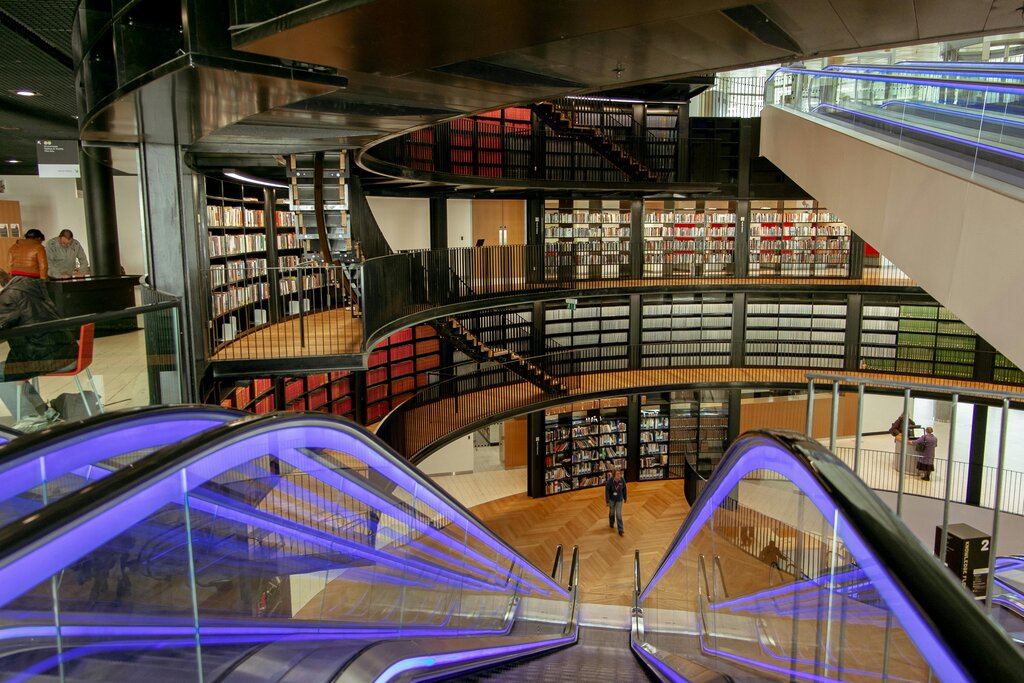
For the libraries themselves, going digital solves many logistical challenges. It reduces the need for vast physical storage space, which is often expensive to build and maintain. A digital file can't get lost, stolen, or damaged by a coffee spill. It also allows a library to serve a much broader community, reaching people who may be homebound, live far from a branch, or work unconventional hours. By analyzing borrowing data, librarians can gain instant insights into what their community is interested in, helping them make smarter decisions about which books and resources to acquire.
Platforms in Practice
Your local library card is the key that unlocks many of these digital services. Most public libraries partner with third-party platforms to manage their digital collections. You simply log in with your library credentials to start borrowing.
Here are a few of the most popular platforms you'll encounter:
Libby: Developed by OverDrive, Libby is one of the most common apps for borrowing ebooks and audiobooks. It has a clean, user-friendly interface and makes it easy to send books to your Kindle or read directly in the app.
Hoopla: This platform often works on a pay-per-use model for libraries, which means you might have a set number of borrows per month. The big advantage is that there are no waitlists. Its catalog includes not just books but also movies, TV shows, music albums, and comics.
Kanopy: If you're a film lover, Kanopy is a treasure trove. It specializes in streaming thoughtful and classic cinema, including independent films, foreign films, and documentaries from providers like The Criterion Collection and A24.
Open Library: This is a different kind of project. Run by the Internet Archive, Open Library's goal is to create “one web page for every book ever published.” It’s a massive, open catalog of books, and for those in the public domain or available through their controlled digital lending program, you can borrow and read them directly from the site.
Let's check your understanding of digital libraries.
What is the primary characteristic that defines a digital library?
A major advantage of digital libraries is that they have no late fees.
Digital libraries have transformed how we access information, blending the traditional mission of libraries with the boundless possibilities of the internet.