Monarchy and Covenant: A Deep Dive into 1 Kings
Succession and Solomon's Legitimacy
The Succession Problem
The story of a royal succession is rarely simple. For King David, it was a crisis. Nearing the end of his life, his kingdom lacked a clear heir. While the Davidic covenant promised an everlasting dynasty, it didn't specify which son would rule next. This uncertainty sets the stage for one of the Bible's most intense political dramas.
The narrative that unfolds, often called the Succession Narrative, spans from 2 Samuel 9 through 1 Kings 2. It’s not just a historical report; it's a masterfully crafted piece of political literature. Its primary goal is to explain and justify how Solomon, a younger son, ascended to the throne over his older brother, Adonijah.
The central tension is legitimacy. In the ancient world, the eldest son typically inherited power. Solomon’s claim was unusual and required a powerful justification to prevent civil war.
The Political Players
As David's health failed, the court split into factions. On one side was Adonijah, David's eldest surviving son. He acted decisively, gathering the support of Joab, the seasoned army commander, and Abiathar, a prominent priest. He hosted a sacrificial feast—a classic public move to proclaim his kingship—pointedly excluding those loyal to his rival, Solomon.
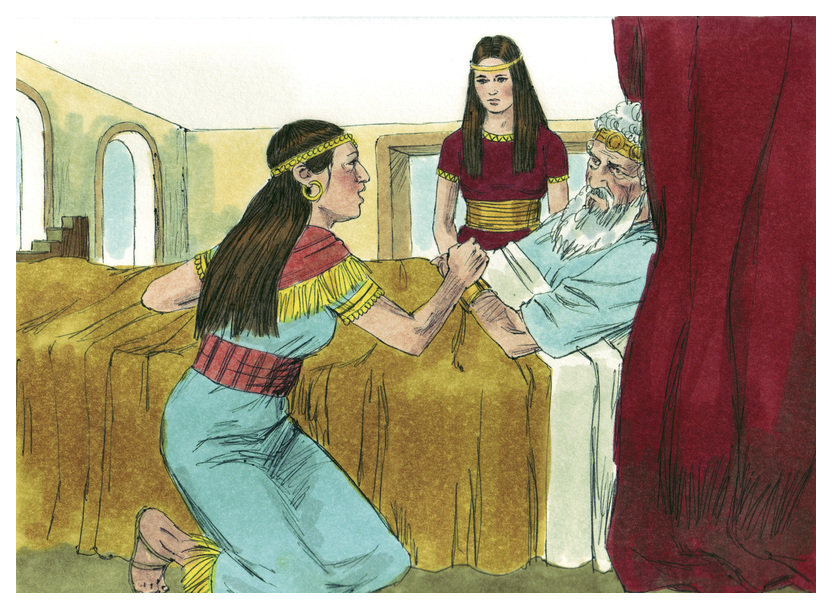
On the other side were Nathan the prophet and Bathsheba, Solomon's mother. They represented the counter-movement. Their strategy was not a public display of power, but a private conspiracy. They approached the frail King David, with Bathsheba reminding him of a supposed off-the-record promise to make Solomon king. Nathan then entered to corroborate her story, creating the impression of a crisis that only David could solve by acting immediately. Their actions blur the line between pious loyalty and shrewd political maneuvering.
Securing the Throne
The plan worked. Galvanized into action, David commanded that Solomon be anointed king immediately. The public ceremony, complete with a ride on the king's own mule, was a clear and undeniable transfer of power. Adonijah's faction dissolved in fear, and Solomon's reign began. But it wasn't secure yet.
Before his death, David gave Solomon a final charge in 1 Kings 2. On the surface, it reads like fatherly wisdom, urging his son to be faithful to God. But woven into the speech is a political hit list. David instructs Solomon to settle old scores with men he himself had been unable to eliminate.
This final charge serves a dual purpose: it allows David to die with a clean conscience while ensuring Solomon’s throne is free from threats. The dirty work is passed to the next generation.
Solomon carried out these instructions with ruthless efficiency. This consolidation of power is often called a political purge.
First, Adonijah made a fatal mistake. He asked Bathsheba to petition Solomon to give him Abishag, David’s young concubine, as a wife. In Ancient Near Eastern custom, possessing the king's harem was a claim to the throne itself. Solomon used this request as a pretext to execute him for treason.
Next was Joab. Hearing of Adonijah's death, he fled to the sanctuary of the altar, a place normally granting asylum. Solomon, however, ordered his execution there, arguing that Joab's past bloodshed had to be avenged to cleanse the house of David.
Finally, there was Shimei, a man who had cursed David years earlier. Solomon placed him under a form of house arrest in Jerusalem, forbidding him to leave. When Shimei eventually violated this order to retrieve runaway servants, Solomon had him executed, framing it as a just punishment for disobedience.
This narrative, therefore, does more than tell a story. It’s a theological and political argument for the legitimacy of Solomon’s rule. It frames a series of calculated political assassinations as the necessary fulfillment of David's final wishes and the establishment of divine justice. This violent and cunning beginning sets a complex tone for Solomon’s reign, which would be marked by both wisdom and profound failure.
What was the primary purpose of the biblical account known as the "Succession Narrative"?
Which group of individuals formed the core of Adonijah's faction in his bid for the throne?
With Solomon's rivals eliminated, the united monarchy entered a new era, built on a foundation of both divine promise and brutal political reality.