Moment of Inertia Explained
Introduction to Rotational Motion
Beyond Straight Lines
So far, we've talked about motion in a straight line, like a ball falling or a car driving down a road. But a lot of motion in the universe isn't linear. Think about a spinning figure skater, a planet orbiting the sun, or even a wheel on a bicycle. This is rotational motion, and it requires a new set of tools to describe.
Instead of tracking how far something has moved in meters, we need to track how much it has turned. We'll use angles to do this, building a rotational version of the concepts you already know: displacement, velocity, and acceleration.
Angular Displacement
When an object moves along a straight path, its change in position is called displacement. For an object that rotates, its change in angle is called angular displacement. It's the angle through which an object has turned. We represent it with the Greek letter theta, .
While we often use degrees in everyday life, in physics we almost always measure angles in radians. A radian is defined by the arc length it subtends on a circle. Specifically, one radian is the angle created when the arc length is equal to the circle's radius.
Because a circle's circumference is , a full rotation of 360 degrees is equal to radians. This might seem strange at first, but using radians simplifies the equations that connect rotational and linear motion.
Full Circle: radians Half Circle: radians
Angular Velocity
If you know how far a car has driven and how long it took, you can find its velocity. In the same way, if you know an object's angular displacement and the time it took to rotate, you can find its angular velocity.
angular velocity
noun
The rate at which an object rotates, measured as the change in angular displacement over time.
We use the Greek letter omega, , for angular velocity. Its formula is a direct parallel to linear velocity:
The unit for angular velocity is radians per second (rad/s). For example, a vinyl record spinning at 33 revolutions per minute (RPM) has a constant angular velocity. We can calculate it in rad/s:
Angular Acceleration
What happens when a spinning object speeds up or slows down? Just as a change in linear velocity is acceleration, a change in angular velocity is angular acceleration. We use the Greek letter alpha, , to represent it.
The formula, again, mirrors its linear counterpart:
The unit for angular acceleration is radians per second squared (rad/s²). When you turn on a ceiling fan, it has a positive angular acceleration as it gets up to speed. When you turn it off, friction and air resistance cause a negative angular acceleration, and it slows to a stop.
Connecting Linear and Angular Motion
Every point on a rotating object is also moving linearly. Think of a merry-go-round. Even though the entire ride has one angular velocity, a person on the outer edge is moving much faster (has a higher linear speed) than a person near the center. Why? Because they have to travel a larger circle in the same amount of time.
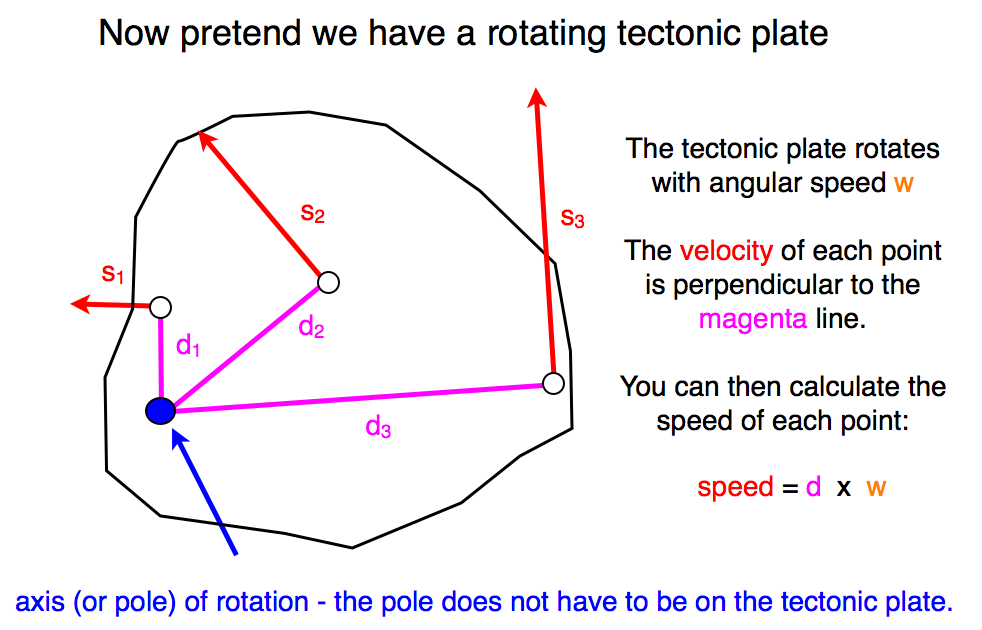
The relationship between an object's linear (or tangential) speed and its angular velocity depends on its distance from the axis of rotation, . Here are the key connections. Notice how simple they become when using radians.
| Concept | Linear (Tangential) | Angular | Relationship |
|---|---|---|---|
| Displacement | (arc length) | ||
| Velocity | |||
| Acceleration |
These simple equations bridge the gap between straight-line motion and rotation. They show that for any rigid rotating body, every part has the same angular velocity and angular acceleration, but the linear speed and acceleration of a point depend on how far it is from the center.
What does angular displacement measure?
A car wheel turns 180 degrees. What is its angular displacement in radians?
These three concepts—angular displacement, velocity, and acceleration—are the building blocks for describing any kind of rotational motion.