Molex Optical Solutions Interview Prep
DWDM Network Architecture
The DWDM Hardware Stack
Dense Wavelength Division Multiplexing (DWDM) isn't just a concept; it's a physical system built from a few key hardware components. Together, they create a high-capacity optical highway. Let's trace the path of a data signal through this stack.
Everything starts at the transponder. Think of it as the on-ramp to the DWDM network. It takes a standard, client-side signal—like a 100G Ethernet signal from a router—and converts it into a very specific wavelength of light. This “color” is its unique lane on the fiber optic highway. Each data stream gets its own color.
Next, these individual colored signals are combined by a multiplexer (Mux). A Mux acts like a prism in reverse, taking many light beams of different colors and merging them into a single, dense beam to be sent down one fiber optic cable. This is the core of DWDM: packing dozens of channels onto a single strand of glass.
DWDM allows dozens of wavelengths on a single fiber pair, each carrying 100G/400G/800G (and beyond).
Of course, over long distances, light signals lose strength. To combat this attenuation without costly conversions, the network uses optical amplifiers. The most common type is the EDFA (Erbium-Doped Fiber Amplifier). An EDFA boosts the power of all the different light wavelengths simultaneously, directly in their optical form. This allows signals to cross continents.
At the destination, a demultiplexer (DeMux) performs the opposite function of the Mux. It separates the combined light beam back into its individual colored channels. Each channel is then sent to a corresponding transponder, which converts the specific wavelength back into a standard client-side signal for the receiving equipment.
Carving Up the Spectrum
Fiber optic glass isn't equally transparent to all wavelengths of light. DWDM systems operate in specific spectral windows where signal loss (attenuation) is minimal. The primary window used for long-haul transmission is the C-band (Conventional band), which roughly spans from 1530 to 1565 nanometers (nm). This is the traditional workhorse of optical networking, offering the best performance for amplification by EDFAs.
As data demands exploded, the C-band started to get crowded. To increase capacity, network operators expanded into the adjacent L-band (Long band), which covers approximately 1565 to 1625 nm. Think of it as adding a whole new set of lanes to the optical highway. Using both C-band and L-band effectively doubles the number of channels a single fiber can carry. This expansion is critical for hyperscale data center interconnects and national telecom backbones where maximizing fiber capacity is paramount.
Flexible Traffic Management
In a simple point-to-point link, a Mux/DeMux pair works fine. But modern networks are complex webs, not straight lines. Data needs to be dropped off at intermediate cities or rerouted based on traffic, all without tearing down the entire network. This is the job of a ROADM, or Reconfigurable Optical Add-Drop Multiplexer.
A ROADM is an intelligent, remote-controlled switching node. It can look at the multi-wavelength signal coming in and perform three key actions on a per-wavelength basis:
- Drop: Selectively pull a specific wavelength out of the main fiber, convert it to a client signal, and deliver it to the local site.
- Add: Introduce a new wavelength carrying local traffic onto the main fiber.
- Pass-through: Allow all other wavelengths to continue on their journey, untouched, to the next node.
This reconfigurability is what makes modern optical networks so powerful and resilient. The magic inside a ROADM is a component called a (WSS). A WSS is what physically steers the individual light beams from an input fiber to the desired output fiber (e.g., to the 'drop' port or the 'pass-through' fiber).
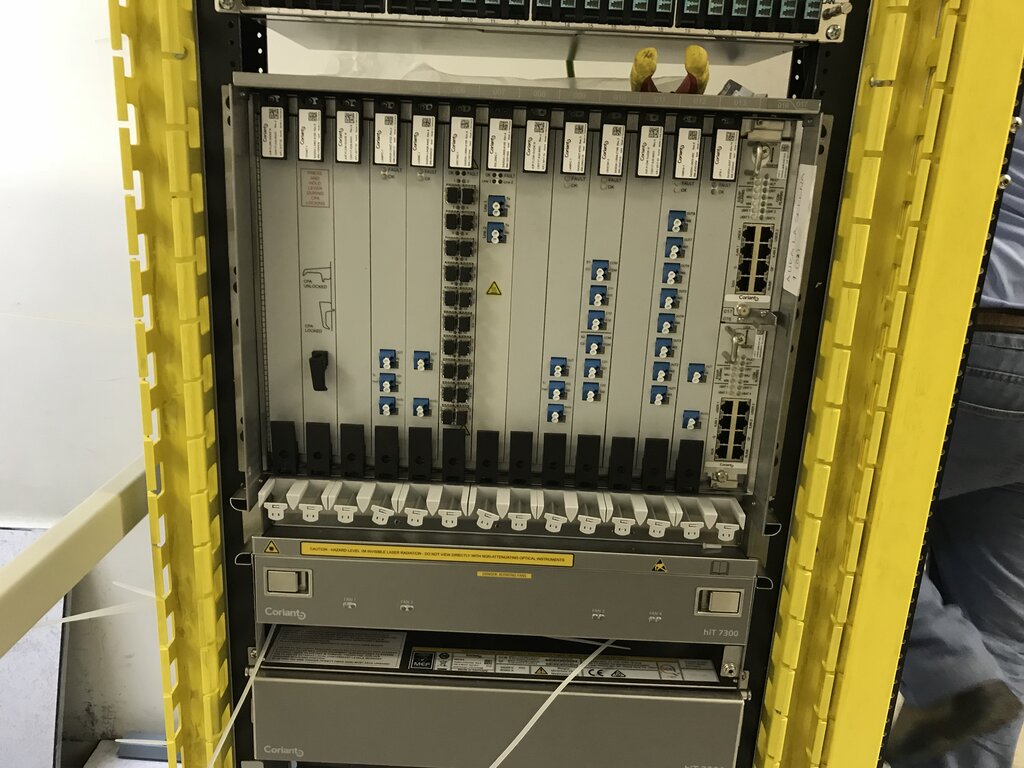
Finally, to ensure everything is working correctly, DWDM systems use Optical Channel Monitoring (OCM). An OCM is a built-in diagnostic tool. It taps a small fraction of the light from the fiber and uses an optical spectrum analyzer to check the power and wavelength of each channel. This allows network operators to verify that all signals are present, at the right power level, and not interfering with each other, ensuring the health and stability of the network.
Understanding this hardware stack—from transponders creating the signal to ROADMs directing it and EDFAs boosting it—is the foundation for planning and managing high-capacity optical networks.