Molecular Orbital Theory Explained
Atomic Orbitals
Electron Addresses
In the old Bohr model of the atom, electrons circle the nucleus in neat, planet-like orbits. It’s a simple picture, but quantum mechanics revealed a more complex and interesting reality. Electrons don't follow fixed paths. Instead, they exist in regions of space where they are most likely to be found. These regions are called atomic orbitals.
An atomic orbital is a three-dimensional region around the nucleus that indicates the probable location of an electron. Think of it as an electron's home address.
Each orbital has a characteristic shape and energy level. We label these orbitals with letters: s, p, d, and f. These letters come from old descriptions of spectral lines but now serve as labels for the different shapes.
Orbital Shapes
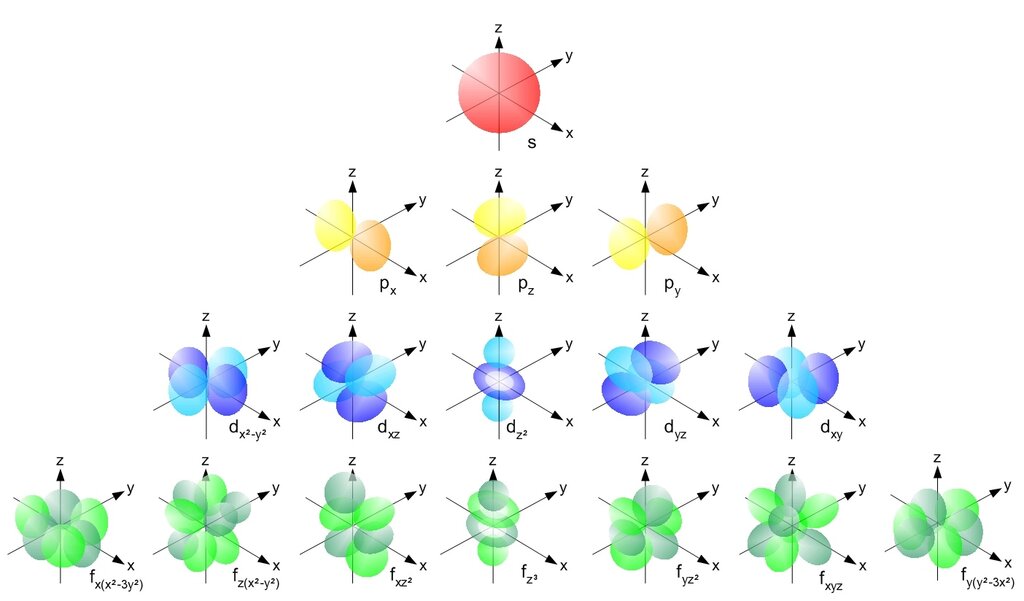
The simplest type is the s orbital. It's spherical, like a ball centered on the nucleus. For any given energy level, there is only one s orbital. The higher the energy level (like 1s, 2s, 3s), the larger the sphere.

Next are the p orbitals. These are dumbbell-shaped and come in sets of three for each energy level (starting from the second level). The three p orbitals are oriented at 90-degree angles to each other along the x, y, and z axes. We call them , , and .
The d orbitals and f orbitals have more complex shapes. There are five d orbitals and seven f orbitals per energy level. The d orbitals often look like four-leaf clovers, with one exception that resembles a dumbbell with a donut around the middle. The f orbitals are even more intricate.
Filling the Orbitals
How do electrons fill these orbitals? They follow a few key rules that determine an atom's electron configuration—the specific arrangement of its electrons.
It’s essential for students to understand how electrons are arranged in shells, subshells and orbitals, and the order orbitals are filled.
The first rule is the Aufbau principle (from the German word for "building up"). It states that electrons fill the lowest energy orbitals available before moving to higher energy orbitals. This makes the atom as stable as possible.
The general order of filling is: 1s, 2s, 2p, 3s, 3p, 4s, 3d, 4p, 5s, 4d, 5p, 6s, 4f, 5d, 6p, 7s, 5f, 6d, 7p
Notice how the 4s orbital fills before the 3d orbital. This overlap in energy levels is a key feature of electron configurations for larger atoms.
The second rule is the Pauli exclusion principle. It's simple but crucial: an atomic orbital can hold a maximum of two electrons, and those two electrons must have opposite spins. We often represent spin with arrows, one pointing up (↑) and one pointing down (↓).
No two electrons in an atom can have the same set of four quantum numbers. Since two electrons in the same orbital have the same first three quantum numbers, their fourth (spin) must be different.
Finally, we have Hund's rule. This rule applies when filling orbitals with the same energy, like the three p orbitals or the five d orbitals. It states that you place one electron in each of these orbitals before you start pairing them up. Furthermore, the single electrons in separate orbitals will have the same spin.
Let's see this in action for a nitrogen atom, which has 7 electrons.
- The first two electrons fill the 1s orbital: $1s^2$ (↑↓)
- The next two fill the 2s orbital: $2s^2$ (↑↓)
- The remaining three electrons go into the 2p orbitals. According to Hund's rule, one electron goes into each of the three 2p orbitals with the same spin: $2p^3$ (↑)(↑)(↑)
The full electron configuration for nitrogen is $1s^22s^22p^3$.
| Orbital | Number of Orbitals | Max Electrons |
|---|---|---|
| s | 1 | 2 |
| p | 3 | 6 |
| d | 5 | 10 |
| f | 7 | 14 |
Time to check your understanding.
What is the characteristic shape of a p orbital?
Which rule dictates that when filling a set of orbitals with the same energy, electrons will occupy separate orbitals before pairing up?
These principles govern the structure of every atom, which in turn determines how they interact to form the world around us.