Molecular Dynamics Simulation Essentials
Introduction to Molecular Dynamics
What is Molecular Dynamics?
Imagine trying to understand a complex dance with thousands of dancers. Watching from a distance gives you a general idea, but you miss the intricate steps and interactions. What if you could create a movie where you could follow every single dancer, see how they move, and predict their next step based on who they're next to? Molecular dynamics (MD) is a lot like that, but for atoms and molecules.
It’s a powerful computer simulation method that lets us watch how atoms and molecules move and interact over time. By observing these movements, we can understand the properties of materials and biological systems on a fundamental level. It's like having a computational microscope that can see things far too small and fast for any real microscope to capture.
The goal of MD is to predict the future state of a system of particles by calculating the trajectory of every atom.
The Rules of the Game
At its core, molecular dynamics is surprisingly simple. It relies on a law of physics you likely learned in high school: Newton's second law of motion. This law states that the force on an object is equal to its mass times its acceleration ().
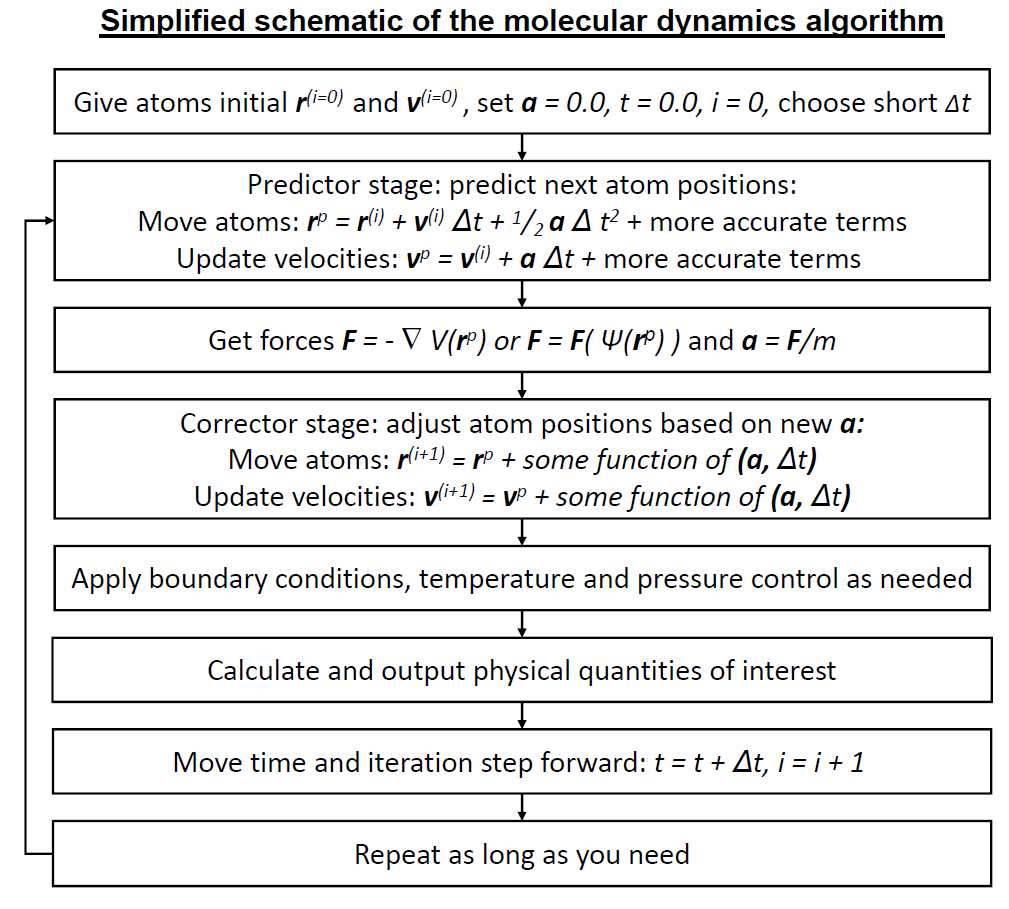
In an MD simulation, each atom is a particle. For every single atom () in our system, we calculate the total force () acting on it from all the other atoms. Since we know the atom's mass (), we can use Newton's equation to find its acceleration ().
Once we have the acceleration, we can predict the atom's new position () and velocity a tiny fraction of a second later. Then, we do it all over again. We recalculate the forces in the new arrangement, find the new accelerations, and move the atoms again. By repeating this process millions of times, we build a movie, one frame at a time, showing the system's evolution.
Modeling the Interactions
This all sounds great, but where do the forces come from? We can't measure them directly. Instead, we use a model called a potential energy function, or a force field. This is a set of mathematical equations that describes the potential energy of the system based on the positions of all its atoms.
Think of atoms as being connected by tiny, invisible springs. The force field describes the stiffness and preferred length of these springs (bonds), the angles they like to form, and how they attract or repel each other from a distance.
The force is simply the negative gradient of the potential energy. In simpler terms, atoms are always being pushed and pulled to move towards a state of lower energy. For example, two atoms connected by a chemical bond have a preferred distance. The force field applies a force that pulls them together if they are too far apart and pushes them away if they are too close, just like a spring.
Force Field
noun
A set of parameters and mathematical functions used in molecular dynamics to describe the potential energy of a system of particles.
A typical force field includes terms for bonds, angles, torsions (rotations around bonds), and non-bonded interactions like van der Waals forces and electrostatic interactions. Choosing the right force field is crucial for getting a realistic simulation.
Keeping It Real
If we just let our atoms fly around according to Newton's laws, the simulation wouldn't be very realistic. In the real world, molecular systems are usually at a specific temperature and pressure. A simulation needs to mimic these conditions.
To do this, MD simulations use algorithms called thermostats and barostats.
A thermostat controls the temperature. Temperature is a measure of the average kinetic energy of the particles. If the atoms are moving too fast (the system is too hot), the thermostat gently slows them down. If they're moving too slowly (too cold), it gives them a little nudge to speed them up. This ensures the simulation stays at the desired temperature.
A barostat does the same thing for pressure. It adjusts the volume of the simulation box. If the pressure is too high, the box expands slightly to give the atoms more room. If it's too low, the box shrinks. This keeps the system at a constant, realistic pressure.
This level of control allows scientists to simulate systems under conditions that match real-world experiments, making the results much more meaningful.
What fundamental law of physics forms the basis for calculating the movement of atoms in a classical molecular dynamics simulation?
In the context of MD, what is a 'force field'?
Molecular dynamics has a rich history, starting in the 1950s with simple models of hard spheres. Today, it's used in countless fields. Chemists use it to design new drugs by simulating how they bind to proteins. Materials scientists use it to understand how cracks form in metals or to design new polymers. Biologists use it to watch proteins fold into their functional shapes.
By combining fundamental physics with powerful computers, MD gives us a unique window into the molecular world, revealing the dynamic dance that underlies nearly everything around us.