Molecular Dynamics of Allelic Segregation
Molecular Meiotic Mechanisms
The Synaptonemal Complex
The precise alignment of homologous chromosomes, or synapsis, is not a passive event. It is actively managed by a zipper-like protein structure called the synaptonemal complex (SC). This tripartite scaffold assembles between homologous chromosomes during prophase I, consisting of two lateral elements derived from the chromosome axes and a central region filled with transverse filaments. The lateral elements, primarily composed of proteins like SYCP2 and SYCP3, form the foundation along each homologue. Bridging the gap are transverse filament proteins, such as SYCP1, which interlock to effectively 'zip' the homologues together.
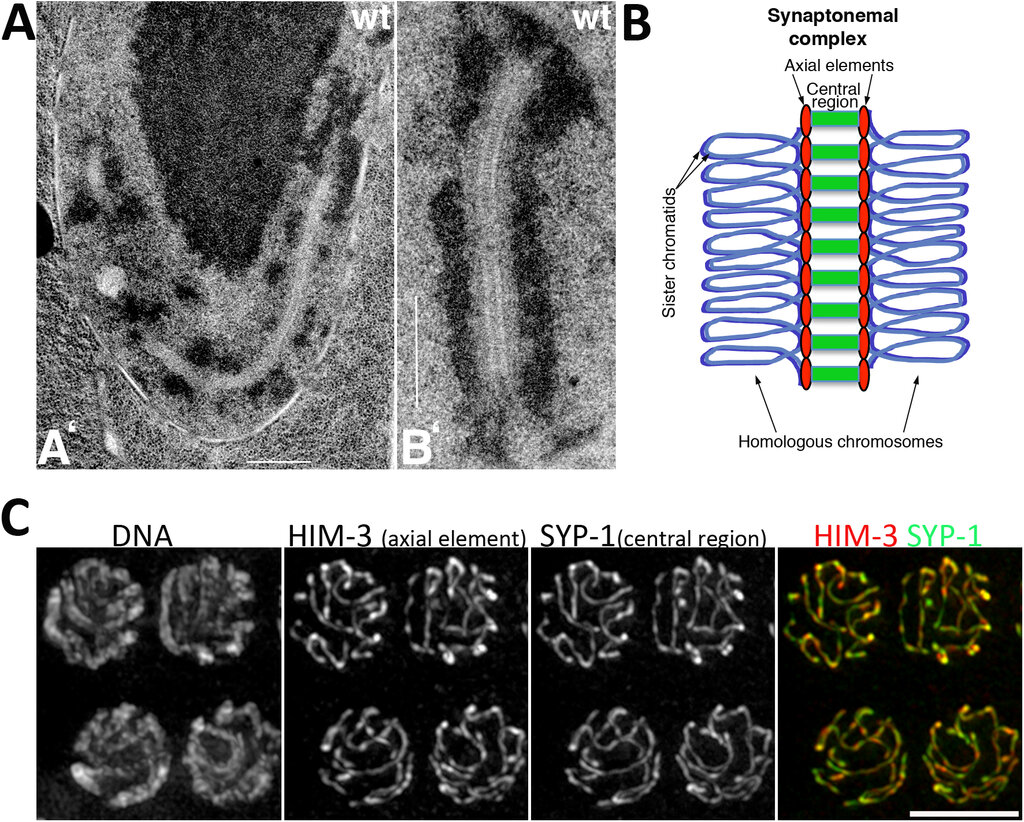
The SC is more than just molecular glue. It creates a microenvironment that is essential for processing recombination intermediates into crossovers. It spatially organises the enzymatic machinery needed for DNA exchange and enforces crossover interference, the phenomenon where one crossover event suppresses the formation of another nearby. While the initiation of double-strand breaks by the Spo11 protein precedes SC formation, the complex is critical for ensuring that at least one crossover, or chiasma, forms per bivalent, which is vital for proper segregation.
Cohesin's Guiding Hand
The entire meiotic process relies on the stepwise removal of cohesin, the protein complex that holds sister chromatids together. Loaded during S phase, meiotic cohesin contains a specific subunit, Rec8, which replaces the mitotic Scc1. This distinction is fundamental to the two-step division of meiosis.
During anaphase I, cohesin along the chromosome arms is cleaved by the enzyme separase. This resolves the chiasmata and allows homologous chromosomes to be pulled to opposite poles. However, cohesin at the centromeres must remain intact to keep sister chromatids joined for meiosis II. This selective preservation is orchestrated by the protein Shugoshin (Sgo).
Shugoshin acts as a guardian of the centromere. It recruits Protein Phosphatase 2A (PP2A), which dephosphorylates Rec8 specifically in the centromeric region. Phosphorylation is a prerequisite for separase-mediated cleavage, so by removing these phosphate groups, Sgo-PP2A renders centromeric cohesin resistant to degradation. This ensures that when the spindle pulls on the homologous chromosomes, only the arm cohesion is lost, while sister chromatids remain tethered at their centromeres, ready for the second meiotic division.
The key to meiosis is the two-step loss of cohesion: first along the arms in anaphase I, then at the centromeres in anaphase II.
The Spindle's Watchful Eye
To prevent catastrophic chromosome mis-segregation, the cell employs a surveillance mechanism known as the Spindle Assembly Checkpoint (SAC). The SAC's job is to delay the onset of anaphase until every chromosome is properly attached to the spindle microtubules. In mitosis, it monitors the attachment of kinetochores from sister chromatids to opposite poles. Meiosis I presents a unique challenge.
Here, sister kinetochores function as a single unit (co-orientation) and must attach to microtubules from the same spindle pole, while the homologous pair's kinetochores attach to opposite poles (bi-orientation). The SAC does not sense attachment directly but rather the consequence of correct attachment: tension. Chiasmata hold the homologous chromosomes together, so when spindle microtubules pull on the kinetochores, this creates physical tension across the bivalent. The SAC detects this tension as a signal that the chromosomes are correctly bi-oriented. If tension is absent, as in the case of an unattached or improperly attached chromosome, the SAC remains active.
An active SAC prevents the activation of the Anaphase-Promoting Complex (APC/C), a ubiquitin ligase that targets key proteins for destruction. One of these targets is Securin, an inhibitor of separase. By keeping the APC/C off, the SAC ensures Securin remains present, separase stays inhibited, and arm cohesin is not cleaved. This provides the cell with crucial time to correct any attachment errors, ensuring the faithful segregation of homologous chromosomes and preserving the integrity of the genome.
What is the primary function of the synaptonemal complex during meiosis I?
Which protein is specifically responsible for protecting cohesin at the centromeres from cleavage during anaphase I?
These interlocking molecular systems, from the structural support of the SC to the precise regulation of cohesin and the vigilant oversight of the SAC, form the physical basis of Mendel's Law of Segregation. They ensure that homologous chromosomes pair, exchange genetic information, and then segregate into different daughter cells with remarkable fidelity.