Molecular Dynamics of Allelic Segregation
Synaptonemal Complex Dynamics
The Synaptonemal Complex Scaffold
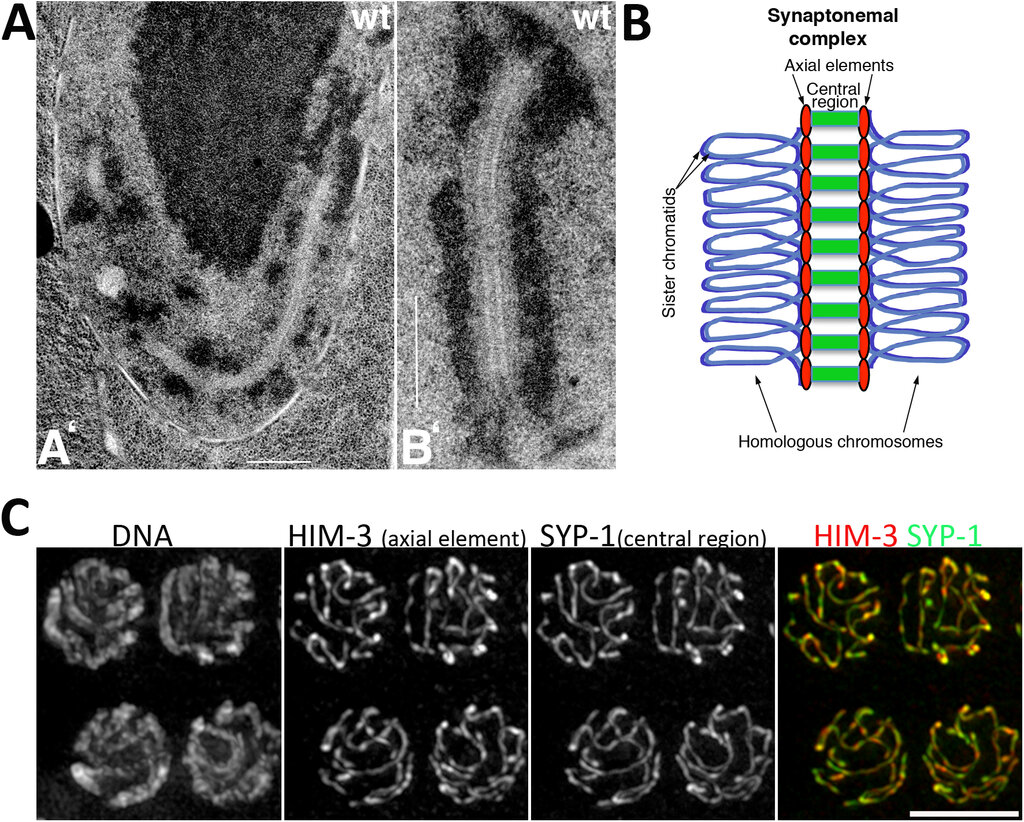
The precise segregation of homologous chromosomes, the physical basis of Mendelian inheritance, is orchestrated by a remarkable proteinaceous structure: the synaptonemal complex (SC). This tripartite ladder-like assembly forms between homologous chromosomes during prophase I, acting as a scaffold to mediate synapsis and facilitate recombination. The structure consists of two parallel lateral elements, each associated with one of the homologous chromosomes, and a central region that bridges them.
The lateral elements are built upon axial elements, which form first. These are primarily composed of the proteins SYCP2 and SYCP3, which polymerise along the chromosome cores during the leptotene stage. The central region is then constructed, with the key player being SYCP1 a protein whose long coiled-coil domains act as transverse filaments, zippering the two lateral elements together. This creates a stable, intimate association that persists through the pachytene stage.
Assembly, Stabilisation, and Homology
The assembly of the SC is a stepwise process that defines the progression from leptotene to pachytene. Initially, in leptotene, the axial elements form from SYCP2 and SYCP3 along each individual chromosome. As the cell enters zygotene, synapsis begins. This is not a random zippering; it is the culmination of a homology search process that brings corresponding chromosome regions into close proximity. The SC then begins to form at these points of contact, with SYCP1 molecules bridging the gap between the axial elements, which are now referred to as the lateral elements of the mature SC.
By the pachytene stage, synapsis is complete, and the SC extends along the entire length of the bivalent, except at the centromeres and telomeres in some organisms. While the SC is essential for stabilising homologous pairing, it's not the primary driver of the homology search itself. The initial recognition is thought to involve dynamic probing of the nuclear space and interactions between uncut DNA strands, with the SC forming only after homology is established, effectively locking the correct partners in place for recombination.
Quality Control and Crossover Regulation
The integrity of the SC is critical for successful meiosis, and cells have evolved mechanisms to monitor it. The pachytene checkpoint is a quality control system that surveys for defects in both synapsis and recombination. If chromosomes fail to synapse correctly, or if DNA double-strand breaks formed to initiate recombination are not repaired properly, the checkpoint can be activated. This typically leads to cell cycle arrest and apoptosis, preventing the formation of aneuploid gametes. The checkpoint machinery involves kinases like ATR, which localise to unsynapsed chromosome regions.
The SC is not merely a static scaffold; its physical properties influence genetic outcomes. There is a direct correlation between the physical length of the SC and the number of crossovers that occur. Longer chromosomes, and thus longer SCs, generally have more recombination events. However, the SC also provides the structural framework for crossover interference, the phenomenon where one crossover event inhibits the formation of another nearby. This ensures crossovers are spaced out, which is crucial for proper chromosome segregation at Anaphase I. The SC's structure is thus a key determinant in the precise partitioning of alleles.
What is the primary protein responsible for 'zippering' the two lateral elements of the synaptonemal complex together?
During which stage of prophase I does the synaptonemal complex complete its formation, extending along the entire length of the bivalent?
Understanding the SC's dynamic assembly and regulatory functions is key to appreciating the molecular machinery that underpins Mendelian genetics.