Molecular Dynamics and Chemical Logic
Periodicity and Bonding
Why the Table Works
The periodic table isn't just a catalog of elements; it's a predictive map of chemical behavior. The patterns we see, from atomic size to reactivity, all stem from the interplay between an atom's nucleus and its electrons. The key to understanding these trends is the concept of effective nuclear charge, or .
Imagine the nucleus as a powerful magnet and the electrons as metal filings. The electrons in the outermost shell, called valence electrons, are the most important for chemical reactions. However, they don't feel the full magnetic pull of the nucleus. The inner-shell electrons get in the way, creating a shielding effect that partially cancels out the positive charge of the protons.
This simple relationship explains a lot. As you move from left to right across a period, you're adding protons to the nucleus, increasing . But since you're adding electrons to the same valence shell, the amount of shielding () doesn't change much. The result? increases, pulling the valence electrons in more tightly.
Conversely, moving down a group adds a whole new shell of electrons. While the nuclear charge increases significantly, the added shell of inner electrons dramatically increases the shielding effect. The valence electrons are now farther from the nucleus and feel a weaker pull.
Predicting Atomic Behavior
Understanding effective nuclear charge allows us to predict several key properties without memorizing facts for every single element.
Atomic Radius: Decreases across a period as the stronger pulls the electron shell closer. It increases down a group because you're adding new, larger electron shells.
Ionization Energy: The energy needed to remove an electron. This increases across a period because a higher holds onto electrons more tightly. It decreases down a group because the valence electrons are farther away and better shielded, making them easier to remove.
Electron Affinity: The energy change when an atom gains an electron. Atoms with a high , like those on the upper right of the table, tend to have a more negative (more favorable) [{
}] because they can strongly attract a new electron into their valence shell.
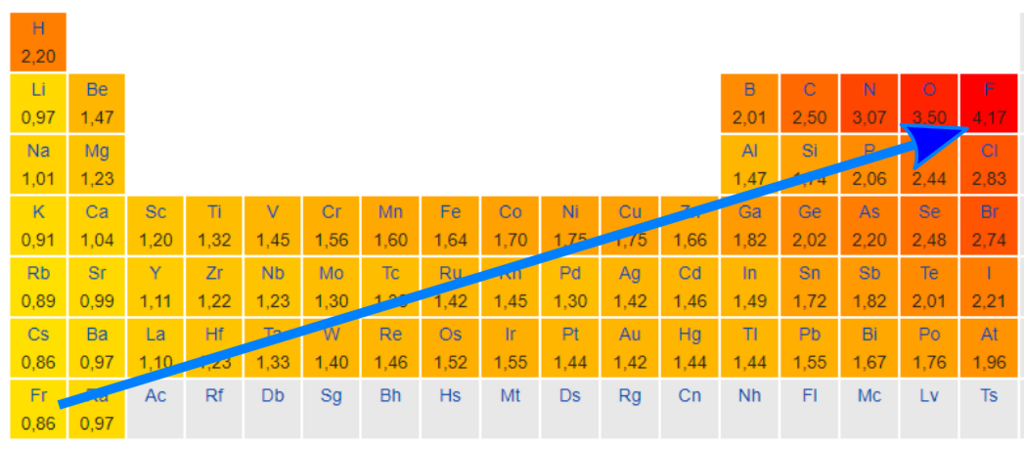
These properties culminate in the most important trend for bonding: electronegativity. This isn't a property of an isolated atom, but rather a measure of how strongly an atom pulls on shared electrons within a chemical bond. Developed by , it's scored on a scale from about 0.7 (Francium) to 4.0 (Fluorine). The trend mirrors ionization energy, increasing to the top right of the table.
The Spectrum of Bonding
The difference in electronegativity between two atoms is the single best predictor of the type of bond they will form. It’s not a set of rigid categories, but a continuous spectrum.
| Electronegativity Difference (ΔEN) | Predominant Bond Type | Electron Behavior |
|---|---|---|
| > 1.7 | Ionic | Transferred |
| 0.4 – 1.7 | Polar Covalent | Unequally Shared |
| < 0.4 | Nonpolar Covalent | Equally Shared |
When a metal with low electronegativity (like sodium) meets a nonmetal with high electronegativity (like chlorine), the difference is huge. Chlorine strips the valence electron from sodium, forming a positive ion (Na⁺) and a negative ion (Cl⁻). The electrostatic attraction between these opposite charges is an ionic bond.
These ions arrange themselves into a highly ordered, three-dimensional crystal lattice. The strength of this lattice is measured by its lattice energy, the energy required to separate one mole of the solid compound into its gaseous ions. Higher charges and smaller ionic radii lead to a stronger attraction and greater lattice energy.
When two atoms have similar electronegativities, neither can win the tug-of-war for electrons. Instead, they share them. This sharing is a covalent bond. If the sharing is perfectly equal (like in O₂ or N₂), it’s a nonpolar covalent bond. If one atom is slightly more electronegative (like the oxygen in H₂O), it pulls the shared electrons closer, creating a slight negative charge on its end and a slight positive charge on the other. This is a polar covalent bond, which results in a dipole moment.
Predicting Molecular Shape
Once we know how atoms are bonded, we can predict the 3D shape of the resulting molecule. The guiding principle is the (VSEPR) theory. It's a simple but powerful idea: electron pairs in the valence shell of a central atom repel each other and will arrange themselves to be as far apart as possible.
The key is to count the number of "electron domains" around the central atom. An electron domain is just a region of electron density, which can be a single bond, a double bond, a triple bond, or a lone pair of electrons. Each counts as one domain.
The distinction between electron geometry (the arrangement of all electron domains) and molecular geometry (the arrangement of only the atoms) is important. If there are no lone pairs, the two are the same. But lone pairs exert a stronger repulsive force than bonding pairs, compressing the bond angles and changing the final shape of the molecule. For example, both water (H₂O) and ammonia (NH₃) have four electron domains, giving them a tetrahedral electron geometry. But the two lone pairs on water bend the molecule significantly, while ammonia's single lone pair results in a trigonal pyramidal shape.
As you move from left to right across a period on the periodic table, why does the effective nuclear charge () generally increase?
Based on periodic trends, which of these compounds would be expected to have the highest lattice energy?
By starting with an element's position on the periodic table, we can deduce its fundamental properties. These properties, driven by effective nuclear charge, allow us to predict how it will bond and what shape the resulting molecule will take. This predictive power is what makes the periodic table the most essential tool in chemistry.