Molecular Docking and Simulation Fundamentals
Introduction to Molecular Docking
The Molecular Handshake
In the world of biology, molecules are constantly interacting. An enzyme grabs a specific sugar to break it down. A hormone travels through the bloodstream and fits perfectly into a receptor on a cell, delivering a message. These interactions are incredibly precise, like a key fitting into a specific lock. This process is called molecular recognition, and it's the foundation of almost every process in our bodies.
Molecular docking is a computational method that simulates this natural handshake. It's a way to predict how two molecules will bind together. We usually call the smaller molecule the 'ligand' and the larger one, often a protein, the 'receptor'. Using computer models, we can test millions of potential handshakes without ever stepping into a wet lab.
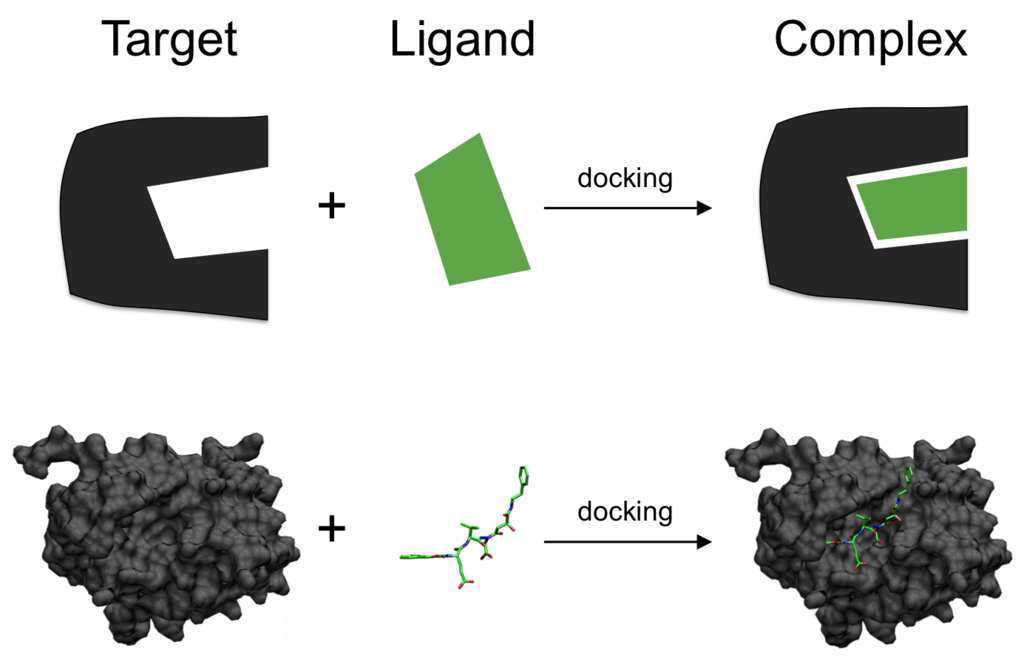
Why is this so important? Imagine trying to design a new drug. The old way involved testing thousands of chemical compounds in the lab, a slow and expensive process. Molecular docking lets us do a virtual screening first. We can predict which compounds are most likely to bind strongly to a target protein involved in a disease, focusing our real-world experiments on only the most promising candidates. This dramatically speeds up the discovery of new medicines.
Molecular docking (MD) is a crucial task in drug design, which predicts the position, orientation, and conformation of the ligand when bound to a target protein.
How Docking Works
The process of molecular docking can be broken down into two main parts: searching and scoring.
First, the searching algorithm explores all the different ways a ligand could possibly fit into the receptor's binding site. It twists and turns the ligand in three-dimensional space, generating millions of potential orientations, or "poses." It's like trying every possible way to fit a key into a lock, turning it at different angles and depths.
Second, for each pose generated, a scoring function calculates a number that estimates how strong the interaction would be. This score is based on principles of physics and chemistry. It considers factors like shape complementarity (how well the shapes match), and chemical interactions such as hydrogen bonds and electrostatic forces. A lower score usually indicates a more stable, favorable binding.
The goal is to find the pose with the best score, which represents the most likely way the ligand will bind to the receptor in real life.
Predicting the Future
The final output of a docking simulation is a prediction. It shows the most probable 3D structure of the ligand-receptor complex and a score representing its binding affinity. This information is a powerful starting point for scientists.
For a drug developer, a good docking result can identify a promising new molecule to synthesize and test. For a materials scientist, it might reveal how a new polymer could bind to a surface. While it's not a perfect crystal ball, molecular docking is an indispensable tool that allows us to peer into the molecular world and design better molecules for a huge range of applications.
What is the primary purpose of molecular docking?
In a typical docking simulation, the smaller molecule is called the 'ligand' and the larger molecule, often a protein, is called the 'receptor'.