Molecular Blueprint and Cellular Division
DNA Molecular Structure
The Direction of Life
The DNA double helix isn't just a twisted ladder; it's a structure with a specific direction. The two strands run antiparallel, like two lanes of a highway going in opposite directions. This directionality is defined by the chemical structure of the deoxyribose sugar in the DNA backbone.
Each carbon atom in the sugar ring is numbered. The key players are the 3' ('three prime') and 5' ('five prime') carbons. One end of a DNA strand will have an exposed phosphate group attached to the 5' carbon of the last sugar. This is the 5' end. The other end has an exposed hydroxyl group (-OH) on the 3' carbon of its last sugar. This is the 3' end. Because the two strands are antiparallel, the 5' end of one strand lines up with the 3' end of the other.
This directional arrangement is not arbitrary. It dictates how genetic information is read and copied. Enzymes that build new DNA strands, like DNA polymerase, can only add new nucleotides to the 3' end of a growing strand. They move along the template strand in a 3' to 5' direction, synthesizing the new strand from 5' to 3'.
The backbone itself is formed by strong covalent bonds called phosphodiester bonds. These bonds link the 5' carbon of one sugar to the 3' carbon of the next via a phosphate group. This creates a continuous, stable sugar-phosphate backbone for each strand.
The Rungs of the Ladder
The 'rungs' of the DNA ladder are made of pairs of nitrogenous bases. These bases fall into two chemical categories: purines and pyrimidines. Purines, which include Adenine (A) and Guanine (G), have a two-ring structure. Pyrimidines, which include Cytosine (C) and Thymine (T), have a smaller, single-ring structure.
A simple way to remember is that the smaller words (purines) are the larger molecules (two rings), and the larger word (pyrimidines) refers to the smaller molecules (one ring).
For the double helix to maintain a consistent width, a purine on one strand must always pair with a pyrimidine on the other. If two purines paired, the ladder would bulge. If two pyrimidines paired, it would constrict. This structural constraint leads to specific base pairing rules: Adenine always pairs with Thymine, and Guanine always pairs with Cytosine.
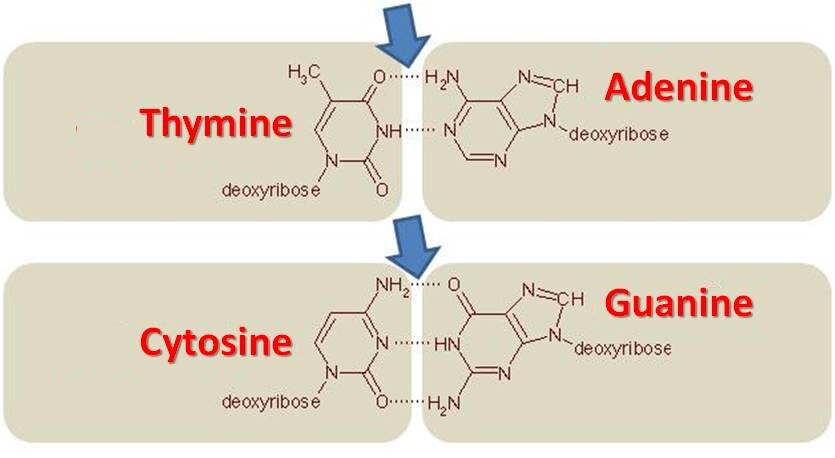
These pairs are held together by hydrogen bonds, which are weaker than the covalent phosphodiester bonds in the backbone. Adenine and Thymine form two hydrogen bonds, while Guanine and Cytosine form three. This difference is significant. The three bonds between G and C make this pair stronger and more thermally stable than the A-T pair. Regions of DNA with high G-C content require more energy to separate, a crucial factor in many molecular biology processes.
The key structural feature of complementary base pairs, which plays an important role in both stability and replication, is also the basis for how DNA functions as genetic material.
A Stable Blueprint
The combination of these features—a strong, directional sugar-phosphate backbone and specific, hydrogen-bonded base pairs—creates an incredibly stable and elegant molecule. The antiparallel orientation ensures that the base pairs fit together perfectly in the center of the helix.
The sequence of these bases along the 5' to 3' direction of a strand is the genetic code. The structure of DNA is perfectly suited for its function: the strong covalent backbone protects the code from degradation, while the weaker hydrogen bonds can be 'unzipped' by enzymes to allow for replication and transcription. This sophisticated architecture is the foundation for all of life's complexity.
Let's review the key terms we've covered.
Now, check your understanding of these structural details.
The two strands of a DNA double helix are described as 'antiparallel.' What does this mean?
What chemical group is found at the 5' ('five prime') end of a DNA strand?
Understanding this molecular framework is essential, as it provides the chemical logic for how genetic information is stored, accessed, and passed on.