Molecular Basis of Life
Nucleic Acid Chemistry
The Architecture of Information
DNA is the ultimate storage medium. It's incredibly stable, capable of preserving information for millennia. This stability isn't magic; it's the result of precise chemistry. The structure of DNA and its cousin, RNA, is a masterclass in how molecular shape and non-covalent forces create a robust yet accessible blueprint for life.
The story begins with the nitrogenous bases. You already know them as adenine (A), guanine (G), cytosine (C), and thymine (T) in DNA, with uracil (U) swapping in for thymine in RNA. These bases fall into two chemical families: the smaller, single-ringed (C, T, U) and the larger, double-ringed purines (A, G). But their simple letter designations hide a crucial chemical subtlety.
Each base can exist in slightly different structural forms, called tautomers, which involve the migration of a proton and the shifting of a double bond. For G and T, this is a switch between a keto form (with a C=O double bond) and an enol form (with a C-OH group). For A and C, it's a switch between an amino (-NH₂) form and an imino (=NH) form.
In the aqueous environment of the cell, the keto and amino forms are vastly more stable and common. This is critical. An enol or imino tautomer would have a different hydrogen bonding pattern and would cause a mismatch during DNA replication—for example, the imino form of adenine pairs with cytosine instead of thymine. The chemical equilibrium strongly favoring the correct tautomers is a fundamental reason why genetic inheritance is so faithful.
The Unbreakable Backbone
The bases provide the information, but the backbone provides the structure. Nucleotides are linked together by strong covalent bonds called phosphodiester linkages. This bond forms between the phosphate group of one nucleotide and the sugar of the next.
The formation of this bond is a condensation reaction that requires energy, typically supplied by breaking high-energy phosphate bonds from a precursor molecule. Once formed, however, phosphodiester bonds are extremely stable, which is exactly what you want for a molecule storing precious genetic data. The backbone's stability is also enhanced in DNA by its sugar, deoxyribose, which lacks the reactive 2'-hydroxyl group found in RNA's ribose. This single atom difference makes RNA more susceptible to hydrolysis and is a key reason DNA was selected by evolution for permanent genetic storage.
Forces in the Helix
A common misconception is that hydrogen bonds between base pairs are the main force stabilizing the double helix. While crucial for specificity (A pairing with T, G with C), they are not the primary source of the helix's thermodynamic stability. The real star of the show is interaction.
The flat, planar surfaces of the bases stack on top of one another, creating favorable van der Waals and hydrophobic interactions that stabilize the helix's core. This stacking, combined with the hydrogen bonds, creates a structure that is sturdy but can also be unzipped by enzymes when the information needs to be read. The two strands of the helix run in opposite directions—one in the 5' to 3' direction, the other 3' to 5'. This antiparallel orientation is essential for the geometry of the helix and for the machinery of replication and transcription.
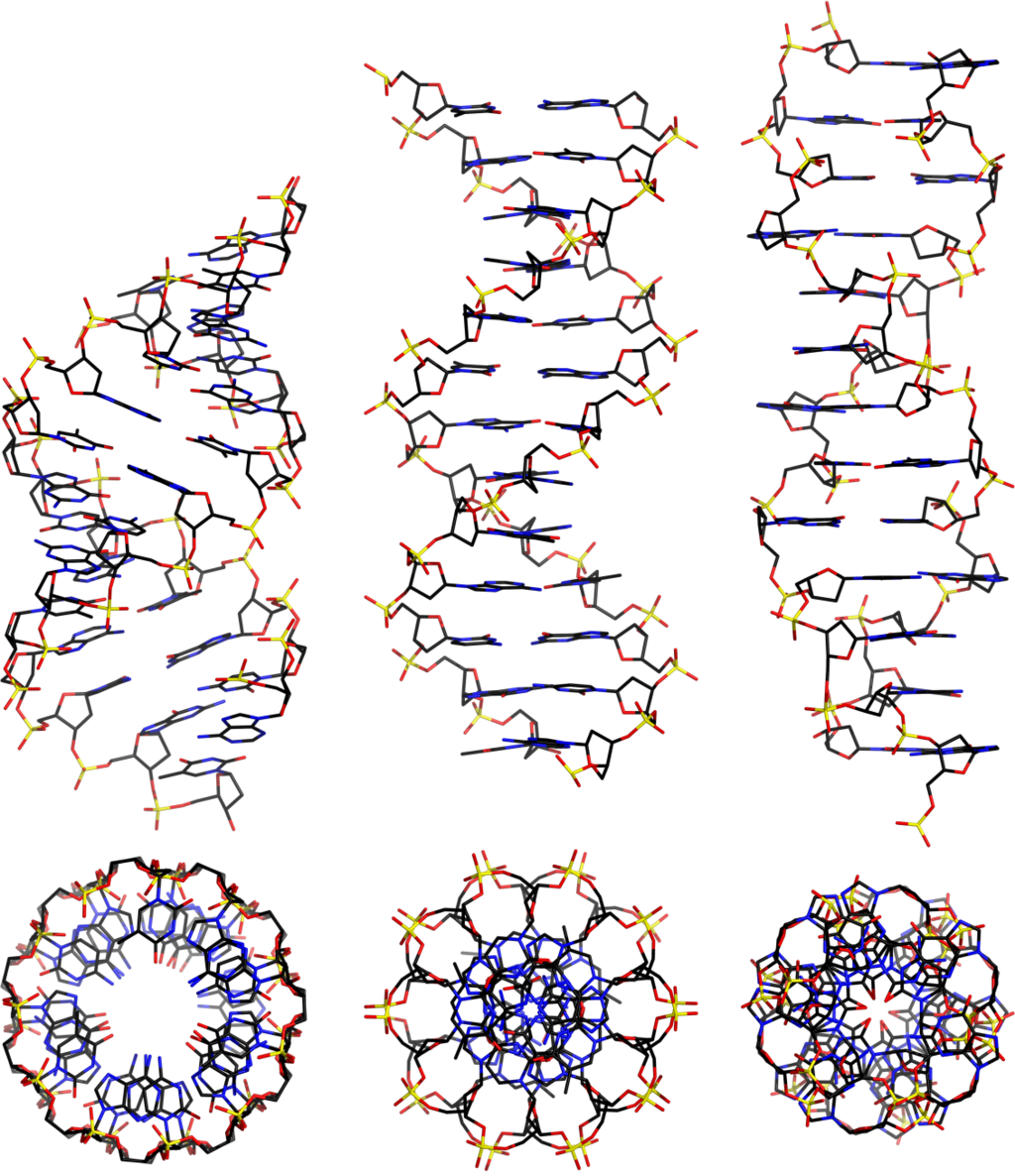
The familiar double helix is just one of several forms DNA can adopt. The most common form in our cells is B-DNA, a right-handed helix. Under dehydrating conditions, DNA can shift into A-DNA, which is shorter, wider, and also right-handed. A-DNA is biologically relevant because RNA-DNA hybrids and double-stranded RNA often adopt this conformation.
There is also Z-DNA, a left-handed helix that is thinner and longer. It forms in regions with alternating purine-pyrimidine sequences (like GCGCGC) and may play a role in regulating gene expression. The transitions between these forms show that DNA is not a rigid, static molecule but a dynamic structure whose shape can be influenced by its environment and sequence.
Let's check your understanding of these structural details.
What is the primary force providing thermodynamic stability to the DNA double helix?
Which structural feature makes DNA more stable and better suited for long-term genetic storage compared to RNA?
Understanding these chemical principles reveals how DNA's structure is perfectly suited for its function: a stable, readable, and transmissible repository of the instructions for life.