Molecular Architecture of Chromosomes and DNA
Nucleosome Structure and Assembly
Beads on a String
Inside the nucleus of a eukaryotic cell, an enormous amount of genetic information is stored in an incredibly small space. A human cell nucleus, just a few micrometers in diameter, contains about two meters of DNA. To manage this, the cell employs a sophisticated packaging system. The first and most fundamental level of this system relies on a family of proteins called histones.
Histones are positively charged proteins that act as spools around which the negatively charged DNA winds. This electrostatic attraction is key to their function. The core of this spool is a structure called the histone octamer.
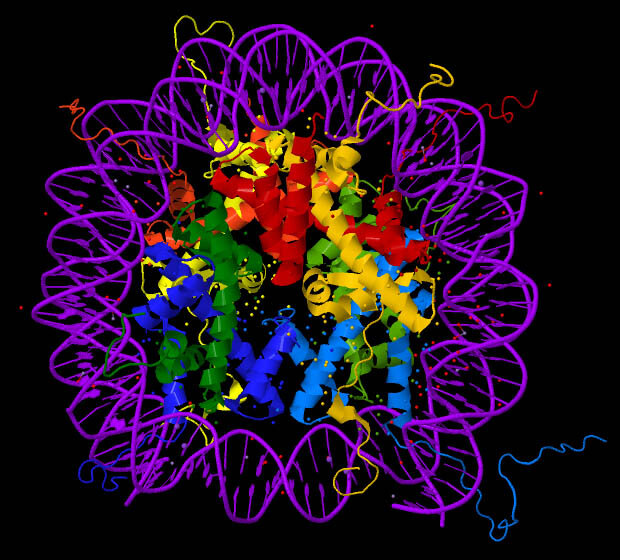
The nucleosome is the basic structural unit of chromatin, consisting of approximately 147 base pairs of DNA wrapped around a histone octamer, which includes two copies each of histones H2A, H2B, H3, and H4.
The histone octamer is composed of eight protein subunits: two copies each of four different core histones, named H2A, H2B, H3, and H4. Together, they form a stable, disc-like structure. The long, thread-like DNA molecule wraps around this protein core approximately 1.65 times. This wrapping encompasses about 147 base pairs of DNA.
The Nucleosome and Linker DNA
The combined structure of the histone octamer and its wrapped DNA is called a nucleosome core particle. These particles are the repeating units of chromatin, the complex of DNA and protein that makes up chromosomes. When viewed under a powerful microscope, this initial level of DNA packaging looks like beads on a string. Each 'bead' is a nucleosome core particle, and the 'string' is the stretch of DNA connecting one nucleosome to the next. This connecting DNA is known as linker DNA.
Chromatin
noun
The complex of DNA and proteins, primarily histones, that makes up the chromosomes in the nucleus of eukaryotic cells.
The length of linker DNA can vary between species and even between different cell types, but it typically ranges from 20 to 80 base pairs. This entire arrangement, with the nucleosome core particles and the linker DNA, forms what is known as the 10nm chromatin fiber, often called the 'beads-on-a-string' model. This is the first step in compacting the vast length of the eukaryotic genome.
The Role of Histone H1
Another histone, called H1, plays a crucial role in stabilizing this structure. H1 is known as a linker histone because it binds to the linker DNA at the point where it enters and exits the nucleosome core particle. Think of it as a clamp or a staple that locks the DNA onto the histone octamer.
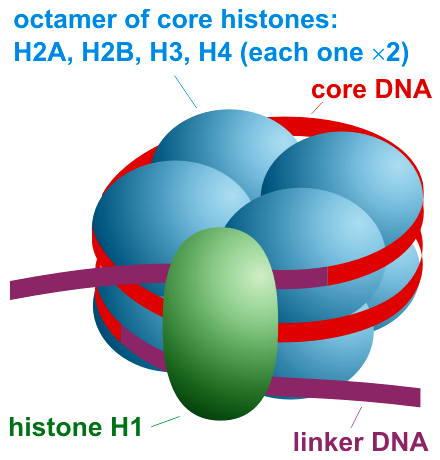
The binding of H1 pulls the nucleosomes closer together, initiating the next stage of DNA compaction. This interaction is fundamental for folding the 10nm fiber into more complex, higher-order structures. The simple but elegant system of wrapping DNA around histone cores is the foundation for all subsequent levels of chromosome architecture, ensuring that our genetic material is organized, protected, and accessible when needed.
What is the fundamental repeating unit of chromatin, consisting of DNA wrapped around a protein core?
The strong interaction between DNA and histone proteins is essential for compacting genetic material. What is the primary basis for this attraction?
This first level of packaging is a universal feature in eukaryotes and provides the essential foundation for the complex architecture of chromosomes.