Module Creation with Trello
Defining Learning Outcomes
Defining Your Destination
Before you can build a course, you need a blueprint. Learning outcomes are that blueprint. They are clear, specific statements about what a student should be able to do after completing your module. Think of them as a destination on a map. They tell the student where they are going, and they help you, the instructor, figure out the best way to get them there. Vague goals lead to confusing content and uncertain students.
Learning outcomes are clear, concise statements that outline what students should be able to know, understand, or do after completing a lesson, course, or program.
Well-defined outcomes guide every decision you make, from the content you include to the activities you plan. They are the foundation of a coherent and effective learning experience.
A Framework for Learning
How do you write outcomes that cover different kinds of thinking? A helpful tool is Bloom's Taxonomy. It's a framework that classifies learning objectives into different levels of complexity and specificity. The levels build on each other, moving from simple recall of facts to more complex skills like creating something new.
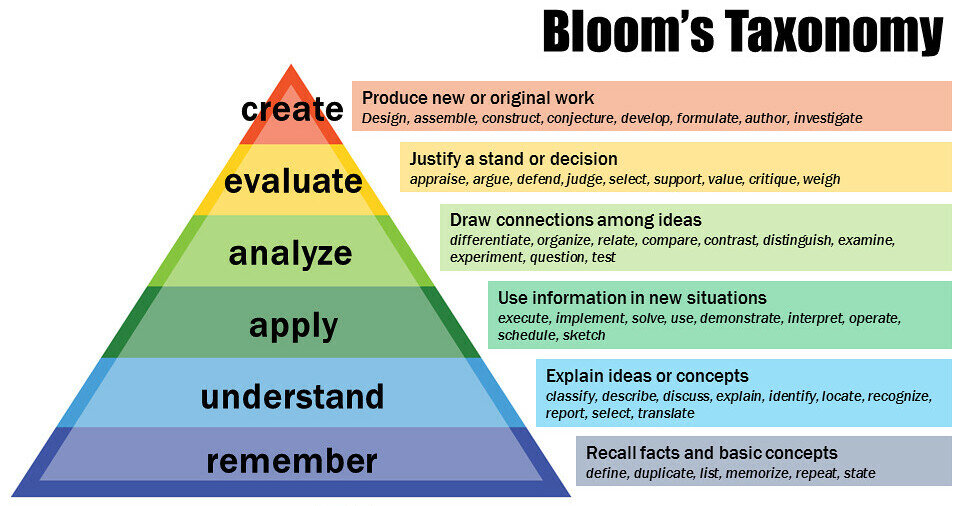
Using this hierarchy helps ensure your course challenges students appropriately. You can design outcomes that start with foundational knowledge and build toward higher-order thinking. The key is to use action verbs that correspond to each level. This makes your outcomes measurable and clear.
| Level | What It Means | Action Verbs |
|---|---|---|
| Remember | Recall facts and basic concepts. | Define, list, name, repeat |
| Understand | Explain ideas or concepts. | Classify, describe, discuss, explain |
| Apply | Use information in new situations. | Execute, implement, solve, use |
| Analyze | Draw connections among ideas. | Differentiate, organize, compare, contrast |
| Evaluate | Justify a stand or decision. | Appraise, argue, defend, support |
| Create | Produce new or original work. | Design, assemble, construct, develop |
Aligning Outcomes with Goals
Each module's learning outcomes shouldn't exist in a vacuum. They need to connect to the larger goals of your overall course. This alignment ensures that every piece of your course serves a purpose and contributes to the student's final learning destination. Think of it like building a house. The design of each room (a module outcome) must fit into the overall blueprint of the house (the course goal).
For example, if a course goal is for students to become proficient in digital marketing, a module outcome might be: Create a social media content calendar for a fictional brand. This specific, measurable outcome directly supports the broader course goal.
When your outcomes are aligned, students can see the connection between what they're doing in a single lesson and what they're trying to achieve in the entire course. This makes the learning process more meaningful and motivating.
What is the primary purpose of a learning outcome?
The text suggests using a specific framework for classifying learning objectives into different levels of complexity. What is it called?
With a solid grasp of how to define learning outcomes, you're ready to start structuring your content.