Modern Solar Horizons 2026
Efficiency Benchmarks 2026
The New Efficiency Standard
The days of 15-20% efficiency being the gold standard for commercial solar panels are firmly behind us. As of 2026, the market has shifted decisively. We're now in an era where N-type solar modules, particularly those using TOPCon and HJT architectures, routinely achieve efficiencies between 22% and 25% right out of the factory. This isn't a lab curiosity; it's the new commercial baseline.
This leap forward is thanks to a move away from the long-reigning PERC (Passivated Emitter and Rear Cell) technology. While PERC was revolutionary, it has approached its practical limits. Newer designs like TOPCon and HJT are fundamentally better at reducing electron-hole recombination, a primary source of efficiency loss in a solar cell. They capture more of the sun's energy and convert it into usable electricity.
| Technology | Typical Efficiency (2026) | Key Advantage |
|---|---|---|
| PERC | 21-22.5% | Mature, cost-effective |
| TOPCon | 22.5-24.5% | High efficiency, low degradation |
| HJT | 23-25%+ | Excellent low-light performance |
This constant push for higher numbers inevitably runs into a wall, but it's a wall defined by physics, not just manufacturing. For any single-junction silicon solar cell, there is a hard theoretical maximum for how much of the sun's energy it can convert into electricity. This ceiling is known as the and it represents a fundamental barrier that engineers are now working to design around rather than push through.
The Shockley-Queisser limit is the theoretical maximum efficiency—33.7 percent—at which single p-n junction flatplate cells can operate.
Hitting this limit is forcing a major pivot in the industry. Since a single layer of silicon can't get any better, the solution is to stack multiple layers. These are called tandem or multi-junction cells. Each layer is tuned to a different part of the light spectrum, allowing the cell as a whole to capture far more energy than a single-junction design ever could. This is the path to breaking the 33.7% barrier and pushing solar efficiency into the 40s.
Beyond the Nameplate
The efficiency number printed on a datasheet, known as the nameplate capacity, is measured under Standard Test Conditions (STC): a cell temperature of 25°C and an irradiance of 1000 W/m². In the real world, panels operate in much hotter conditions. A dark panel on a sunny roof can easily reach 65°C or more.
This is where the temperature coefficient comes in. It tells you how much power the panel loses for every degree Celsius above 25°C. A typical panel might have a coefficient of -0.35%/°C. While that sounds small, it has a significant impact on annual energy yield.
Another crucial real-world factor now standard on datasheets is bifaciality. Bifacial panels can capture light on both their front and back sides. The energy gained from the rear side, called bifacial gain, depends on the reflectivity of the surface beneath the panel, a property known as albedo. A panel installed over a white, reflective roof or light-coloured ground can see a significant performance boost, sometimes as much as 10-20%.
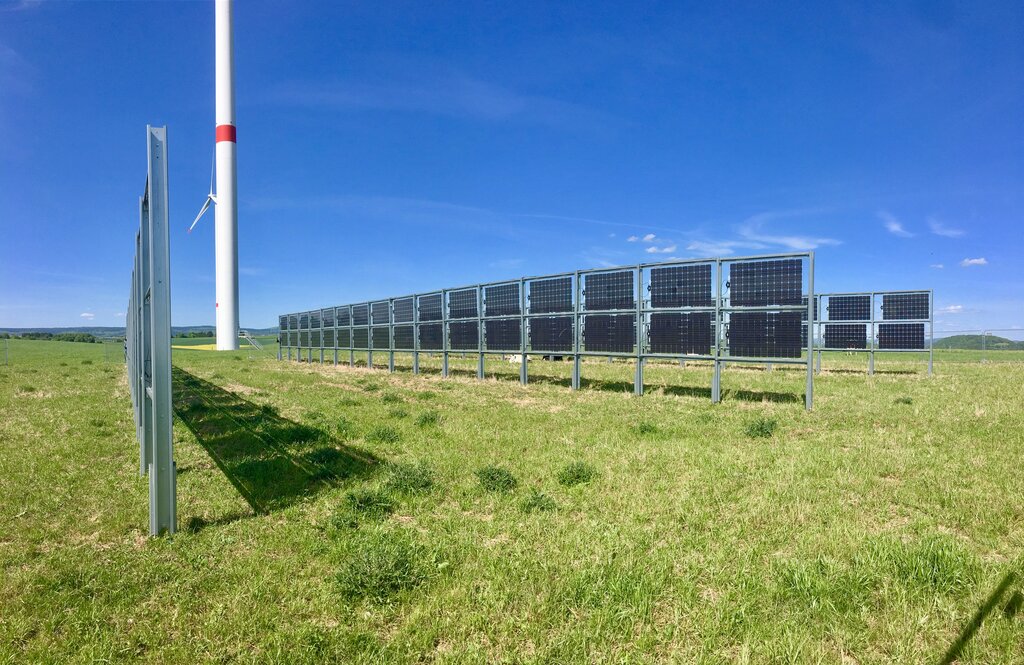
Modern datasheets combine these factors, moving beyond a single efficiency number to provide a much clearer picture of how a panel will perform over its lifetime in a specific location. Understanding these metrics is key to accurately forecasting a solar project's energy output and financial returns.
As of 2026, what is the typical efficiency range for new commercial N-type solar modules like TOPCon and HJT?
What is the name of the theoretical maximum efficiency for a single-junction silicon solar cell?