Modern Software Construction and Logic
Advanced Data Structures
Smarter Ways to Store Data
You already know that arrays are a great way to store an ordered list of items. But as you build more complex software, you'll find that a simple list isn't always the best tool for the job. Sometimes you need to find data instantly, store only unique items, or add and remove elements without shuffling everything around.
This is where more advanced data structures come in. They offer specialized ways to organize information, giving you major advantages in speed and efficiency. Let's look at three of the most common and powerful ones: hash maps, sets, and linked lists.
Hash Maps for Instant Lookups
Imagine a filing cabinet where every folder has a unique label. To find a document, you don't need to look through every folder one by one. You just find the right label and grab the contents. A hash map (also called a dictionary or associative array) works just like that.
It stores data in key-value pairs. You provide a unique key (the label), and the hash map stores your value (the document). Under the hood, the hash map uses a special hash function to convert your key into a numerical index, which tells it exactly where to store the value in memory. This process is incredibly fast.
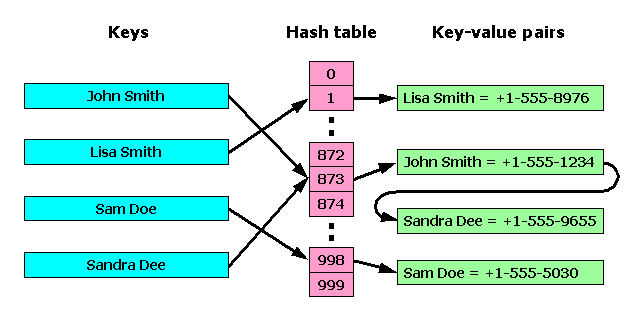
Because the hash function can calculate the location in a single step, finding, adding, or removing an item takes roughly the same amount of time no matter how much data you have. In computer science, we describe this as a constant time operation, or . This makes hash maps ideal for things like user profiles, caches, or any scenario where you need to look up information quickly by a unique identifier.
What happens if two different keys generate the same index? This is called a collision. Modern hash maps handle this gracefully, often by storing the colliding items in a small list at that index. While this can slightly slow down retrieval in rare cases, it's a well-solved problem.
// Creating a hash map to store user data
const userProfiles = new Map();

// Adding key-value pairs
userProfiles.set('user123', { name: 'Alice', theme: 'dark' });
userProfiles.set('user456', { name: 'Bob', theme: 'light' });

// Retrieving a value by its key is very fast
const aliceProfile = userProfiles.get('user123');
console.log(aliceProfile.name); // Outputs: Alice

// Checking if a key exists
console.log(userProfiles.has('user789')); // Outputs: false
Sets for Enforcing Uniqueness
A set is a simpler structure. Think of it as a hash map where you only care about the keys. Its main job is to store a collection of unique items. If you try to add an item that's already in the set, nothing happens. The set simply ignores the duplicate.
This is extremely useful for tasks like tracking all the unique visitors to a website or finding the distinct tags on a blog post. Like hash maps, sets use hashing to store and retrieve items, making operations like adding, removing, and checking for an item's existence very fast, typically .
Sets also provide powerful methods for combining or comparing collections, such as finding the union (all items from both sets), intersection (items that appear in both sets), or difference (items in one set but not the other).
Linked Lists vs. Arrays
Arrays store data in a single, continuous block of memory. This is great for quickly accessing an element by its index, since the computer can calculate its exact location instantly (). But it has a downside: if you want to insert or delete an item in the middle, you have to shift all the subsequent elements over, which can be slow ().
A linked list takes a different approach. Instead of one big block, it stores each item in its own separate container called a node. Each node holds a piece of data and a pointer—a reference to the next node in the sequence. It's like a scavenger hunt where each clue tells you where to find the next one.
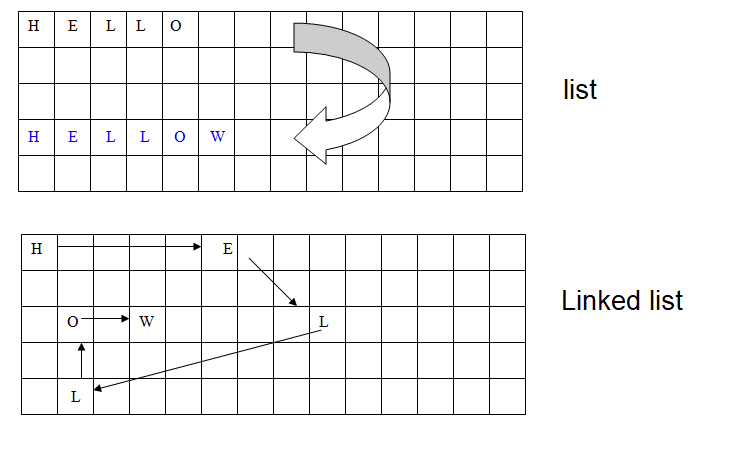
This structure makes insertions and deletions incredibly efficient. To add an item, you just create a new node and update the pointers of its neighbors. No data needs to be shifted. This is an operation. The trade-off is that accessing an element by its index is slower. To find the 100th item, you have to start at the beginning (the head) and follow the pointers 99 times. This makes access an operation.
Linked lists are perfect for use cases where you have frequent additions and removals, like a task queue or the "undo" history in a text editor.
Choosing the Right Structure
So, how do you decide which data structure to use? It all comes down to understanding the trade-offs and what your program needs to do most often. The efficiency of different operations is often described using Big O notation, which gives a high-level sense of how an algorithm's runtime scales with the amount of data ().
| Operation | Array | Linked List | Hash Map / Set |
|---|---|---|---|
| Access (by index/key) | |||
| Search (by value) | |||
| Insertion (at end) | * | ||
| Insertion (in middle) | |||
| Deletion (in middle) |
Array insertion at the end is on average, but can be if the array needs to be resized.
Here's a simple guide:
- Need to look up data by a unique ID? Use a Hash Map.
- Need to store a list of unique items and check for existence? Use a Set.
- Need fast access to elements by index and insertions/deletions are rare? An Array is your best bet.
- Need to frequently add or remove items from the middle of a list? A Linked List is the way to go.
Understanding these core data structures and their performance characteristics is a huge step toward writing clean, efficient, and professional code.
Ready to check your understanding? Let's see how well you can apply these concepts.
What is the primary mechanism that allows a hash map to retrieve values so quickly?
You are building a feature to track all the unique tags used in a blog. If a tag is already on your list, you should ignore it. Which data structure is specifically designed for this purpose?
Choosing the right data structure is about picking the right tool for the job. By analyzing your needs for access, insertion, and uniqueness, you can build software that is both fast and memory-efficient.