Modern Software Application Architecture and Development
Architectural Patterns and Trade-offs
The Architectural Blueprint
Every complex software application has an architecture, a blueprint that defines how its parts fit together. Just like in construction, the wrong blueprint can lead to a system that's unstable, hard to modify, and expensive to maintain. Two of the most common architectural patterns you'll encounter are the monolith and microservices.
A monolithic architecture builds an application as a single, unified unit. The user interface, business logic, and data access layer are all combined into one codebase and deployed as a single application.
Imagine building a house where all the plumbing, electrical wiring, and structural supports are fused into a single, inseparable mass. Early on, this is simple. Everything is in one place, and making changes is straightforward. This is the appeal of the monolith. For new projects or small teams, it's fast to develop, easy to test, and simple to deploy. Everyone works on the same codebase, so coordination is straightforward.
The Monolith First Strategy
Because of this initial simplicity, many successful companies start with a monolith. This approach is called the 'Monolith First' strategy. It avoids the trap of premature optimization, where you build a complex, distributed system for a problem you don't have yet. You focus on building your product and finding a market fit without getting bogged down by unnecessary complexity.
The downside appears as the application grows. That simple, unified codebase becomes a 'big ball of mud'. A small change in one part of the application can have unintended consequences elsewhere. Scaling becomes an all-or-nothing affair; if your payment processing module is under heavy load, you have to scale the entire application, not just that one piece. Deployments become risky and slow, as the entire system must be redeployed for even minor updates.
As Monolithic applications evolve, they become increasingly difficult to maintain and improve, leading to scaling and organizational issues.
Breaking It Down
When a monolith becomes too cumbersome, teams often turn to microservices. This architectural style structures an application as a collection of small, autonomous services, each focused on a specific business capability. Think of it like a team of specialists instead of a single generalist.
Each service runs in its own process, can be written in a different programming language, and manages its own data. They communicate with each other over a network, typically using lightweight APIs. This approach is a form of Service-Oriented Architecture (SOA), where the core idea is to build systems from reusable, independent services.
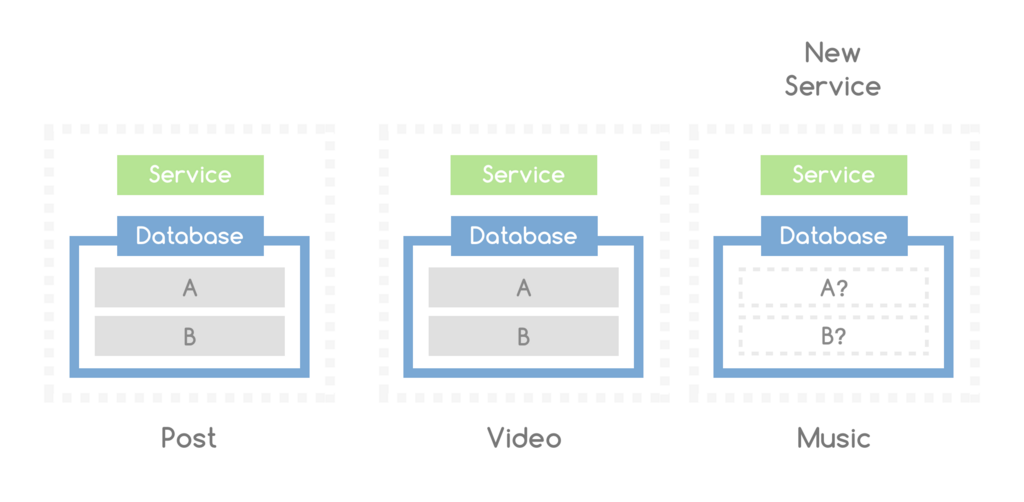
This model offers significant advantages. Services can be developed, deployed, and scaled independently. A team can update the user profile service without touching the inventory service. If the recommendation engine needs more power, you can scale it up without affecting the rest of the application. This autonomy and flexibility are why companies like Netflix famously migrated from a monolith to a distributed microservices architecture to handle their massive global scale.
The Microservices Premium
However, this flexibility comes at a cost, often called the 'Microservices Premium'. You've traded the simplicity of a single application for the complexity of a distributed system. Now, you have a new set of problems to solve.
| Challenge | Description |
|---|---|
| Network Overhead | Services communicate over a network, which is slower and less reliable than in-process calls. Latency and network failures must be handled. |
| Service Discovery | With services potentially starting, stopping, or moving, how do they find each other? You need a mechanism, like a service registry, to manage this. |
| Distributed Tracing | A single user request might travel through multiple services. If something goes wrong, you need tools to trace the request across the system to find the source of the error. |
| Data Consistency | Each service often manages its own data. Maintaining data consistency across services (e.g., ensuring an order is reflected in both the Orders and Inventory services) is complex. |
| Operational Complexity | Instead of one application to deploy and monitor, you now have dozens or even hundreds. This requires sophisticated automation and a robust DevOps culture. |
Choosing between a monolith and microservices is a critical trade-off. There is no single right answer. The decision depends on your team's size, the application's complexity, and your expected scale. Starting with a monolith and strategically breaking it apart into services as needed is often a pragmatic path.
Now, let's test your understanding of these architectural trade-offs.
What is the primary advantage of starting a new project with a monolithic architecture?
A rapidly growing e-commerce company finds that its single application is slow to deploy, and a bug in the inventory system can bring down the entire website. Which architectural style would most directly address these specific problems?