Modern Political Analysis
Institutional Design Trade-offs
The Blueprint of Power
Choosing a system of government is like drafting a blueprint for a nation. The fundamental choice often boils down to two models: federalism or unitarism. This decision isn't just academic; it dictates how power is distributed, how policies are made, and how a country responds to everything from local needs to national crises.
A unitary system concentrates power in a single, central government. Think of France, where major decisions in Paris shape life across the entire country. This design promotes national unity and policy uniformity. It can be highly efficient, allowing for swift, coordinated action because there are fewer layers of government to negotiate with. The downside? It can be slow to respond to diverse local needs and may stifle regional innovation.
Federalism, in contrast, divides power between a national government and regional governments (like states or provinces). The United States and Germany are classic examples. This structure is excellent for managing large, diverse countries. It allows regions to act as "laboratories of democracy," experimenting with different policies. However, it can lead to inequality between regions and create coordination problems, especially during a crisis. The lines of authority can blur, causing friction between state and national leaders.
Blurring the Lines
The distinction between federal and unitary isn't always sharp. Some unitary states grant significant autonomy to their regions through a process called This is different from federalism because, in a devolved system, the central government lends power to regional bodies. It can, in theory, take that power back. In a federal system, the power of regional governments is constitutionally guaranteed and cannot be taken away by the central authority alone.
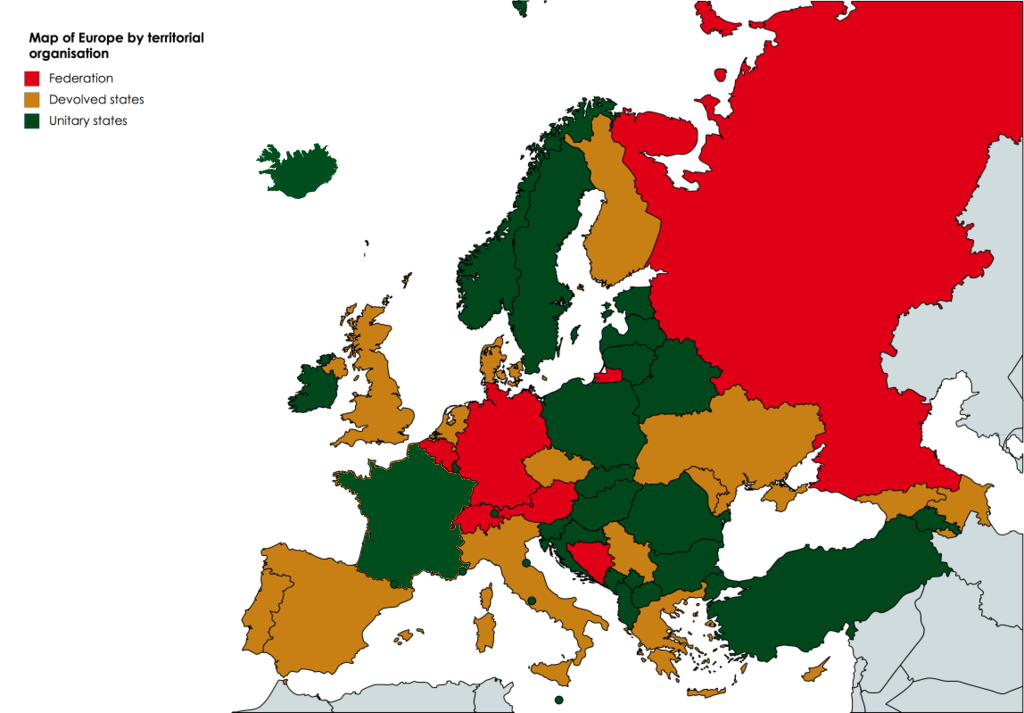
The United Kingdom is a prime example. While it is a unitary state, the UK Parliament has devolved significant powers to the Scottish Parliament, the Welsh Senedd, and the Northern Ireland Assembly. These bodies can make laws on a wide range of issues, from education to healthcare. Spain is another case, with its system of "autonomous communities" like Catalonia and the Basque Country, which enjoy substantial self-governance. However, in both cases, ultimate sovereignty rests with the central government.
Follow the Money
A crucial test of where power truly lies is fiscal autonomy. The ability to raise, spend, and manage money is the lifeblood of any government. examines how revenue and responsibilities are shared across different levels of government. In robust federal systems like Germany, states (Länder) have significant authority to levy their own taxes. This financial independence gives them real power to shape policy and deliver public services tailored to their populations.
In many unitary states, even those with significant devolution, the central government holds the purse strings. Regional governments may be responsible for administering services, but their funding comes largely from the national treasury. This financial dependence limits their practical autonomy, as the central government can use funding to influence regional policies. This creates a key distinction: even a highly decentralized unitary state functions differently from a federal one, where regional fiscal power is constitutionally protected.
Constitutional structure is the starting point, but the real distribution of power often comes down to who controls the budget.
Ultimately, the choice between these models involves navigating fundamental trade-offs. A country seeking to unite a diverse population with distinct regional identities might lean toward federalism. A nation prioritizing administrative clarity, national standards, and decisive action might prefer a unitary structure. Most modern states fall somewhere on a spectrum, blending elements of both to fit their unique historical and cultural contexts.
Ready to test your knowledge?
What is the primary distinction between a federal and a unitary system of government?
A country is facing a national crisis that requires a rapid, uniform response. Which system of government is generally considered more efficient for this type of decisive action?