Modern Perspectives on Human Sexuality and Intimacy
Sexual Response Cycles
Mapping the Response
Understanding what happens in the body during sexual activity isn't just about anatomy. It’s about a sequence of physiological and emotional changes known as the sexual response cycle. Think of it as a map that charts the journey from initial arousal to resolution. While we often talk about stages, it's important to remember this journey isn't always a linear trip. It can be a loop, a spiral, or sometimes a path that doubles back on itself.
The Classic Four-Stage Model
The most famous map of sexual response was drawn by William Masters and Virginia Johnson in the 1960s. Their research, based on direct observation, broke the cycle into four distinct phases: Excitement, Plateau, Orgasm, and Resolution. This model is built on two fundamental physiological processes that occur throughout the body: and myotonia.
Myotonia
noun
Increased muscle tension throughout the body. It can be voluntary, like flexing, or involuntary, such as facial grimaces, spasms in the hands and feet during orgasm, and the rhythmic contractions of the pelvic muscles.
The Excitement phase is the on-ramp, where vasocongestion begins. The Plateau is a period of intensified arousal before orgasm. Orgasm is the climax, characterized by a series of intense, involuntary muscle contractions and the release of built-up neuromuscular tension. Finally, the Resolution phase is the return to the body's unaroused state.
This model revealed important differences. For instance, after orgasm, males enter a during which they cannot achieve another orgasm. The length varies with age and other factors. Many females, however, do not have this mandatory waiting period and can experience multiple orgasms if stimulation continues.
Adding Desire to the Mix
While groundbreaking, the Masters and Johnson model focused purely on physiological mechanics. In the 1970s, psychiatrist proposed a different view. She argued that the cycle really begins before any physical touch. Her triphasic model—Desire, Excitement, and Orgasm—placed a new emphasis on the mind's role.
For Kaplan, desire wasn't just a prequel to arousal; it was the spark. Without the cognitive and emotional willingness to be sexual, the physiological cycle might not even begin.
The Neurochemistry of Arousal
Modern science adds another layer to these models: neurochemistry. The feelings of excitement, pleasure, and bonding are driven by a cocktail of hormones and neurotransmitters. Dopamine, often called the "motivation molecule," surges in anticipation of pleasure, driving us to seek out sexual activity. It's the engine of desire.
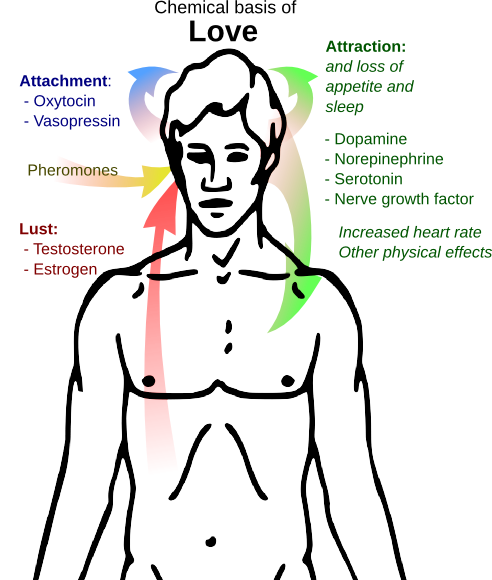
During orgasm, the brain is flooded with , sometimes called the "cuddle hormone." It plays a crucial role in social bonding and is responsible for the feelings of closeness and attachment felt after sex. In both sexes, oxytocin also stimulates the powerful muscle contractions that characterize orgasm.
According to the foundational research by Masters and Johnson, what are the two fundamental physiological processes that drive the sexual response cycle?
Which neurotransmitter is often called the 'motivation molecule' and plays a key role in driving the desire to seek out sexual activity?