Modern Operating System Architecture
Kernel Architecture Trade-offs
Kernel Space vs. User Space
An operating system juggles two fundamental roles: providing services to applications and managing the computer's hardware. To do this safely, it divides its virtual memory into two distinct realms: kernel space and user space. This separation is the bedrock of system stability and security.
Think of kernel space as a high-security area where the OS kernel lives and works. When code runs in kernel space, it's in what's called 'kernel mode'. In this mode, it has unrestricted access to all hardware and memory. It's the master of the machine, handling critical tasks like scheduling processes, managing memory, and communicating with devices like your hard drive and network card.
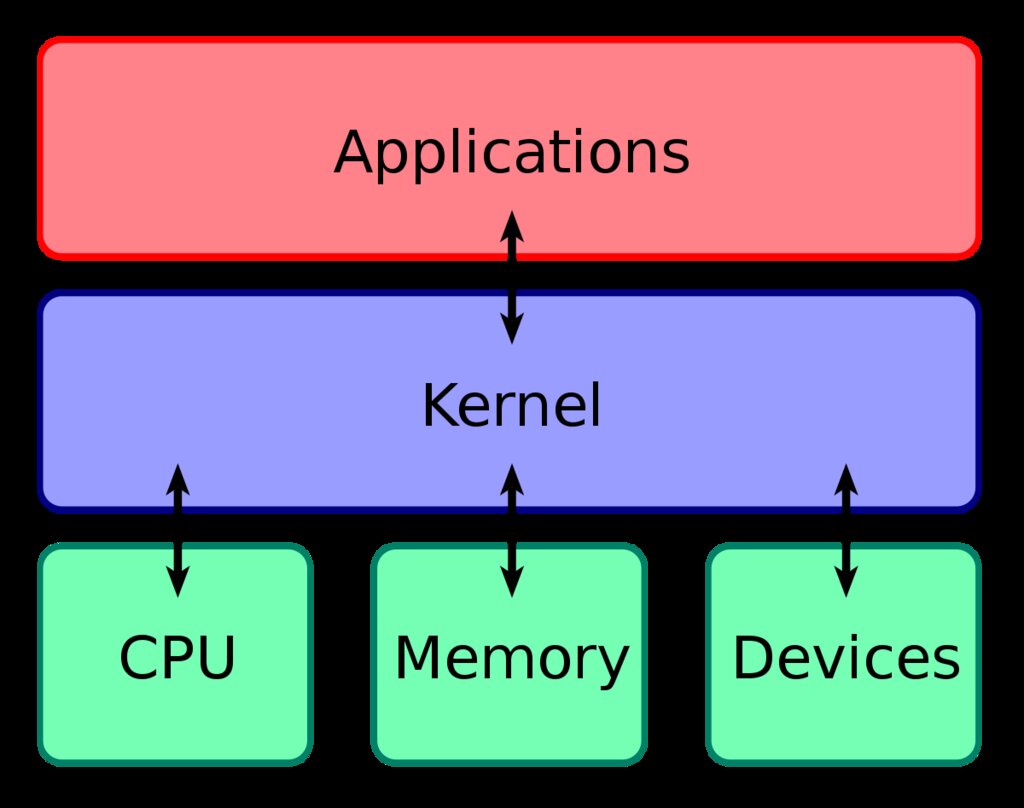
User space is where everything else runs: your web browser, your text editor, your games. These applications run in 'user mode', a restricted state with no direct access to hardware. If an app in user space wants to do something like read a file or open a network connection, it can't do it directly. It must ask the kernel for help.
This formal request is known as a system call. The application sends a system call to the kernel, which then switches from user mode to kernel mode, performs the requested task, and returns the result. This switch, called a context switch, ensures that the kernel always remains in control, preventing a buggy application from bringing down the entire system.
Architectural Trade-offs
While all modern operating systems enforce this kernel/user separation, they differ on a crucial point: how much work should be done in the privileged kernel space? This design choice leads to different kernel architectures, each with its own set of strengths and weaknesses. The two primary designs are the monolithic kernel and the microkernel.
In a , nearly all operating system services run together in a single, large program in kernel space. This includes process management, memory management, file systems, and all device drivers. The Linux kernel is the most famous example of this design.
The main advantage is speed. When the file system needs to talk to a device driver, it's just a simple function call within the same address space. Communication is incredibly efficient. However, this tight integration is also its biggest weakness. A bug in a single device driver has the potential to crash the entire system. The massive, interwoven codebase can also be difficult to maintain and debug.
A takes the opposite approach. It aims to make the kernel as small and simple as possible. Only the most fundamental services, such as inter-process communication (IPC), basic scheduling, and memory management, reside in kernel space. Other services that are typically part of a monolithic kernel—like device drivers, file systems, and network stacks—are moved into user space, where they run as separate processes called servers.
The main benefit is improved reliability and security. Since most components run as isolated processes in user space, a crash in one service (like a USB driver) won't take down the whole system. The downside is performance overhead. Communication between the application and the file system server, for instance, requires multiple context switches and messages passing through the kernel's IPC mechanism, which is slower than a direct function call.
| Feature | Monolithic Kernel | Microkernel |
|---|---|---|
| Core Idea | All OS services run in kernel space. | Only essential services in kernel space; others in user space. |
| Performance | High (fast internal communication). | Lower (overhead from message passing). |
| Reliability | Lower (a bug can crash the system). | High (services are isolated). |
| Security | Smaller attack surface at the user/kernel boundary, but a flaw in any kernel component is critical. | Larger attack surface via IPC, but exploits are contained to user-space servers. |
| Complexity | High complexity within the kernel itself. | Simple kernel, but complex interactions between user-space servers. |
| Examples | Linux, FreeBSD, MS-DOS. | QNX, Zircon, Minix. |
The Best of Both Worlds?
Given the clear trade-offs, many modern operating systems use a hybrid approach. A starts with a microkernel structure but allows some additional services to run in kernel space for performance reasons. This attempts to strike a balance between the speed of a monolith and the modularity of a microkernel.
Windows and macOS are prominent examples. They have a small kernel that handles core functions, but they also include other components, like parts of the graphics subsystem, within kernel space to improve performance for the user interface.
Another key concept that enables this flexibility is the (HAL). The HAL is a layer of software within the OS that provides a standard interface for the kernel to communicate with different types of hardware. Instead of the kernel needing to know the specific, low-level commands for every possible motherboard or CPU, it simply talks to the HAL. This makes the OS more portable across different hardware platforms.
Time to test your understanding of these core concepts.
What is the primary mechanism for an application in user space to request a service from the operating system kernel?
A newly installed, poorly written graphics card driver causes the entire operating system to crash repeatedly. This scenario is a classic disadvantage of which kernel architecture?
Ultimately, there is no single 'best' kernel architecture. The choice depends on the system's goals. For a high-performance desktop or server, the speed of a monolithic design is often preferred. For a life-critical embedded system in a car, the reliability and fault isolation of a microkernel are indispensable.