Modern NLP from Foundations to Transformers
Modern Architecture Evolution
The Sequential Bottleneck
For a long time, models designed to understand language worked a bit like we read: one word at a time. Architectures like Recurrent Neural Networks (RNNs) and their more sophisticated cousins, Long Short-Term Memory (LSTM) units, processed text sequentially. They would read the first word, form a memory of it, then read the second word while trying to remember the first, and so on.
This approach has a fundamental problem. As the text gets longer, the model struggles to retain information from the beginning. It's like trying to remember the name of a character introduced in chapter one of a novel by the time you reach chapter thirty. The initial context fades. This weakness, known as the vanishing gradient problem, created a bottleneck. It limited the length of text that could be effectively analysed and capped how well models could grasp long-range dependencies, the subtle connections between words far apart from each other.
Sequential processing was slow and forgetful, preventing models from understanding the full context of long documents.
A Parallel Revolution
The breakthrough came in 2017 with the Transformer architecture. Instead of reading word-by-word, it processes the entire sequence at once. The key to this parallel processing is a mechanism called .
Imagine you're reading the sentence: "The robot picked up the screwdriver because it was heavy." To understand what "it" refers to, your brain instantly weighs the importance of other words. "Robot" and "screwdriver" are strong candidates; "picked" and "up" are less relevant. Self-attention allows a model to do the same thing. For every word it processes, it generates three vectors: a Query (Q), a Key (K), and a Value (V).
- Query: What I'm looking for (e.g., the meaning of "it").
- Key: What information I hold (e.g., the context of "screwdriver").
- Value: The actual meaning I can provide.
The model compares the Query of one word to the Key of every other word in the sequence. This comparison generates an attention score, indicating relevance. These scores then determine how much of each word's Value contributes to the final understanding of the query word. This all happens simultaneously for every word, allowing the model to build a rich, context-aware representation of the entire text in one go.
The Transformer's core innovation lies in its self-attention mechanism, which allows the model to weigh the importance of different parts of the input data relative to each other, enabling parallel processing and capturing long-range dependencies more effectively than previous architectures like recurrent neural networks (RNNs).
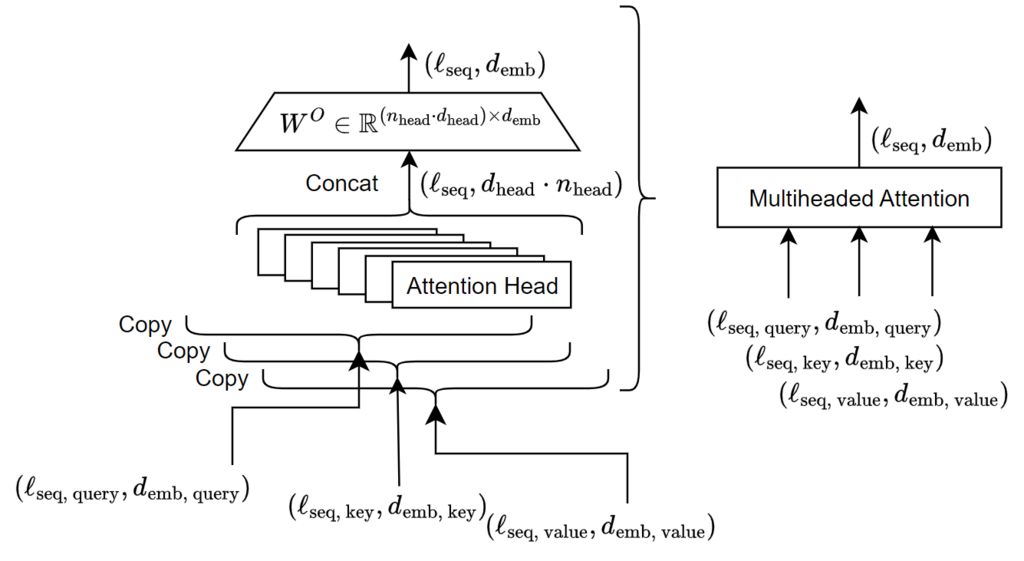
But why stop at one perspective? The Transformer uses Multi-Head Attention to enhance this process. It runs the self-attention mechanism multiple times in parallel, each with different, learned Q, K, and V matrices. Each "head" can learn to focus on different types of relationships. One head might track syntactic links (subject-verb agreement), while another follows semantic connections (synonyms and related concepts). The outputs from all heads are then combined, giving the model a much more nuanced understanding of the text.
Keeping Track of Order
Processing everything at once creates a new problem: the model loses the original word order. Without this information, "man bites dog" and "dog bites man" would look identical. Early Transformers solved this by adding a fixed "positional encoding" to each word's embedding, essentially stamping it with its position number.
A more elegant solution is now common: Rotary Positional Embeddings (RoPE). Instead of adding a static number, RoPE rotates each word's embedding vector by an amount proportional to its position in the sequence. This method is brilliant because it encodes position relatively. The model learns the relationship between words based on the rotational difference between them, which is more flexible and scales much better to very long texts.
Making Attention Efficient
The power of Multi-Head Attention comes at a cost. The number of calculations grows quadratically with the length of the sequence, making it very expensive for massive context windows. To solve this, more efficient attention variants have been developed.
Grouped-Query Attention (GQA) is a clever compromise. Instead of each Query head having its own dedicated Key and Value heads, multiple Query heads share a single K/V pair. This dramatically reduces the amount of computation and memory needed during inference, making models like Llama 3 faster and more accessible without a huge drop in performance.
Multi-Head Latent Attention (MLA), used in models like DeepSeek-V3, takes a different approach. It uses a smaller, fixed number of "latent" or summary vectors to represent the entire context. The Query heads then attend to this compressed representation instead of the full sequence. This makes it possible to process incredibly large contexts—up to millions of tokens—while keeping computations manageable.
The evolution from sequential RNNs to parallel Transformers, and now to highly efficient attention variants, is what enables modern AI. These architectural choices directly translate to the ability to train on vast datasets and process massive amounts of context, allowing models to understand nuance, maintain coherence, and perform complex reasoning tasks that were impossible just a few years ago.
Time to check your understanding of these core architectural concepts.
What was the primary limitation of sequential language models like RNNs and LSTMs that the Transformer architecture was designed to overcome?
In the self-attention mechanism, what is the role of the 'Query' vector for a given word?
These architectural innovations, from self-attention to its modern, efficient forms, are the engine driving the capabilities of today's most advanced language models.