Modern Martial Arts Mastery and Integrated Combat Systems
Kinetic Chain Biomechanics
The Body as a Whip
A powerful strike isn't just about arm or leg strength. True power comes from the ground up, transferred through a sequence of movements known as the kinetic chain. Think of it like cracking a whip: the motion starts at the handle, and the energy travels along its length until the very tip snaps forward at incredible speed. In martial arts, your body is the whip, and the ground is the handle.
Every powerful technique, from a punch to a kick, begins with your feet pushing against the floor. This initial push creates what's known as [{
}]—the foundation of all power generation in striking.
This force travels up through your legs, is amplified by the rotation of your hips, and stabilized by your core. Your torso then channels this energy to the shoulder, which funnels it down the arm to the fist, or from the hip down the leg to the foot. Each joint and muscle group in the sequence adds to the momentum, building upon the last.
The core is the critical bridge in this chain. A stable, engaged core ensures that the power generated by the legs and hips isn't lost or dissipated. It acts like a solid transmission, efficiently transferring energy to the upper body. Without strong core stability, the whip becomes flimsy and loses its snap.
Circular vs. Linear Power
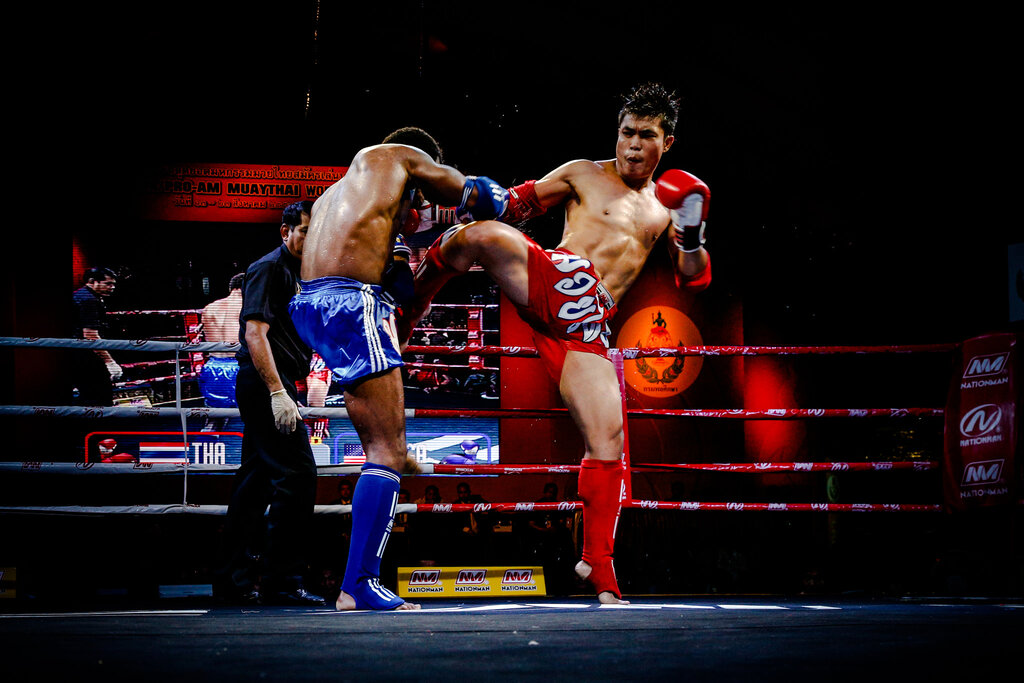
The way energy travels up the kinetic chain defines a strike's character. In arts like Muay Thai, the roundhouse kick is a perfect example of rotational power. The fighter pivots on their standing foot, whipping their entire body around. The power comes from the immense torque generated by the violent rotation of the hips and torso. It's a full-body commitment to a single, devastating arc.
Contrast this with the linear power of a Karate reverse punch, or gyaku-zuki. While this strike also starts from the ground and involves hip rotation, the energy is channeled in a straight line directly towards the target. The rotation happens to drive the body forward, converting rotational energy into linear momentum. The goal is speed and directness, like a piston firing.
Our data indicates that the typical Karate and Taekwondo snap-like kick is based heavily on rapid knee extension, while Muay Thai uses a technique that places greater emphasise on COM movements to develop high impact forces.
Neither approach is inherently superior; they are simply different applications of the same biomechanical principles. Rotational strikes often carry more mass behind them and are harder to stop, while linear strikes are typically faster and more direct.
Speed from Elasticity
The final element in powerful striking is speed, which is amplified by elasticity. As you initiate a strike, your muscles and tendons stretch and store elastic energy, much like a rubber band. This is known as elastic recoil. As the kinetic chain unfolds, this stored energy is released, causing the final limb to accelerate rapidly—the whip-crack at the end of the movement.
This sequential acceleration means the fist or foot is the last thing to move, but it moves the fastest, concentrating all the body's generated force into a single point of impact.
By understanding how to link your body from the ground up, you can transform simple movements into powerful, efficient strikes. It's the science of turning your body into a finely tuned machine for generating and delivering force.
What is the foundational source of power in a powerful strike, according to the principle of the kinetic chain?
In the analogy of the body as a whip, what does the core represent?