Modern Irish Tales
Introduction to Modern Irish Literature
Forging a National Voice
Modern Irish literature didn't just appear; it was forged in a period of intense cultural and political change. In the late 19th century, Ireland was still under British rule, and a powerful movement began to push back against centuries of cultural suppression. The goal was to rediscover and celebrate a distinctly Irish identity, separate from that of its neighbor.
Gaelic Revival
noun
A cultural movement in the late 19th century that aimed to revive the Irish language, traditional folklore, sports, and arts to promote a distinct Irish national identity.
This movement, known as the Gaelic Revival, was the engine of a literary renaissance. Writers and thinkers looked to Ireland’s ancient past—its myths, legends, and folklore—for inspiration. They wanted to create a new body of work that was authentically Irish. Figures like W.B. Yeats, Lady Gregory, and J.M. Synge were central to this effort. They founded the Irish Literary Theatre in 1899, which later became the famous Abbey Theatre, to provide a stage for plays written by and for Irish people. This wasn't just about entertainment; it was a declaration of cultural independence.
Life After Independence
Achieving political independence with the formation of the Irish Free State in 1922 profoundly shifted the focus of Irish literature. The heroic, mythic themes of the revival gave way to a more sober, critical look at the new nation. The revolutionary fervor was over, and writers began to grapple with the realities of building a country.
Disillusionment became a common theme. Authors explored the limitations of the new state, focusing on the powerful influence of the Catholic Church, the strict social conservatism, and the economic hardships that led many to leave. The once-celebrated rural life was often portrayed as stifling and parochial. Emigration, in particular, cast a long shadow over the national consciousness, as generations of young people left Ireland for opportunities elsewhere.
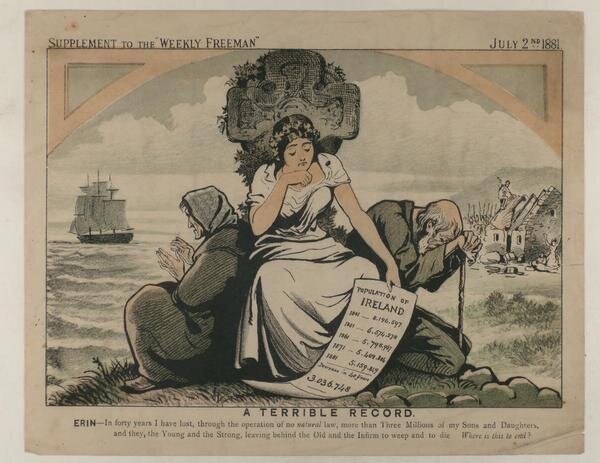
This was a period of introspection and often harsh self-criticism. Writers turned their gaze inward, examining the soul of the new Ireland and finding it more complex and troubled than the revolutionary ideal.
The Modern Irish Experience
The latter half of the 20th century and into the 21st brought seismic shifts to Irish society, and its literature transformed alongside it. The economic boom of the 1990s, known as the Celtic Tiger, brought unprecedented prosperity and connected Ireland to the global economy. At the same time, the dominance of the Catholic Church rapidly declined, and a series of social referendums legalized divorce, contraception, abortion, and same-sex marriage, signaling a move toward a more secular, liberal society.
Contemporary Irish writers are less concerned with defining what it means to be Irish in opposition to Britain. Instead, they explore what it means to be Irish in a globalized world.
As a result, the themes in Irish literature have become more diverse and outward-looking. While still engaging with the past, writers now tackle issues like urban life, immigration (with Ireland becoming a destination rather than a source of migrants), multiculturalism, and shifting identities. The narrative has expanded from the small farm and the local parish to the city and the wider world, reflecting the complex, modern nation that Ireland has become.
What was the primary goal of the Gaelic Revival in the late 19th century?
After the formation of the Irish Free State in 1922, what became a common theme in Irish literature?