Modern Indonesian Culture Unveiled
Introduction to Indonesian Culture
The Islands of Spice and Story
Indonesia isn't just one country; it's a sprawling collection of over 17,000 islands draped across the equator. This massive archipelago stretches from the Asian mainland to Australia, creating a bridge between two continents and two oceans. Its geography as a chain of volcanic islands, part of the Pacific's "Ring of Fire," has physically separated its people for centuries, allowing thousands of distinct cultures to blossom.
This geographical diversity is mirrored by a deep historical complexity. Long before European traders arrived in search of spices, Indonesia was a crossroads. Austronesian peoples first settled the islands thousands of years ago, forming the bedrock of the population. Later, powerful Hindu-Buddhist kingdoms, like Srivijaya and Majapahit, controlled vast maritime trade routes, leaving behind magnificent temples like Borobudur and Prambanan. The arrival of Islam via merchants created powerful sultanates, and finally, centuries of Dutch colonization stitched the diverse islands into a single political entity.
Each wave of history—trade, religion, and colonization—added another layer to the Indonesian identity without erasing what came before.
A Tour of Cultural Hubs
Because of its immense size, Indonesia's culture is best understood by looking at its major regions. Each island or island group has a unique flavor.
Sumatra: Located on the western edge of the archipelago, Sumatra has long been a center for trade and Islamic scholarship. It's home to diverse groups like the Acehnese and the Minangkabau.
Java: As the most populous island, Java is the political and economic heart of Indonesia. It has a rich history of sophisticated courtly arts, music (gamelan), and spiritual traditions.
Bali: Though just a small island, Bali is world-famous. It stands out as a pocket of Hindu culture in a predominantly Muslim nation, known for its vibrant arts, dance, and ceremonies.
Kalimantan: The Indonesian portion of Borneo is a land of dense rainforests and rivers, home to the Dayak peoples, who have a rich heritage of animist beliefs and communal living in longhouses.
Sulawesi: This uniquely shaped island is incredibly diverse. You can find the seafaring Bugis people in the south and the Torajans, famous for their elaborate funeral rites, in the central highlands.
The Maluku Islands: Historically known as the "Spice Islands," this region was the original prize for European traders. Its history is one of trade, conflict, and cultural exchange.
Papua: The easternmost part of Indonesia is culturally distinct from the rest of Asia. Its indigenous peoples have more in common with Pacific Islanders, with hundreds of unique languages and traditions.
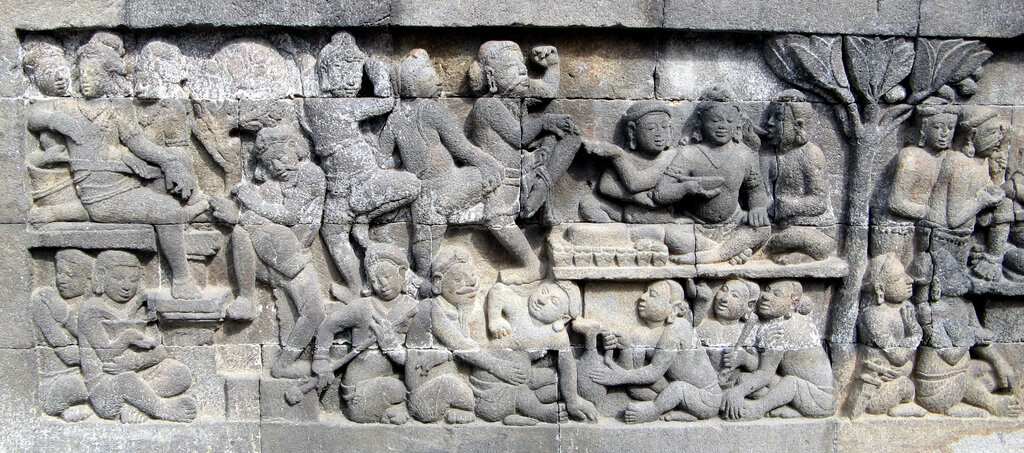
This incredible variety is captured in Indonesia's national motto, Bhinneka Tunggal Ika. It translates to "Unity in Diversity." This phrase acknowledges that while the nation is made up of countless different cultures, languages, and religions, they all form a single, unified country.
Indonesia's location on the Pacific "Ring of Fire" has directly resulted in which significant geographical feature?
Before the arrival of Islam and European colonization, powerful Indonesian kingdoms like Srivijaya and Majapahit were primarily shaped by which major cultural and religious influence?
This overview only scratches the surface. Indonesia's culture is a living, breathing entity, shaped by its geography, history, and the vibrant spirit of its people.