Modern Control Systems Engineering
Introduction to Control Systems
What is a Control System?
At its heart, a control system is simply something that manages, commands, or regulates the behavior of another system. Think about the cruise control in a car. You set a desired speed, and the control system works to maintain it, whether you're driving uphill, downhill, or on a flat road. It's the brains behind the operation, ensuring a system achieves a specific goal without your constant intervention.
Every control system has a few key players. First, there's the system itself, often called the plant, which is the thing we want to control—like the car's engine. Then, there's a controller, which is the decision-maker. It figures out what action to take. Finally, an actuator carries out the controller's command. In our cruise control example, the actuator would adjust the throttle to give the engine more or less gas.
Open-Loop vs. Closed-Loop
Control systems come in two main flavors: open-loop and closed-loop. The difference is all about information.
An open-loop system runs without paying any attention to the results it's producing. The control action is completely independent of the system's output. A simple toaster is a perfect example. You set a timer, push the lever, and the heating elements turn on for a fixed amount of time. It doesn't matter if you put in a thin slice of white bread or a thick, frozen bagel; the toaster performs the same action. It has no way of knowing if the toast is perfectly golden or burnt to a crisp.
Open-loop systems are simple and often cheaper, but they can't compensate for unexpected changes or disturbances.
A closed-loop system, on the other hand, is much smarter. It uses a crucial piece of information called feedback. Feedback is data about the system's output that is sent back to the controller. This allows the system to compare the actual result with the desired result and make corrections.
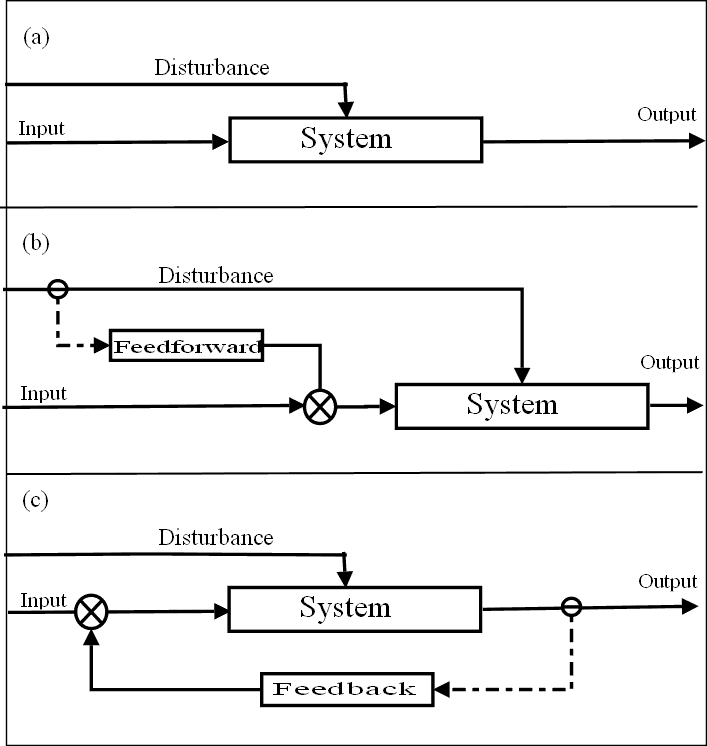
Think of a home thermostat. You set your desired temperature (the setpoint). A sensor in the thermostat constantly measures the actual room temperature (the output). The controller compares the actual temperature to your setpoint. If the room is too cold, the controller tells the furnace (the actuator) to turn on. Once the room reaches the desired temperature, the sensor feeds this information back to the controller, which then turns the furnace off. This continuous loop of measuring, comparing, and correcting is the essence of a closed-loop system.
The Power of Feedback
Feedback is what makes control systems robust and adaptable. It allows them to handle disturbances—unexpected events that affect the system's output. For the thermostat, a disturbance could be an open window letting in cold air. The system doesn't need to know why the temperature is dropping; the feedback loop just detects the change and commands the furnace to work harder to counteract it.
This ability to self-correct is vital in countless engineering applications. A self-driving car uses feedback from cameras and sensors to stay in its lane, adjusting the steering in real-time to correct for curves in the road or gusts of wind. In a chemical plant, control systems use feedback from temperature and pressure sensors to keep reactions stable and safe, adjusting valves and heaters automatically.
By constantly checking the output and correcting for errors, closed-loop systems provide stability and precision that open-loop systems simply can't match.
Now, let's test your understanding of these core concepts.
In the context of a car's cruise control system, what is the 'plant'?
A standard drip coffee machine brews for a fixed amount of time regardless of how strong the coffee becomes. This is an example of an open-loop system.
Understanding these fundamentals—from the basic components to the critical difference between open and closed loops—is the first step into the world of control systems engineering.