Modern Automotive Engineering Systems
Advanced Powertrain Dynamics
Beyond the Basics of Combustion
The standard four-stroke cycle is a workhorse, but modern engines need more finesse to meet demands for higher efficiency and lower emissions. This has led engineers to modify the fundamental Otto cycle, creating variations like the Atkinson and Miller cycles. These cycles prioritize efficiency by changing how the engine breathes.
The Atkinson cycle achieves a higher expansion ratio than its compression ratio. It does this by leaving the intake valve open for a short period during the initial phase of the compression stroke. As the piston begins to rise, some of the air-fuel mixture is pushed back into the intake manifold. This reduces the effective volume being compressed, lowering the compression pressure and the work required to compress the charge. However, the full expansion stroke is still used, extracting more energy from the combustion gases. The result is better fuel efficiency, but at the cost of lower power output for a given engine size, since less mixture is burned.
The Miller cycle is similar but adds a crucial component: forced induction, usually a turbocharger or supercharger. By forcing more air into the cylinder, it compensates for the power loss inherent in the Atkinson cycle's design. The Miller cycle can either close the intake valve early (late intake valve closing is more common) or late, achieving a similar effect of a shorter effective compression stroke. The key takeaway is that both cycles decouple the geometric compression ratio from the effective compression ratio to improve thermal efficiency.
Advanced Combustion Strategies
Beyond modifying valve timing, engineers are exploring entirely new ways to manage combustion. Two of the most promising are Homogeneous Charge Compression Ignition (HCCI) and Reactivity-Controlled Compression Ignition (RCCI).
Both methods aim to achieve a cleaner, more efficient burn similar to a diesel engine, but with a premixed, gasoline-like fuel-air charge. In HCCI engines, the air and fuel are mixed thoroughly, and the mixture is compressed until it auto-ignites from the heat of compression, without a spark plug. This low-temperature combustion produces very low NOx and particulate matter. The main challenge is control; auto-ignition is highly dependent on temperature and pressure, making it difficult to time precisely across a wide range of operating conditions.
RCCI is a more advanced version of HCCI. It uses two fuels with different reactivities, such as gasoline and diesel. A low-reactivity fuel (like gasoline) is injected into the port to create a well-mixed charge, and a small amount of high-reactivity fuel (like diesel) is injected directly into the cylinder just before combustion. This direct injection creates pockets of higher reactivity that act as ignition sites, providing much better control over the start of combustion than HCCI. This dual-fuel strategy allows for extremely high thermal efficiencies, sometimes approaching 60%, but adds significant complexity to the fuel and engine control systems.
Refining Fuel Delivery and Engine Load
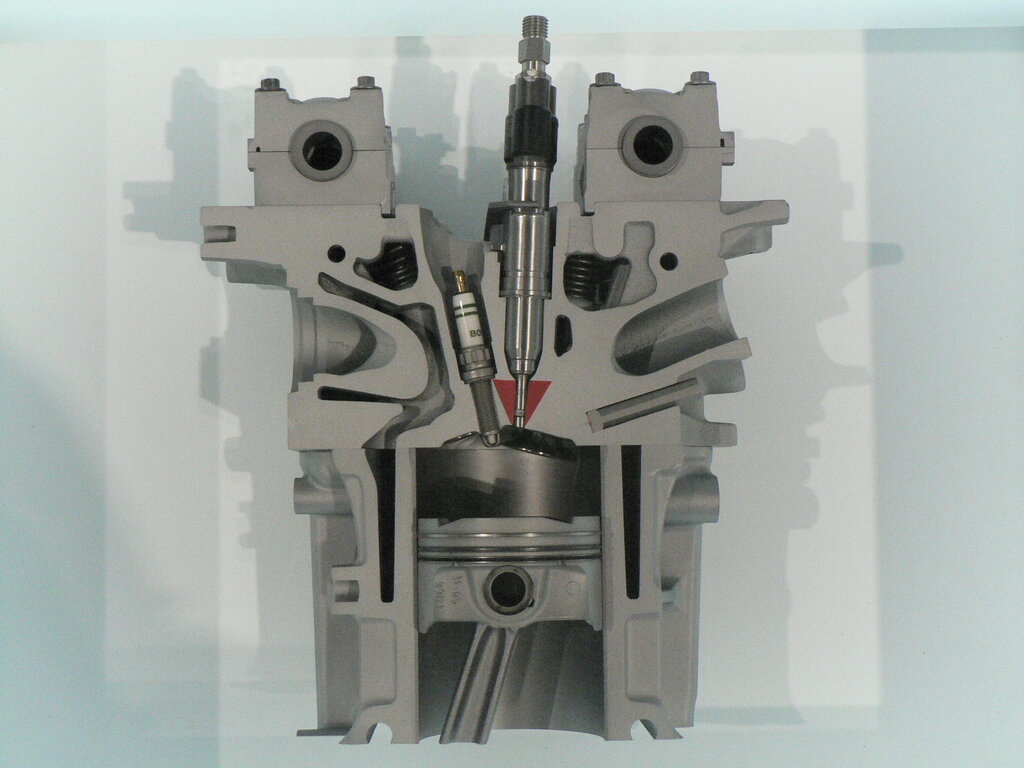
Gasoline Direct Injection (GDI) has become nearly standard in modern engines. By injecting fuel directly into the combustion chamber at high pressure, GDI allows for more precise fuel control and a cooling effect within the cylinder. This charge cooling effect helps prevent engine knock, enabling higher compression ratios and boosting efficiency. Engineers carefully design GDI spray patterns to control how the fuel mixes with air. This can range from a homogeneous, evenly mixed charge for full power to a stratified charge, where a rich mixture is concentrated near the spark plug for light-load conditions, allowing the rest of the cylinder to be very lean to save fuel.
Finally, for situations where the engine isn't working hard, like cruising on the highway, running all cylinders is inefficient. This is where cylinder deactivation comes in. The engine control unit (ECU) can shut down a set of cylinders by keeping their intake and exhaust valves closed. With no air flowing through, the pistons in the deactivated cylinders just compress and decompress the trapped air, acting like air springs with very little energy loss. This forces the remaining active cylinders to work harder and more efficiently to maintain the desired speed, significantly improving fuel economy under low-load conditions.
Modern engines are complex systems. Each of these technologies represents a trade-off between efficiency, power, emissions, and cost. By combining them, engineers can create powertrains that are far more adaptable and efficient than their predecessors.
Ready to test your knowledge on these advanced concepts?
What is the primary trade-off of the Atkinson cycle compared to a conventional Otto cycle engine?
How does the Miller cycle compensate for the power loss typically associated with the Atkinson cycle?