Modern Automotive Engineering and Repair
Advanced Engine Mechanics
The Engine's Inner Dialogue
A standard compression test gives you a quick health check, but it's a blunt instrument. It tells you if a cylinder is weak, but not always why. For a deeper diagnosis, we need tools that listen more closely to the engine's mechanical conversations. Two of the most powerful are the leak-down tester and the vacuum gauge.
A leak-down test pressurises a cylinder with compressed air when its piston is at top dead centre (TDC) on the compression stroke. By measuring how much air escapes and listening for where it goes, you can pinpoint the source of a leak with incredible accuracy. Air hissing from the oil cap points to worn piston rings. Bubbles in the coolant suggest a failed head gasket. A whisper from the throttle body or exhaust pipe indicates a leaky intake or exhaust valve, respectively.
The vacuum gauge offers a dynamic view of the engine's health while it's running. Connected to a manifold vacuum source, it measures the difference between atmospheric pressure and the pressure inside the intake manifold. A healthy engine at idle will pull a steady vacuum of 17-21 inches of mercury (in-Hg). Deviations from this tell a story. A low, steady reading might indicate retarded ignition timing or a uniform sealing issue across all cylinders. A needle that fluctuates rapidly often points to a problem with a specific valve or guide.
| Vacuum Gauge Reading | Potential Cause |
|---|---|
| Steady, low reading (10-15 in-Hg) | Late ignition or valve timing, major vacuum leak. |
| Needle fluctuates slowly (3-5 in-Hg) | Carburettor or fuel injection issue. |
| Needle drops sharply on acceleration | Restricted exhaust (e.g., clogged catalytic converter). |
| Needle vibrates rapidly at idle | Worn valve guides. |
| Intermittent drop | Sticking valve. |
The Geometry of Airflow
An engine is essentially an air pump. Its power output is directly related to how efficiently it can move air and fuel into the cylinders and exhaust out. This is known as volumetric efficiency (VE), a percentage representing how much air-fuel mixture fills the cylinder compared to its theoretical maximum volume. A VE of 100% means the cylinder is completely filled. Naturally aspirated engines typically operate between 80-90% VE at their peak, while forced induction (turbochargers or superchargers) can push VE well over 100%.
The cylinder head and valvetrain are the primary architects of this airflow. The shape and size of the intake and exhaust ports, the angle of the valves, and the design of the combustion chamber all have a profound impact on how easily air can enter and exit. This complex interplay is often called 'engine breathing'.
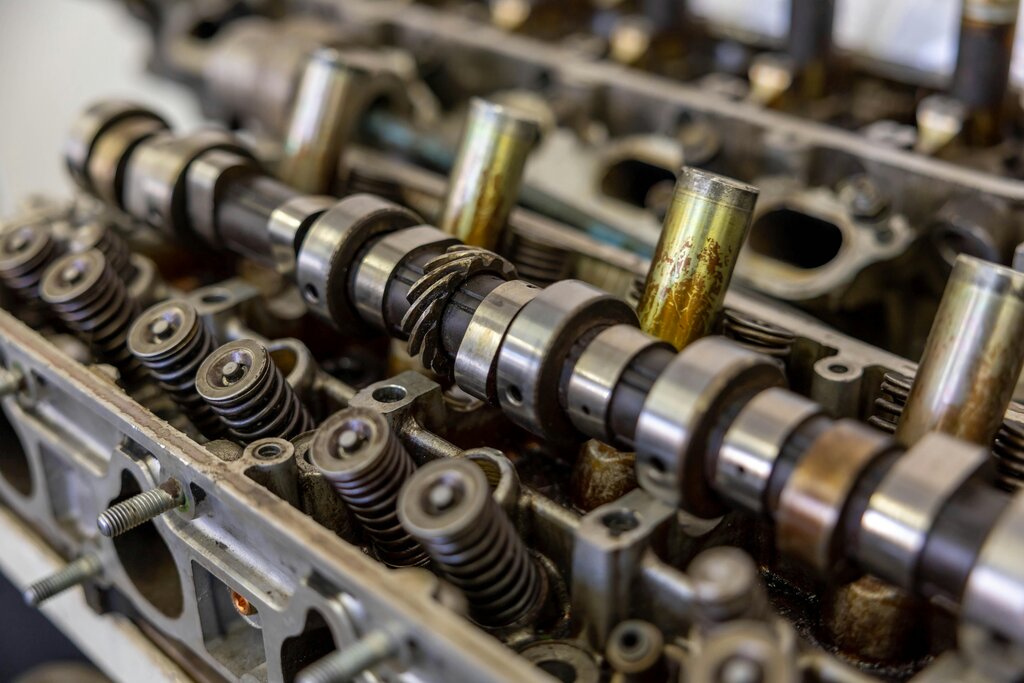
The acts as the conductor of this symphony, its lobes dictating precisely when the valves open, how far they lift off their seats, and how long they stay open. These three parameters—timing, lift, and duration—define the camshaft's profile.
A camshaft with high lift and long duration will hold the valves open wider and for a longer period, allowing more air to flow at high RPM. This is great for peak horsepower but often results in a rough idle and poor low-end torque. Conversely, a 'mild' cam with lower lift and shorter duration provides a smooth idle and strong torque at lower RPMs, but can feel asthmatic at the top end of the rev range.
Dynamic Timing for Modern Engines
The trade-off between low-end torque and high-end power has been a central challenge in engine design for a century. The ideal valve timing for a smooth idle is completely different from the ideal timing for maximum power at 6,000 RPM. The solution is to change the timing on the fly. This is the job of (VVT) systems.
Most common VVT systems use a hydraulic mechanism called a cam phaser, mounted on the end of the camshaft. The engine's computer (ECU) directs pressurised oil into chambers within the phaser, causing it to rotate the camshaft slightly, independent of the timing chain or belt. This effectively advances or retards the valve timing in real-time.
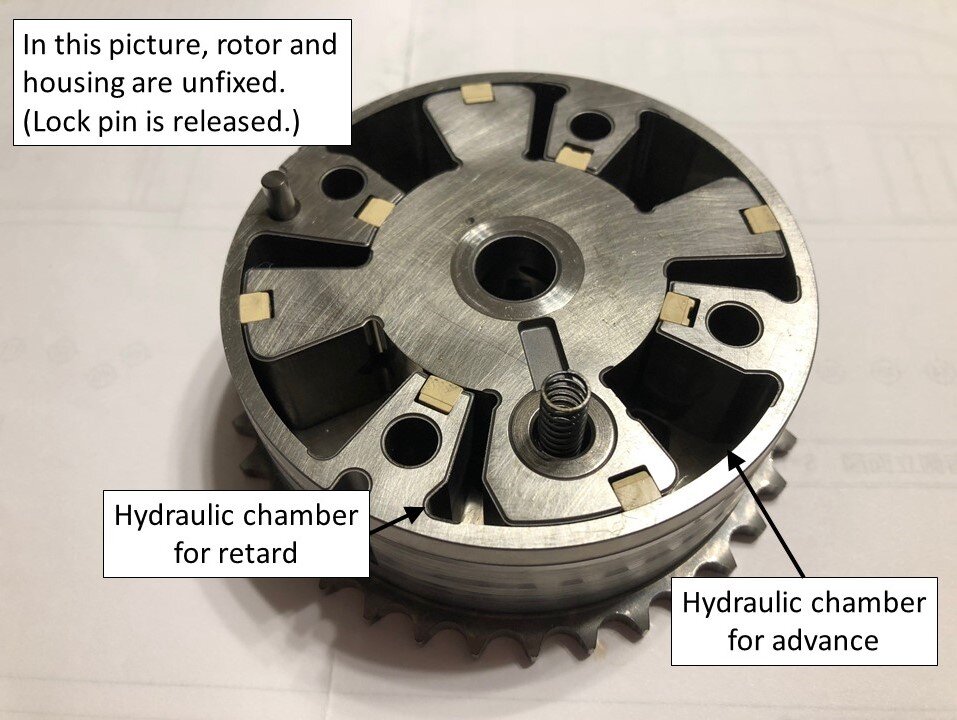
By advancing the intake cam timing at low RPM, VVT improves torque and throttle response. At high RPM, it retards the timing to maximise airflow and horsepower. This optimisation across the rev range results in a broader powerband, improved fuel efficiency, and reduced emissions—the best of both worlds. Diagnosing VVT systems involves checking for proper oil pressure, functioning control solenoids, and ensuring the timing chain has not stretched, which can cause timing correlation faults.
Time to test your knowledge on these advanced concepts.
During a leak-down test on a cylinder at TDC, you introduce compressed air and notice bubbles forming in the coolant reservoir. What is the most likely culprit?
When connected to a running engine at idle, a vacuum gauge shows a needle that is fluctuating rapidly over a wide range. What does this reading typically indicate?
Understanding these advanced mechanical interactions is the key to moving from a component replacer to a true engine diagnostician. It's about seeing the engine not as a collection of parts, but as a dynamic, interconnected system.