Modern Artificial Intelligence and its Applications
Neural Network Logic
How Neural Networks Learn
A neural network's goal is to make accurate predictions. When it starts, its predictions are essentially random guesses. The process of learning is all about correcting those guesses. To do that, the network first needs to measure how wrong it is.
Learning is the process of systematically reducing prediction error.
This measurement is done using a loss function, also called a cost function. It's a mathematical formula that compares the network's prediction to the correct answer and spits out a single number: the error, or "loss." A high loss means a bad prediction; a low loss means a good one. The entire goal of training is to minimize this number.
For classification tasks (like identifying an image as a 'cat' or 'dog'), a different approach is needed. Here, Cross-Entropy Loss is more effective. It measures how different the predicted probability distribution is from the actual distribution (where the correct class has a probability of 1 and all others are 0).
Finding the Right Path
Once the network calculates its loss, it needs a way to adjust its internal parameters, the weights and biases, to reduce that loss. This optimization process is called gradient descent an algorithm that works by finding the steepest "downhill" path on the loss landscape.
The "gradient" is just a vector of partial derivatives pointing in the direction of the steepest ascent. By moving in the opposite direction of the gradient, the algorithm takes a small step toward the minimum loss. This process is repeated thousands or millions of times, with each step hopefully bringing the model's predictions closer to the truth.
While standard gradient descent calculates the gradient using the entire dataset, variants like Stochastic Gradient Descent (SGD) use single examples or small batches, making the process faster but more erratic. More advanced optimizers like Adam adapt the step size for each parameter, often leading to faster convergence.
The Correction Mechanism
So, how does the network know which weights and biases to change, and by how much? The answer is an algorithm called backpropagation. It's the engine of modern deep learning, allowing the model to efficiently assign blame for the error to each of its millions of parameters.
Backpropagation works by applying the chain rule from calculus. After calculating the total loss at the output layer, the algorithm moves backward through the network, layer by layer. At each neuron, it calculates how much that neuron contributed to the final error. It then uses this information to slightly adjust the neuron's weights and bias to reduce that error.
If AI makes a mistake, it needs to learn how not to make it again! Backpropagation is the process where AI adjusts its learning by going backward and updating the importance (weights) of connections.
Think of it like a team project. If the final product has a mistake, the project manager (the loss function) flags it. Backpropagation is the process of tracing that mistake back through the team members to find out who was responsible and how to correct their contribution for the next project.
Adding Nuance with Non-linearity
If a network only used linear operations, stacking more layers wouldn't make it more powerful. The entire network would just be equivalent to a single, simple linear transformation. To model complex, real-world patterns, networks need to introduce non-linearity. This is the job of the activation function.
After a neuron sums its weighted inputs, the result is passed through an activation function before being sent to the next layer. This simple step is what allows neural networks to learn everything from the curve of a road in an image to the subtle nuances of human language.
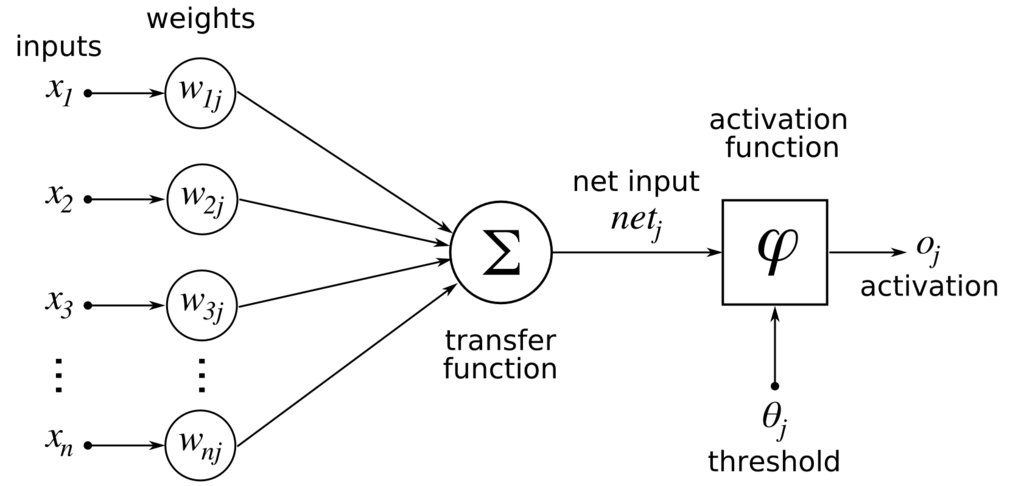
Different activation functions have different properties. The (ReLU) is the most common choice today due to its simplicity and efficiency. It simply outputs the input if it's positive, and zero otherwise. Other functions like Sigmoid or Tanh are also used, especially in older architectures or for specific tasks.
| Activation | Formula | Output Range | Use Case |
|---|---|---|---|
| Sigmoid | (0, 1) | Binary classification output layer | |
| Tanh | (-1, 1) | Hidden layers in recurrent networks | |
| ReLU | [0, ∞) | General purpose for hidden layers |
Finally, even the starting values of the weights matter. This is called weight initialization. If all weights start at zero, every neuron in a layer will learn the exact same thing. If they're too large or too small, the gradients can explode or vanish, halting the learning process. Smart initialization strategies, like Xavier or He initialization, set the initial weights to small random values within a specific range, helping to ensure that the learning process gets off to a smooth start.
Now, let's test your understanding of how these pieces fit together.
What is the primary role of a loss function in training a neural network?
The backpropagation algorithm is fundamentally an efficient application of which mathematical rule?
Together, these components—loss functions, gradient descent, backpropagation, and activation functions—form the core logic that allows a neural network to transform from a random collection of parameters into a powerful tool for prediction.