Modern Artificial Intelligence and its Applications
Architectural Decision Making
The Decision Matrix
Choosing between traditional Machine Learning (ML) and Deep Learning (DL) isn't about picking the newest or most powerful tool. It's a strategic decision based on the specific constraints of your project. The right choice depends on your data, your resources, and how much you need to understand the model's reasoning.
Think of it as choosing between a master craftsman's toolkit and a sophisticated 3D printer. One gives you precise, transparent control over hand-picked materials, while the other can build incredibly complex structures from raw material, provided you give it enough to work with. Neither is universally better; their value is context-dependent. Let's break down the key factors in this decision.
| Factor | Traditional ML | Deep Learning |
|---|---|---|
| Data Volume | Effective with <10,000 samples | Requires massive datasets (100k+) |
| Feature Engineering | Manual, requires domain expertise | Automated feature extraction |
| Interpretability | High ('glass box') | Low ('black box') |
| Hardware | CPU-friendly | Requires GPU for efficient training |
Features and Interpretability
One of the biggest divides between ML and DL lies in how they handle features. With traditional ML models like Random Forests or Support Vector Machines, the data scientist performs . This means you use your domain knowledge to select, transform, and create the most relevant input variables from the raw data. If you're predicting house prices, you might create a 'price per square foot' feature. This process makes the model highly dependent on the quality of your handcrafted features.
Deep Learning models, on the other hand, perform automated feature extraction. A neural network learns a hierarchy of features directly from the data. For an image, the first layer might learn to detect edges, the next might combine edges to find shapes like eyes or noses, and a deeper layer might recognise faces. This removes the need for manual feature engineering but requires vast amounts of data for the model to learn these representations effectively.
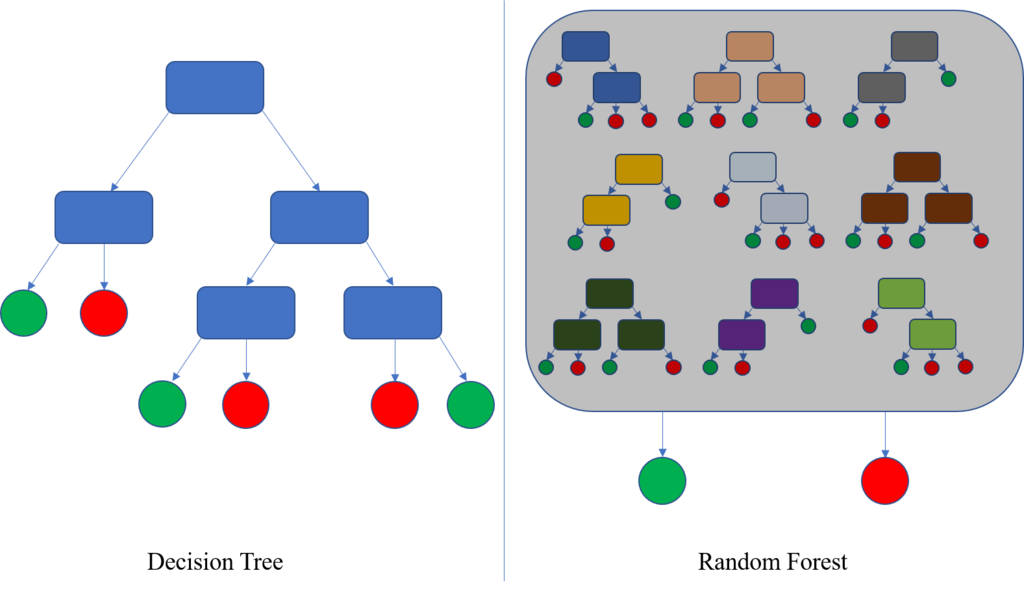
This difference leads directly to the trade-off between interpretability and accuracy. Traditional ML models are often called 'glass box' models because you can inspect their internal logic. You can see exactly why a decision tree classified a loan application as 'high-risk'. This transparency is crucial in regulated fields like finance and healthcare, where you must be able to justify a model's decision.
Deep Learning models are often referred to as models. Due to their complex, multi-layered structure with millions of parameters, it's difficult to pinpoint the exact reason for a specific output. They might achieve higher accuracy on complex, unstructured data like images or text, but that performance comes at the cost of transparency.
Data and Resources
The performance of ML and DL models is heavily tied to the amount of data you have. A common rule of thumb is the '10k sample rule'. If you have fewer than roughly 10,000 data points, traditional ML is often the better choice. With limited data, the complex architecture of a deep learning model is prone to overfitting—essentially memorising the training data instead of learning generalisable patterns.
Traditional ML models, guided by handcrafted features, can find meaningful patterns in smaller datasets. Deep Learning needs a massive dataset to learn those features from scratch.
Finally, consider your hardware. Training traditional ML models is often computationally manageable on a standard CPU. The mathematical operations are less intensive.
Deep learning, however, involves vast numbers of matrix multiplications. This is a task that GPUs (Graphics Processing Units) are exceptionally good at, thanks to their ability to perform many calculations in parallel. Training a large deep learning model on a CPU would be impractically slow, taking days or weeks instead of hours. Therefore, access to powerful GPUs is a key requirement for any serious deep learning project.
What is the key difference between traditional Machine Learning (ML) and Deep Learning (DL) regarding how they handle input variables or 'features'?
In a highly regulated industry like healthcare, why might a traditional ML model (e.g., a Random Forest) be preferred over a Deep Learning model for diagnosing a medical condition?
Ultimately, the choice is a balancing act. You must weigh the need for interpretability against the potential for higher accuracy, and balance the allure of automated feature extraction with the reality of your data and hardware constraints.