Modern API Architecture and Integration
Modern API Architectures
Beyond the Basics: Choosing Your API Architecture
You already know what an API is, but how you design one is a critical architectural decision. It's not just about getting data from point A to point B; it's about how efficiently, flexibly, and reliably that happens. The most common architectural style is REST, but it's not the only one. Let's explore the modern landscape, starting with a deeper look at what makes an API truly RESTful.
A well-designed API is the backbone of modern software development, particularly in a landscape dominated by microservices, cloud computing, and distributed systems.
REST, or Representational State Transfer, isn't just about using HTTP methods like GET, POST, and DELETE. A truly RESTful API adheres to a set of architectural constraints. The most important is statelessness—each request from a client must contain all the information needed to process it. The server doesn't remember anything about the client between requests. This makes the system simple, visible, and reliable.
REST APIs are built around resources. A resource is any object or piece of data you want to expose, like a user, a product, or a post. You interact with these resources using standard HTTP verbs. For example, to get a user, you might send a GET request to /users/123. This resource-based approach is predictable and easy to understand, which is why it's dominated web APIs for years. Its use of standard HTTP also means it works well with existing web infrastructure, like caching.
GraphQL: Ask for What You Need
REST is great, but it can be inefficient. Imagine you need a user's name, their last five posts, and the names of their followers. With a typical REST API, this might require three separate requests:
GET /users/123to get the user's name.GET /users/123/poststo get their posts.GET /users/123/followersto get their followers.
This is known as under-fetching—making multiple requests to get all the data you need. The opposite problem is over-fetching, where an endpoint returns more data than you require, like getting the user's full address and purchase history when all you needed was their name.
GraphQL solves this by letting the client specify exactly what data it needs in a single request. Instead of multiple endpoints for different resources, a GraphQL API typically has a single endpoint. The client sends a query that describes the shape of the data it wants, and the server returns a JSON object with that exact shape.
GraphQL is a query language for APIs that gives clients the power to request exactly the data they need, nothing more, nothing less.
This makes GraphQL incredibly efficient, especially for mobile applications where network latency is a concern. The client dictates the response, which decouples the frontend from the backend. However, this flexibility comes at a cost. Caching becomes more complex, as requests can be highly dynamic. Server-side development can also be more involved, requiring a well-defined schema using the (SDL).
gRPC: High-Speed Communication
While REST and GraphQL are excellent for client-server communication over the public internet, another architecture shines for internal, service-to-service communication: gRPC (gRPC Remote Procedure Call).
Developed by Google, gRPC is designed for high performance and low latency. Instead of text-based formats like JSON, it uses Protocol Buffers (Protobuf) to serialize structured data. Protobuf is a binary format, which is much smaller and faster to parse than text. Think of it like a highly compressed ZIP file for your data.
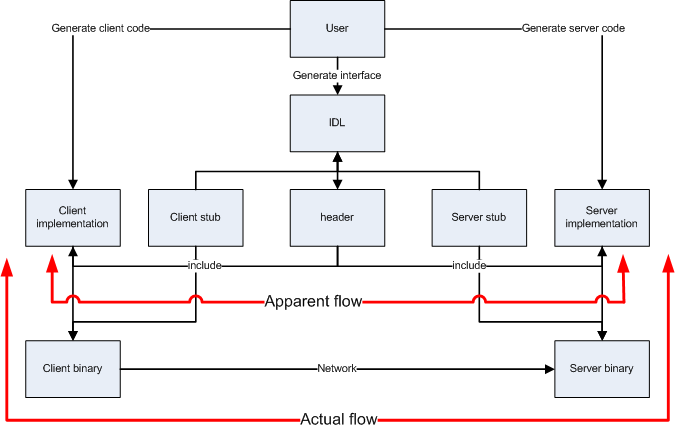
Furthermore, gRPC is built on HTTP/2, a major upgrade to the web's underlying protocol. HTTP/2 allows for multiplexing—sending multiple requests and responses over a single connection simultaneously. This is a huge advantage for microservices that need to communicate with each other constantly.
The trade-off? gRPC is not natively supported by web browsers, making it less suitable for public-facing APIs. Its binary format also makes it harder for humans to read and debug without special tools. For these reasons, it’s most commonly used for internal backend services.
Choosing the Right Tool
There's no single "best" API architecture; the right choice depends on your specific needs. REST's simplicity and widespread support make it a great default. GraphQL offers flexibility and efficiency for complex frontends. gRPC provides raw performance for internal services.
| Feature | REST | GraphQL | gRPC |
|---|---|---|---|
| Primary Use Case | Public & simple APIs | Flexible client data fetching | High-performance internal services |
| Data Format | Typically JSON | JSON | Protocol Buffers (Binary) |
| Protocol | HTTP/1.1 or HTTP/2 | Typically HTTP/1.1 or HTTP/2 | HTTP/2 |
| Data Fetching | Multiple endpoints | Single endpoint, client-defined query | Procedure calls |
| Strengths | Simple, cachable, ubiquitous | Efficient data loading, no over/under-fetching | High performance, low latency, strong typing |
| Weaknesses | Over/under-fetching | Complex caching & server-side logic | Not browser-native, less human-readable |
Many modern systems use a hybrid approach. For example, a company might use a public-facing REST API for third-party developers, a GraphQL API for its own mobile and web apps, and gRPC for communication between its internal microservices. Understanding the trade-offs of each style allows you to build a more robust and efficient system.