Modern AI Explained
Introduction to Artificial Intelligence
What Is Artificial Intelligence?
Artificial intelligence, or AI, is about creating machines that can think, learn, and solve problems like humans do. It's a broad field in computer science with a simple goal: to simulate human intelligence in a machine. This doesn't just mean building a robot that can walk and talk. It's about enabling computers to understand language, recognize patterns, and make decisions.
This introduction to this special issue discusses artificial intelligence (AI), commonly defined as “a system’s ability to interpret external data correctly, to learn from such data, and to use those learnings to achieve specific goals and tasks through flexible adaptation.”
Think of it this way: when you learn to ride a bike, you're not just following a set of instructions. You're adapting to balance, speed, and the feel of the road. AI aims to give machines that same ability to adapt and learn from experience, rather than just executing commands blindly.
A Brief History of AI
The dream of intelligent machines has been around for centuries, but the actual field of AI is relatively new. The journey began in the mid-20th century with pioneers who believed that machines could, in theory, simulate human thought. The term "Artificial Intelligence" itself was officially coined in 1956 at a workshop at Dartmouth College. This event is widely considered the birth of AI as a formal field of study.
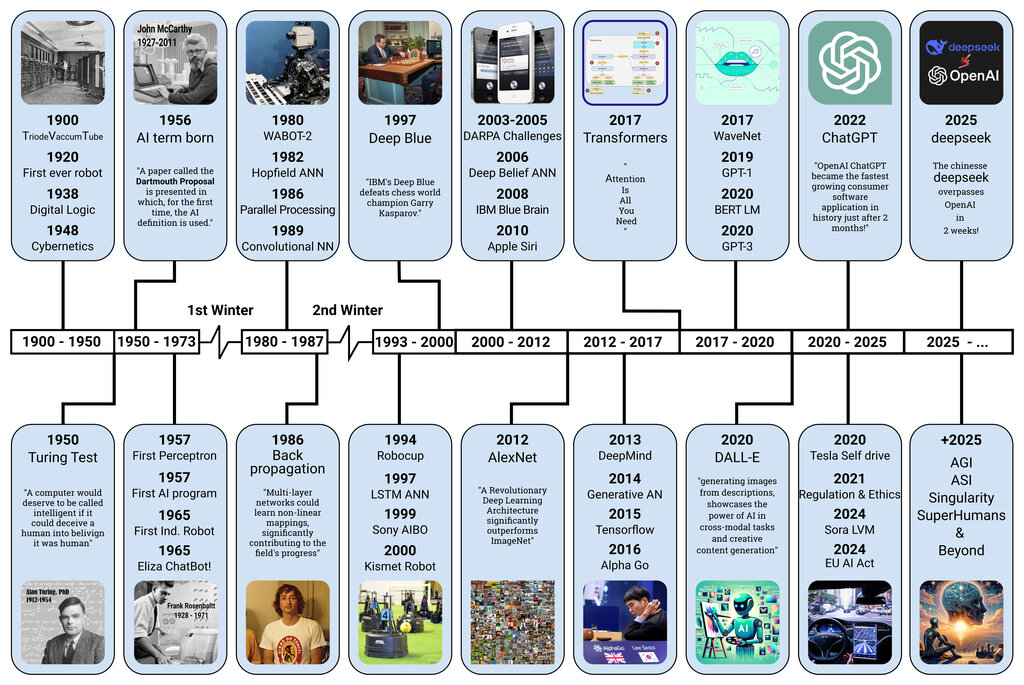
The early years were filled with excitement and bold predictions. Researchers developed programs that could solve algebra problems, prove theorems in logic, and speak simple English. But progress was slower than expected. The complexity of creating true intelligence led to periods known as "AI winters," when funding dried up and public interest waned.
However, the field always bounced back. In recent decades, two major factors have fueled an AI renaissance: the availability of massive amounts of data and the development of powerful computers. This combination has allowed for breakthroughs that early researchers could only dream of.
Two Flavors of AI
Historically, researchers have taken two fundamentally different paths to creating intelligence. These can be broadly categorized as Symbolic AI and modern, data-driven approaches.
Symbolic AI is based on rules written by humans. Modern AI creates its own rules by learning from data.
Symbolic AI, sometimes called "Good Old-Fashioned AI" (GOFAI), was the dominant approach for many years. The idea was to program a computer with a set of rules and logical statements about the world. For example, to identify a cat, you might give the AI rules like: "If it has fur, whiskers, and pointy ears, then it is a cat." This approach works well for structured problems with clear rules, like playing chess or solving logic puzzles. The human expert essentially transfers their knowledge to the machine.
Modern AI, on the other hand, takes a different route. Instead of feeding the machine rules, you feed it data. This approach, which includes machine learning and deep learning, allows the AI to learn the patterns for itself. To identify a cat, you would show it thousands of pictures labeled "cat." The system then learns the features that cats have in common on its own, without being explicitly told what to look for.
This shift from rule-based systems to data-driven learning is the key reason AI has become so powerful and widespread today. While symbolic AI still has its uses, modern approaches are what power most of the AI applications you encounter.
Ready to check your understanding?
What is the fundamental goal of Artificial Intelligence (AI)?
The term "Artificial Intelligence" was officially coined at a 1956 workshop held at which institution?
Understanding these foundational ideas is the first step. From these simple concepts of simulating intelligence and learning from data, the entire world of AI unfolds.