Modeling Earth's Complex Systems
Introduction to Earth Systems
Earth's Four Spheres
Planet Earth isn't just a big rock floating in space. It's a complex, dynamic system made of interconnected parts. Think of it like the human body, where the circulatory, nervous, and respiratory systems all work together. Earth has its own set of systems, often called spheres, that constantly interact. Understanding these spheres is the first step to seeing the big picture of how our planet works.
Earth is composed of a geosphere (the rocks and molten core of earth) a hydrosphere (the water and ice in the oceans, air, lakes, rivers, and underground), an atmosphere (the various gases that form the air around earth), and a biosphere (living organisms on earth).
These four spheres contain all of the planet's matter. Everything from the air you breathe to the ground you walk on belongs to one or more of them.
| Sphere | Description |
|---|---|
| Geosphere | All the solid and molten rock, soil, and sediments—from the mountains on the surface to the planet's core. |
| Hydrosphere | All of Earth's water, including oceans, rivers, lakes, groundwater, ice caps, and glaciers. |
| Atmosphere | The envelope of gases surrounding the planet, protecting us from space and enabling weather. |
| Biosphere | All living organisms, from the smallest microbes to the largest whales, and the ecosystems they inhabit. |
How the Spheres Interact
The real magic happens where the spheres meet. They are constantly exchanging energy and matter in a never-ending dance. No single sphere acts in isolation. A change in one can cause ripples across the others.
Consider a simple volcanic eruption. Hot magma from the geosphere spews ash and gases into the atmosphere. This can block sunlight, affecting weather (atmosphere), and the ash can settle on land and in water, impacting plants, animals (biosphere), and water chemistry (hydrosphere).
This constant interplay is what makes Earth a living, breathing planet. Rain from the atmosphere weathers rocks in the geosphere. Rivers from the hydrosphere carve canyons and carry nutrients to the sea. Plants in the biosphere release oxygen into the atmosphere and draw nutrients from the geosphere.
Why We Model Systems
Because these interactions can be incredibly complex, we use models to understand them. A model is a simplified representation of a system that helps us see the connections and predict how changes might affect the whole. This could be a simple flowchart showing how water moves from a river to a plant, or a complex computer simulation of global climate.
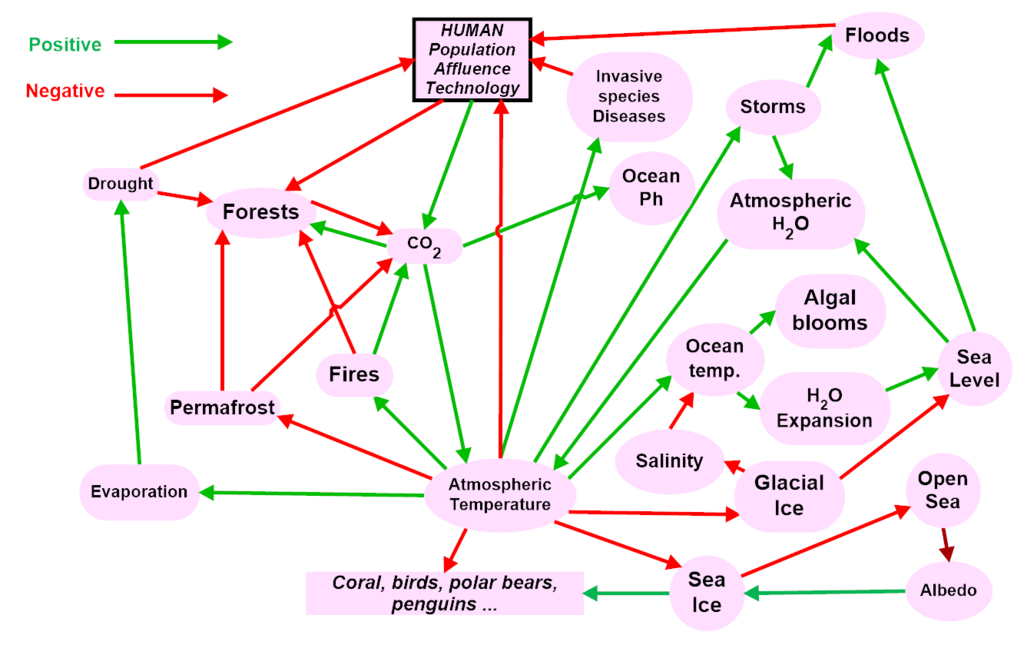
Modeling helps us answer big questions. What happens if a forest is cut down? How does pollution in a river affect ocean life? By understanding the four spheres and how they interact, we can build better models that give us clearer insights into the workings of our world.
Let's review these core concepts.
Now, test your understanding of how these systems fit together.
What is the primary reason for describing Earth as a system of interconnected "spheres"?
A plant absorbing water and nutrients from the soil is an example of an interaction between which two spheres?
With this foundation, you're ready to explore specific processes, like biogeochemical cycles, that move essential elements through these four spheres.