Model Context Protocol Explained
Introduction to Multimodal Large Language Models
Beyond Words
We've gotten used to AI models that are masters of language. Large Language Models, or LLMs, can write essays, summarize articles, and even code. They do this by learning from vast amounts of text data. But the world isn't just made of text. We experience it through sight, sound, and conversation. For AI to truly understand and interact with our world, it needs to do the same.
This is where Multimodal Large Language Models (MLLMs) come in. The term "multimodal" simply means using more than one mode, or type, of data. An MLLM can process and understand information from different sources at once, like text, images, audio, and video. It's an AI that can look at a picture, listen to a question about it, and give a spoken answer.
Multimodal Large Language Models (MLLMs) stand at the forefront of artificial intelligence (AI) systems.
The ability to connect different types of data makes these models incredibly powerful. An LLM might read a description of a sunset, but an MLLM can connect that text to the actual colors and shapes in a photograph of a sunset. This richer understanding allows for more helpful and intuitive interactions. It's the difference between reading a recipe and watching a cooking video with instructions.
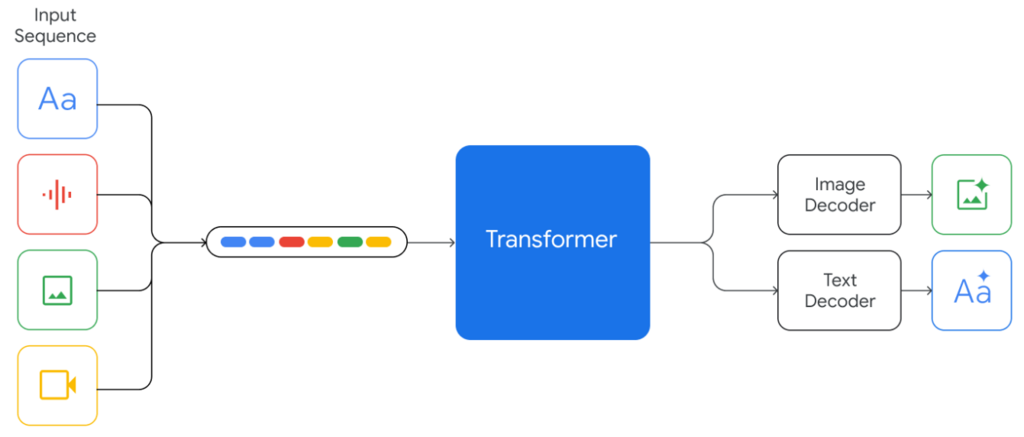
How It All Connects
So how does an MLLM handle so many different kinds of information? The core idea is to translate everything into a common language that the AI can understand. The model's architecture has specialized components, called encoders, for each data type. An image encoder processes pixels, an audio encoder processes soundwaves, and a text encoder processes words.
Each encoder converts its specific data type into a numerical representation, essentially a list of numbers called a vector. Once the image, audio, and text are all in this vector format, the model can process them together. It learns the relationships between a picture of a cat, the word "cat," and the sound of a meow by finding patterns in these numerical representations. This shared space is where the magic happens, allowing the model to reason across modalities.
Real World Applications
Because they mirror human perception more closely, MLLMs are useful in a wide range of fields. They can describe images to visually impaired users, generate recipes based on a photo of ingredients, or even help doctors by analyzing medical images and patient notes simultaneously. Any task that involves understanding multiple types of information at once is a perfect fit for an MLLM.
| Domain | Example Application |
|---|---|
| Healthcare | Analyzing X-rays and summarizing findings from patient records. |
| E-commerce | Recommending products based on images and text reviews. |
| Automotive | Powering in-car assistants that respond to voice and gesture commands. |
| Entertainment | Generating subtitles and audio descriptions for videos automatically. |
| Education | Creating interactive lessons that combine text, images, and Q&A. |
The Integration Challenge
Combining different data types isn't easy. One of the biggest hurdles is alignment. How does a model learn that a specific sequence of pixels in an image corresponds to a particular word in a sentence? This requires enormous and carefully curated datasets where different data modalities are explicitly linked.
Another challenge is complexity. Each data type has its own unique structure. A high resolution image contains millions of data points, while a sentence contains just a few words. Training a single model to efficiently handle these varying levels of complexity is a significant computational challenge. As researchers find better ways to align and integrate data, MLLMs will become even more capable and seamlessly integrated into our daily lives.
What is the primary characteristic that distinguishes a Multimodal Large Language Model (MLLM) from a standard Large Language Model (LLM)?
How do MLLMs process different types of data, like images and audio, so they can be understood together?